


VAT on UAE Number Plates (2026): When You Pay 5%, When You Don't, and What Dealers Never Show You
Last updated: 23 August 2026
Quick answer
Whether you pay 5% VAT on a UAE number plate depends entirely on who is selling it, not on what the plate is or what it costs. Buy from the RTA — at auction or at a fixed price — and 5% VAT is added on top of the price, plus AED 100 for the ownership certificate and AED 20 in Knowledge and Innovation fees. Buy from a VAT-registered dealer and the 5% is already inside the advertised price, because consumer prices in the UAE must be shown VAT-inclusive. Buy from a private individual selling a plate they owned and used, and there is no VAT at all — a one-off personal sale is not a supply made "in the course of Business", so it falls outside the VAT system entirely. The only thing you pay is the agreed price and the RTA transfer fee.
Almost every guide to buying a Dubai plate contains the same throwaway line: "plus 5% VAT". It appears in RTA auction announcements, in newspaper write-ups, in our own cost breakdowns. Nobody stops to explain what it is actually attached to.
That gap costs people real money. A buyer who assumes VAT applies everywhere over-budgets by thousands on a private deal. A seller who assumes VAT never applies to them discovers, several plates later, that they have been running an unregistered business. And a buyer negotiating with a dealer who quotes "AED 400,000 plus VAT" is being asked to pay tax twice over, because UAE law already requires that advertised figure to include it.
This guide sets out the actual rules, sourced from the published legislation — Federal Decree-Law No. 8 of 2017 on Value Added Tax and Cabinet Decision No. 52 of 2017, its Executive Regulation — and applies them to the three ways a plate changes hands in this country. It also covers something no competitor has written about: under UAE VAT law, a plate number is not goods, and that single classification decides whether a dealer's 5% lands on their margin or on your entire purchase price.
Table of contents
- The answer in one table: three sellers, three totals
- Why a government authority charges VAT on a number at all
- What the RTA receipt actually adds up to
- The private sale: why there is genuinely no VAT
- The plate is not the car, and the number is not the plate
- When you stop being a collector and become a taxable person
- Can a company recover the VAT on a plate?
- Tax invoices, records, and what e-invoicing changes
- What we cannot tell you
- Six VAT mistakes that cost UAE plate buyers money
- Frequently asked questions
The answer in one table: three sellers, three totals
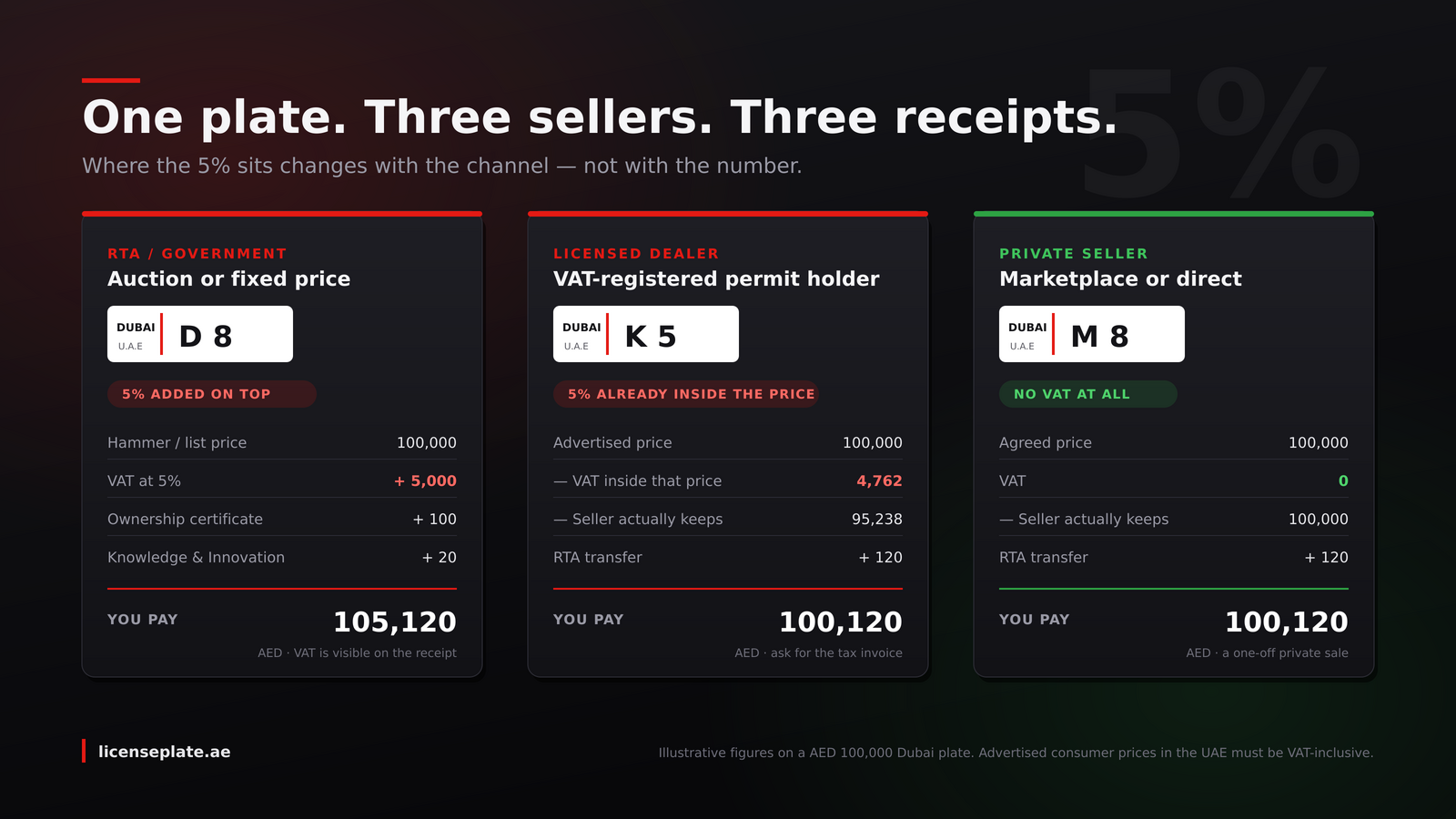
Direct answer: VAT attaches to the seller's status, not to the plate. Take one plate, agree one price of AED 100,000, and change nothing except who is selling it:
| Seller | Is VAT charged? | Where the 5% sits | What you hand over |
|---|---|---|---|
| RTA auction or fixed-price sale | Yes, 5% | Added on top of the hammer or list price | AED 105,120 (100,000 + 5,000 VAT + 100 certificate + 20 K&I) |
| VAT-registered dealer or permit holder | Yes, 5% | Already inside the advertised price (Art. 38) | AED 100,120 — of which AED 4,762 is VAT the dealer remits, not money you get back |
| Private individual selling their own plate | No | There is no 5% — the sale is outside the VAT system | AED 100,120 — the price plus the RTA transfer fee, nothing else |
Two things in that table surprise almost everyone. The first is that a private plate is not 5% cheaper than an auction plate at the same number — it is 5% cheaper than the auction plate plus whatever premium the auction produced on the day. The second is that the dealer column and the private column show the same total, but for opposite reasons: the dealer has quietly absorbed AED 4,762 of tax inside a headline number, while the private seller keeps the entire AED 100,000.
That is the honest economic case for the secondary market, and it is worth stating plainly: on a private plate, the money you pay goes to the person who owns the number. On a dealer plate, part of it goes to the Federal Tax Authority and part goes to the dealer's margin, and neither is visible in the price you were quoted.
Why a government authority charges VAT on a number at all
Government departments do not normally charge VAT. If they did, every fine, permit and licence in the country would carry 5%. So why does an RTA plate sale?
The answer is in Article 10 of Federal Decree-Law No. 8 of 2017, which sets out exactly when a government body is treated as trading rather than governing. A Government Entity is regarded as making a supply in the course of business in two cases: "If its activities are conducted in a non-sovereign Capacity" and "If its activities are in competition with the private sector."
Selling a premium number to the highest bidder in a hotel ballroom is the textbook example of both. It is not the exercise of sovereign authority — the law defines "Activities conducted with Sovereign Capacity" as those carried out by government entities "in their sole competent capacity". Registering a vehicle is sovereign; nobody else may do it. Auctioning D 8 to a collector is not, because a private owner can sell the identical asset the next day. And plate sales compete directly with a private secondary market that has existed for decades.
So the RTA charges 5% on the number for the same reason a dealer does: at that moment it is a commercial supplier, not a regulator. Meanwhile the parts of the transaction that are sovereign — the act of registering the vehicle, the traffic file itself — behave differently, which is why the fee schedule and the tax line are separate items on your receipt rather than one blended figure.
What the RTA receipt actually adds up to
Every RTA plate announcement lists the same components, and every year people budget for the headline number and forget the rest. Here is the full stack on a Dubai purchase, using the AED 100,000 example.
| Line | Amount (AED) | Notes |
|---|---|---|
| Auction fee | 120 | Non-refundable, paid at registration. You pay this whether or not you win. |
| Security deposit | 5,000 or 25,000 | Refundable. AED 5,000 for online auctions, AED 25,000 for open hall auctions. Not a cost, but it must be liquid. |
| Hammer price | 100,000 | The number itself. |
| VAT at 5% | 5,000 | Added on top. This is the line that catches people who bid to the exact limit of their budget. |
| Ownership certificate | 100 | The document that proves the number is yours. |
| Knowledge & Innovation fees | 20 | AED 10 each, applied to almost every Dubai government transaction. |
| Total payable | 105,240 | Including the non-refundable auction fee. Payment is due within 10 days of winning, under Article 4(7) of Dubai's Administrative Resolution No. 916 of 2021. |
The practical lesson is simple and it costs bidders money every month: set your bidding ceiling at your budget divided by 1.05, not at your budget. If you can afford AED 200,000 all-in, your maximum bid is roughly AED 190,300, not AED 200,000. Our first-timer's walkthrough of the RTA online auction covers the mechanics of registration and bidding, and the full Dubai fee table lists the plate issuance charges that follow once you fit the number to a car.
The same 5% applies to the RTA's fixed-price channel, where you buy an available number outright without competing for it. If you have never used it, our guide to buying a Dubai plate at a fixed price explains how Direct Sale works. The tax treatment does not change — only the price discovery does.
The private sale: why there is genuinely no VAT
This is the part people find hardest to believe, so it is worth walking through the legal chain rather than simply asserting it.
VAT is charged on a Taxable Supply. The Decree-Law defines that as "a supply of Goods or Services for Consideration during the course of Business by any Person in the State". Everything turns on those four words: during the course of Business.
"Business" is then defined as "any activity conducted regularly, on an ongoing basis and independently by any Person, in any location, such as industrial, commercial, agricultural, professional, vocational, service or excavation activities or anything related to the use of tangible or intangible properties."
Regularly. On an ongoing basis. A person who bought a plate for their own car, drove behind it for four years and has now decided to sell it is doing none of those things. They are disposing of a personal asset. There is no taxable supply, so there is no VAT — not a zero rate, not an exemption, simply nothing for the tax to attach to.
This is the same principle that applies when you sell your own car to another individual: no VAT changes hands, whereas the identical car sold by a dealership carries it. The Federal Tax Authority's automotive-sector guidance treats private disposals and dealer sales as fundamentally different transactions for exactly this reason, and a plate number follows the same logic.
Two practical consequences follow. First, a private seller must not add 5% to their asking price — they have no Tax Registration Number, cannot issue a tax invoice, and any "VAT" they collect is simply extra margin with a misleading label. If a private seller quotes you "plus VAT", that is a red flag worth pausing on; our pre-purchase due diligence checklist covers the other signals worth checking before money moves.
Second, the absence of VAT is not the absence of fees. The RTA transfer still costs AED 120 in Dubai (AED 100 for the new ownership certificate plus AED 20 in Knowledge and Innovation fees), and if you are fitting the number to a car there are plate issuance charges on top. Our Dubai transfer guide sets out the full process and paperwork.
The plate is not the car, and the number is not the plate
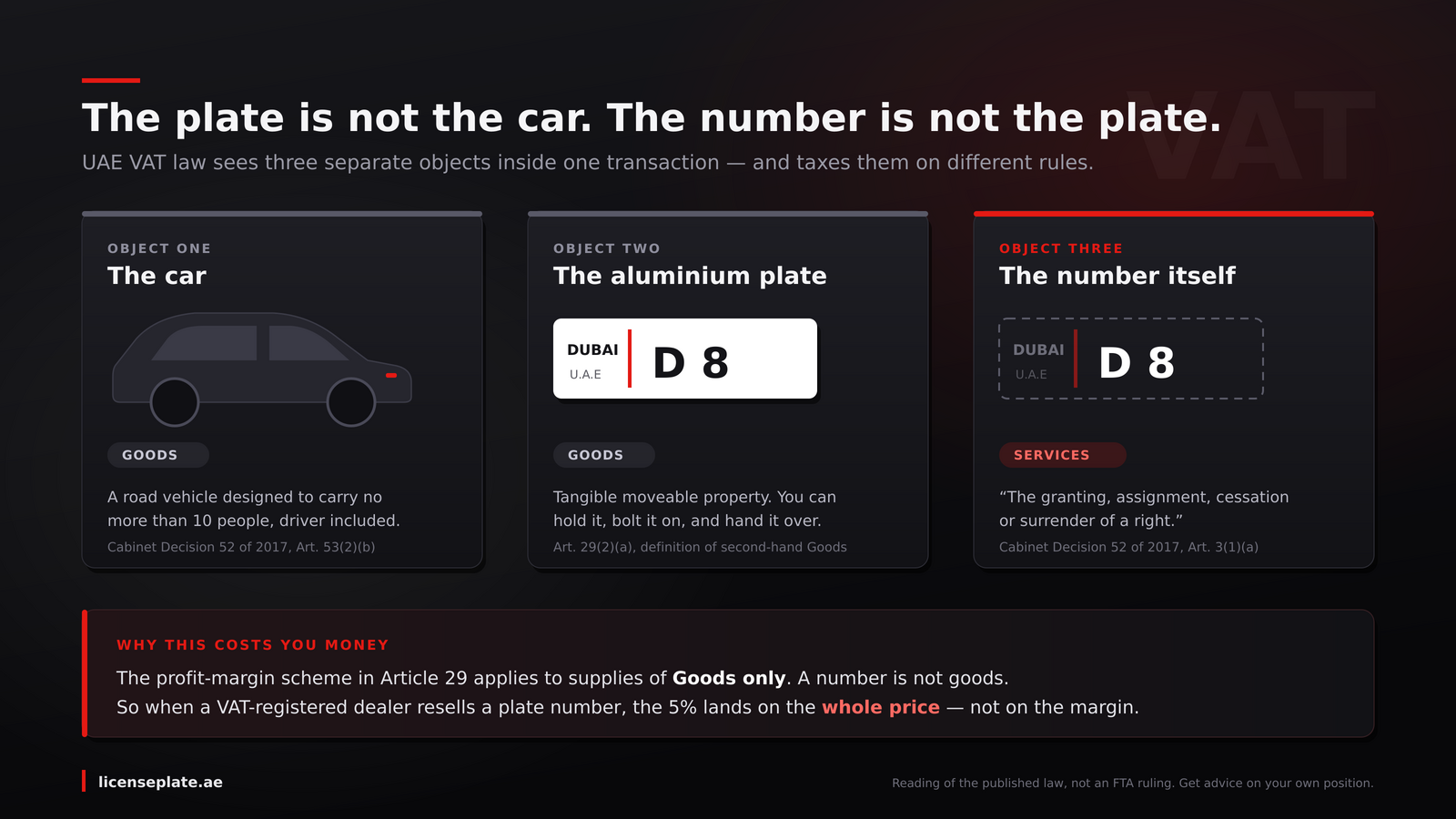
Here is the analysis nobody in this market publishes, and it matters most if you are buying from a dealer.
UAE VAT law splits everything in the world into two categories. Goods are "physical property that can be supplied". Services are "anything that can be supplied other than Goods" — a deliberately residual definition. Article 3 of the Executive Regulation then spells out what falls on the services side, and the very first item on the list is "the granting, assignment, cessation, or surrender of a right."
Now separate the three things you are actually buying:
- The car is goods. It is also a "motor vehicle" in the specific sense the Executive Regulation uses — "a road vehicle which is designed or adapted for the conveyance of no more than 10 people including the driver" — which matters for input tax recovery.
- The aluminium plate bolted to the bumper is goods. It is tangible, moveable, and it costs AED 105 to AED 570 depending on the type you order.
- The number itself — the thing worth AED 8,500 or AED 38 million — is not physical property. What transfers when a plate changes hands is the licensing authority's assignment of that number to you. On the plain wording of Article 3(1)(a), that is the assignment of a right: a supply of services.
Why does this matter in dirhams? Because of the profit margin scheme in Article 29 of the Executive Regulation. That scheme is the reason a used-car dealer's VAT bill is bearable: rather than charging 5% on the whole selling price of a second-hand car, they may charge it only on the difference between what they paid and what they sold it for. The FTA published its first comprehensive guidance on the scheme, VATGPM1, in January 2026.
But read the opening words: "The Taxable Person may calculate Tax on any supply of Goods by reference to the profit margin", and the qualifying category is "Second-hand Goods, meaning tangible moveable property that is suitable for further use as it is or after repair."
A plate number is neither tangible nor moveable property. It cannot be repaired. On the face of the legislation, the margin scheme does not reach it — which means a VAT-registered dealer reselling a number accounts for 5% on the full consideration, not on their spread. A used-car dealer buying at AED 90,000 and selling at AED 100,000 accounts for VAT on AED 10,000. A plate dealer doing the same trade accounts for it on AED 100,000.
That cost does not evaporate. It is priced into what the dealer asks. It is the clearest structural reason why the private secondary market prices better than the trade channel on identical numbers — and it is a genuinely useful thing to understand before you accept a dealer's "best price". If you are weighing the routes, our comparison of the auction versus the secondary market and our guide to licensed dealers and permit holders set out what each channel gives you in return.
One caveat, stated plainly: this is a reading of the published legislation, not a ruling. The FTA has not, to our knowledge, published guidance specifically classifying vehicle plate numbers. If you trade plates as a business, get a written opinion on your own facts rather than relying on any article, including this one.
When you stop being a collector and become a taxable person
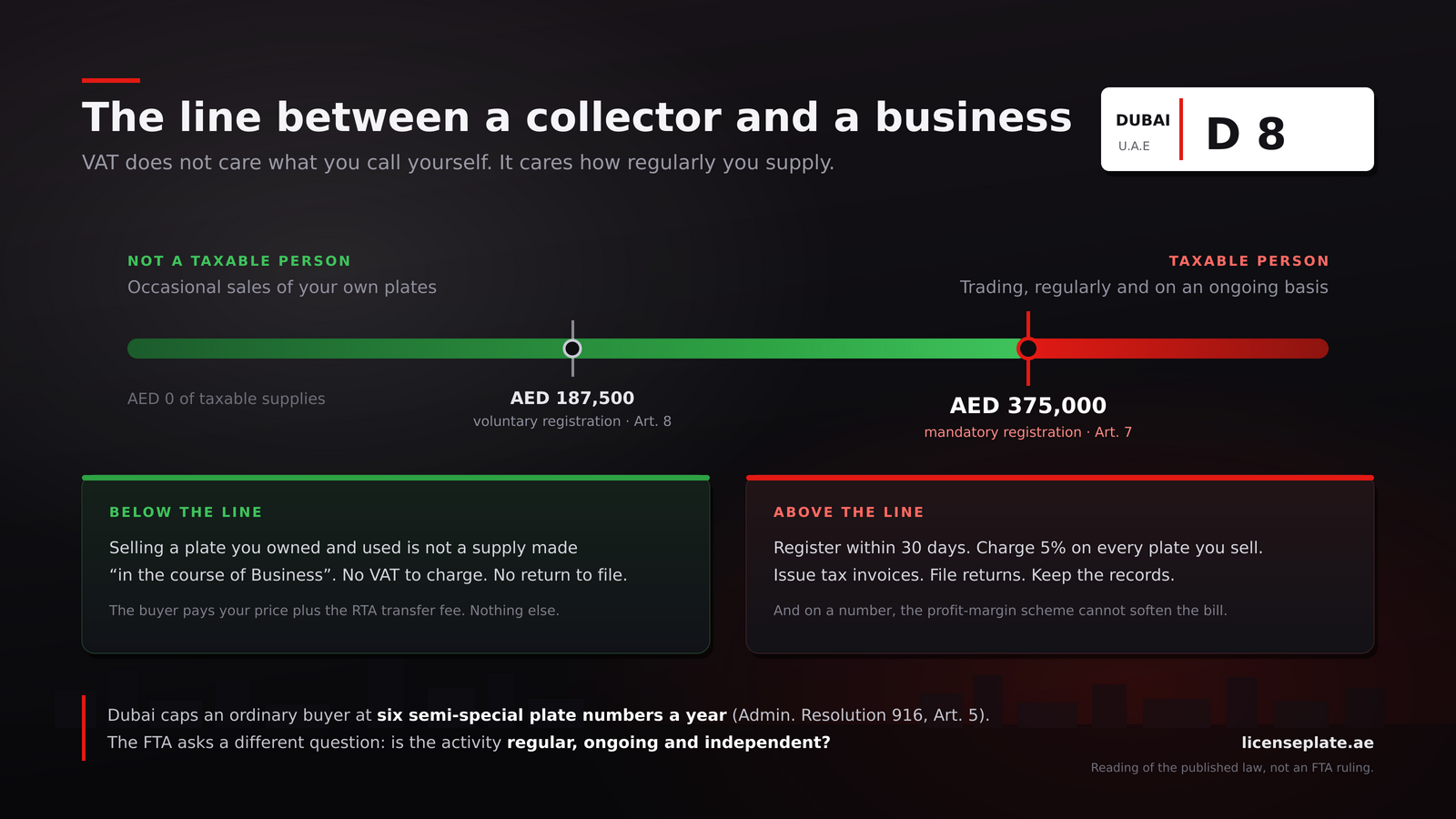
Everything above assumes you are on one side or the other. The interesting question is what happens when you drift across.
The thresholds are fixed and unambiguous. Article 7 of the Executive Regulation: "The Mandatory Registration Threshold shall be AED 375,000", with an application due "within 30 days of being required to register". Article 8: "The Voluntary Registration Threshold shall be AED 187,500". Both are measured on taxable supplies over a rolling 12-month period, or on a reasonable expectation of exceeding the threshold in the next 30 days.
But a threshold only bites once you are making taxable supplies at all, and that returns you to the regularity test. A collector who sells one inherited plate for AED 600,000 has not made a taxable supply, so nothing counts toward AED 375,000. Someone who buys and sells four plates a year at AED 120,000 each has crossed AED 375,000 and looks like an activity conducted regularly and on an ongoing basis. The number is not the test; it is the consequence of failing the test.
There is a neat local coincidence here that is worth knowing. Dubai's Administrative Resolution No. 916 of 2021, which governs the sale of Dubai plate numbers, caps an ordinary person at six semi-special plate numbers per year — permit holders are exempt, because they are licensed to trade. So Dubai already draws its own line between a private buyer and a dealer. The FTA's line is drawn somewhere else, on different criteria, and neither authority's answer binds the other. Do not assume that staying under six plates keeps you outside VAT, or that exceeding it automatically puts you inside.
Late registration is not a small matter. Article 7(7) makes a late registrant "liable to account for and pay to the Authority the Due Tax on all Taxable Supplies and Imports made by him before registering" — meaning you owe the 5% on sales you already completed and never collected it on. That comes out of your own pocket, with penalties on top.
VAT is also not the only tax that changes when flipping becomes a business. Our companion guide on UAE corporate tax and plate investors covers the parallel corporate tax question, which uses a similar but not identical test, and reaches its own conclusions about when a collection becomes a trade.
Can a company recover the VAT on a plate?
Direct answer: only if the plate is genuinely used for making taxable supplies, and personal use of the car it sits on is the thing most likely to break the claim.
The general rule is that a registered business recovers input tax on costs incurred for its taxable activities. Article 53 of the Executive Regulation then lists what is blocked, and the relevant entry is input tax "where a motor vehicle was purchased, rented or leased for use in the Business and is available for personal use by any Person." The exceptions are narrow: licensed taxis, emergency vehicles, and vehicles used in a rental business.
Notice what that block does and does not cover. It is written about the motor vehicle — defined as a road vehicle for no more than 10 people. A number is not a road vehicle, so the specific block does not literally reach it. But that is not permission to recover: the ordinary test still applies, and the FTA will ask what taxable supplies the plate is being used to make. A premium number on a director's private car is difficult to characterise as a business cost regardless of which article you point to.
Where businesses do have a real case — a fleet with numbers used in advertising, a rental company, a marketing asset genuinely deployed in campaigns — the argument turns on evidence of business use, and it should be made with a tax adviser rather than assumed. Our piece on developers buying premium plates as marketing assets looks at how companies actually use plates commercially.
Tax invoices, records, and what e-invoicing changes
If VAT was charged on your purchase, you are entitled to a proper tax invoice — a document headed as such, showing the supplier's Tax Registration Number, a unique sequential number, the date, a description of the supply, the amount and the tax. A receipt headed "Invoice" with no TRN is not a tax invoice and will not support any recovery claim.
Keep it regardless of whether you are VAT-registered. It is the cleanest proof of what you paid for the number, which matters later for three separate reasons: establishing your cost base if you ever do become a taxable person, evidencing the transaction in an inheritance or divorce context, and demonstrating provenance to a future buyer who is doing their own diligence.
The paperwork side is about to change. The UAE is rolling out mandatory e-invoicing under Ministerial Decisions 243 and 244 of 2025: a pilot and voluntary phase from 1 July 2026, mandatory compliance for large businesses from 1 January 2027, and for remaining in-scope VAT-registered businesses from 1 July 2027. Invoices will move to a structured XML format exchanged through accredited service providers — PDFs and scans will not satisfy the requirement.
For a private buyer this changes nothing. For anyone trading plates through a company, it means the informal WhatsApp-and-bank-transfer style of deal that is still common in this market becomes progressively harder to reconcile with your compliance obligations. If you are building toward a business, build the invoicing discipline now.
What we cannot tell you
Three questions in this area do not have a clean published answer, and we would rather say so than invent one.
Whether the FTA classifies a plate number as goods or services. Our reading of Articles 2 and 3 of the Executive Regulation points firmly to services, and the consequence for the margin scheme follows logically. But we have not found published FTA guidance addressing vehicle plate numbers by name. Anyone who tells you the position is settled should be asked to cite the clarification.
Exactly where your own regularity line sits. "Regularly, on an ongoing basis and independently" is a standard applied to facts, not a counter. Two people who each sold three plates last year can land on opposite sides of it depending on intention, holding period, financing, marketing and how the money moved. Nobody can give you a safe number, and anyone who offers one is guessing.
What a specific dealer's price actually contains. Article 38 requires displayed prices to be VAT-inclusive, but the split between margin and tax inside a quoted figure is not something you can derive from the outside. You can only ask — and a dealer who will not put the VAT breakdown on an invoice is telling you something useful.
Six VAT mistakes that cost UAE plate buyers money
- Bidding your full budget at auction. Your ceiling is your budget divided by 1.05, then minus AED 120. Bidders miss this every month and lose deposits or scramble for cash inside the 10-day payment window.
- Paying "plus VAT" to a private seller. An individual selling their own plate has nothing to remit and no TRN. That 5% is not tax; it is a price increase.
- Accepting "plus VAT" on a dealer's advertised price. Article 38 of the VAT Decree-Law is explicit: "For Taxable Supplies, the advertised price shall include the Tax." If a dealer advertises AED 400,000 and then adds 5%, ask for the tax invoice showing the split before you agree.
- Assuming a company can reclaim it. Registering the plate to a company does not make it recoverable. The test is business use for taxable supplies, and a plate on a personal car will not meet it.
- Treating VAT as the only cost difference between channels. The 5% is visible; the auction premium, the dealer margin and the transfer fees are the larger variables. Our analysis of 50,710 live listings gives you the asking-price context to judge whether a number is priced sensibly in the first place.
- Drifting into trading without registering. The obligation is self-assessed and the deadline is 30 days. Nobody sends you a warning letter; you simply become liable for tax on sales you never collected it on.
Frequently asked questions
Do I pay VAT when I buy a number plate in Dubai?
Only if the seller is charging it. At an RTA auction or fixed-price sale, yes — 5% is added to the price. From a VAT-registered dealer, yes, but it is already inside the advertised figure. From a private individual selling their own plate, no.
Is VAT charged on the hammer price or the total including fees?
On the price of the number. The AED 100 ownership certificate and AED 20 Knowledge and Innovation fees are separate lines, and the AED 120 auction participation fee is paid before bidding regardless of the outcome.
How much is VAT on a AED 1 million plate?
AED 50,000 if you buy it from the RTA, taking the all-in cost to roughly AED 1,050,120 before plate issuance. Nothing at all if you buy the same number from a private owner.
Does a private seller have to register for VAT?
Not for a one-off sale of a plate they owned and used, because that is not a supply made in the course of business. Registration becomes mandatory once taxable supplies exceed AED 375,000 in a rolling 12 months — but only supplies made in the course of a business count toward that figure.
Is a number plate goods or services under UAE VAT law?
The physical plate is goods. The number is best read as services: Article 3(1)(a) of the Executive Regulation treats "the granting, assignment, cessation, or surrender of a right" as a supply of services, and a plate number is a right assigned by the licensing authority. The FTA has not published guidance naming plate numbers specifically.
Can a dealer use the profit margin scheme on a plate?
On the plain wording, no. Article 29 applies to supplies of goods, and defines the qualifying category as second-hand goods meaning "tangible moveable property". A number is neither. That means the dealer's 5% falls on the whole price rather than their margin — a cost that ends up in what they quote you.
Can my company reclaim the VAT on a premium plate?
Only where the plate is genuinely used to make taxable supplies and is not tied to a car available for personal use. Article 53 blocks input tax on motor vehicles available for private use, and the general business-use test applies to the number itself. Take advice before claiming.
Why does the RTA charge VAT when other government fees do not?
Article 10 of the VAT Decree-Law treats a government entity as making a business supply when it acts in a non-sovereign capacity or in competition with the private sector. Selling a premium number is both. Sovereign acts — registration itself, licensing — are treated differently.
Do I pay VAT on transferring a plate between two cars I own?
No sale means no supply, so no VAT arises on the number. You still pay the RTA's administrative fees, and moving a plate between vehicles requires the licensing authority's prior approval — doing it yourself is a criminal offence under the federal traffic law, not a paperwork slip.
Is VAT different in Abu Dhabi, Sharjah or the other emirates?
No. VAT is federal, so the 5% rate and every rule above apply identically across all seven emirates. What differs between emirates is the fee schedule and the auction platform, not the tax.
Does a non-resident buyer pay VAT on a UAE plate?
Yes, if buying through a channel that charges it — the supply takes place in the UAE regardless of where the buyer lives. There is no tourist refund on a plate. Our non-resident buying guide covers the eligibility side.
What happens to the VAT if I sell the plate later?
Nothing comes back. VAT you paid as a private buyer is a sunk cost, not a credit. If you later sell as a private individual, you charge nothing; if you have become a taxable person by then, you charge 5% on the sale.
Do I get a tax invoice from the RTA?
You receive the payment documentation and the plate ownership certificate through the RTA channels. If you need a compliant tax invoice for accounting purposes, request it explicitly and check it carries a TRN and is headed "Tax Invoice" — a plain receipt is not sufficient for a recovery claim.
Does the 5% apply to plate issuance and manufacturing fees?
The physical plate you order — AED 105 to AED 570 depending on type — is a supply of goods by the authority and is priced accordingly. Check your receipt: the tax line is shown separately where it applies, which is exactly why it is worth reading rather than glancing at the total.
Will e-invoicing change how I buy a plate?
Not as a private buyer. If you buy or sell through a company, the phased mandate — voluntary from 1 July 2026, mandatory for large businesses from 1 January 2027 and for the rest from 1 July 2027 — means structured electronic invoices exchanged through accredited providers, with PDFs no longer acceptable.
The one sentence to remember
VAT on a UAE number plate is not a property of the plate. It is a property of the person selling it — and on the same number, at the same price, that difference is 5% of everything you were about to spend.
Before you commit to any channel, work out what you are actually paying for: the number, the tax, the margin, or the theatre of the auction room. Our guides to when to buy and sell and how to sell a plate in the UAE handle the timing and the pricing. This one just makes sure the 5% never surprises you.
This article explains published UAE tax legislation for general information. It is not tax advice, and it is not an FTA ruling. Your own position depends on your facts — take professional advice before acting, particularly if you buy and sell plates regularly.