

How to Avoid Number Plate Scams in UAE: Safety Guide 2026
20 February 2026
Dubai
LicensePlate.ae Team
The UAE plate market moves hundreds of millions of dirhams every year. The December 2025 RTA auction alone cleared AED 109 million from 90 plates. Where that kind of money changes hands, scammers follow.
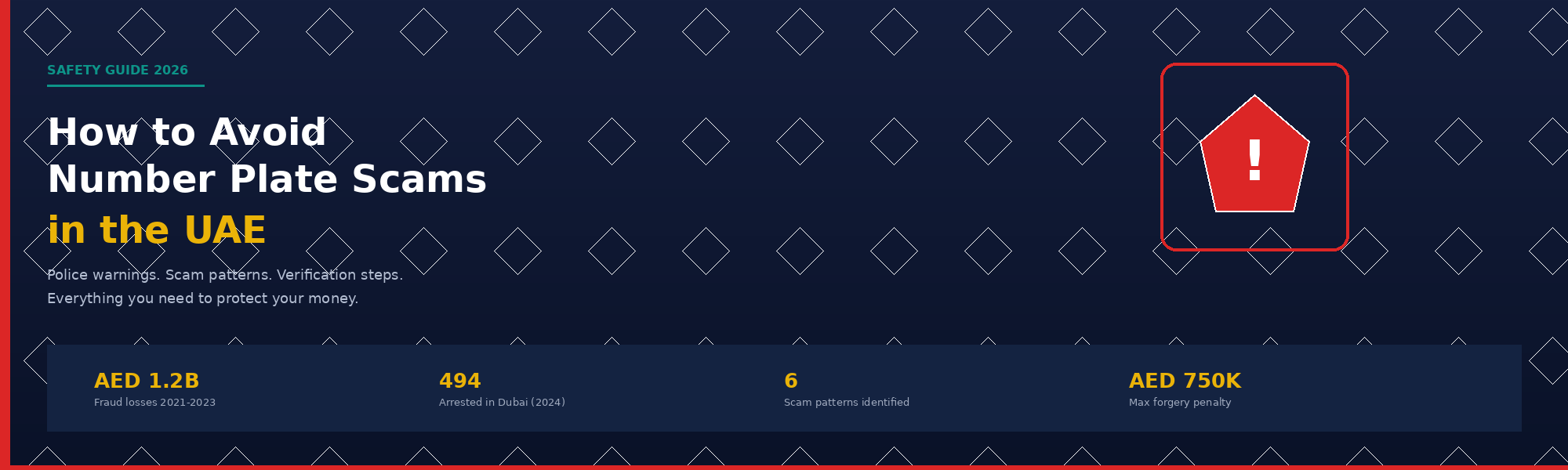
Abu Dhabi Police issued a public warning in August 2024 after a wave of fake social media accounts appeared offering distinctive plates at suspiciously low prices. The UAE Financial Intelligence Unit reported AED 1.2 billion in total fraud losses between 2021 and 2023. And in April 2024 alone, Dubai Police arrested 494 individuals tied to 406 separate fraud cases.
None of this means buying a plate is inherently risky. It means that the process of verifying who owns what, and whether the price makes sense, requires more attention than most buyers give it. This guide breaks down the actual scam patterns that target plate buyers in the UAE, the verification steps that stop them, and the official channels you should use if something goes wrong.
Why Plate Buyers Are Targeted
Plate transactions in the UAE share a few features that make them attractive to scammers. The amounts involved are large. A mid-range three-digit plate trades between AED 1 million and AED 10 million, and even five-digit plates on desirable codes can reach AED 50,000 or more. That means a single successful scam generates a significant payout.
The other factor is urgency. When a buyer finds a plate they want, especially a specific number that matches a birthday, a car model, or a personal preference, the fear of losing it to another buyer creates pressure. Scammers exploit that pressure by pushing for quick deposits before the buyer has time to verify anything.
Add the fact that much of the secondary plate market operates through informal channels like WhatsApp groups, Instagram accounts, and word of mouth, and you have an environment where legitimate sellers and fraudsters use the exact same communication tools. Without a structured verification process, telling them apart is harder than it should be.
The Six Scam Patterns That Target Plate Buyers
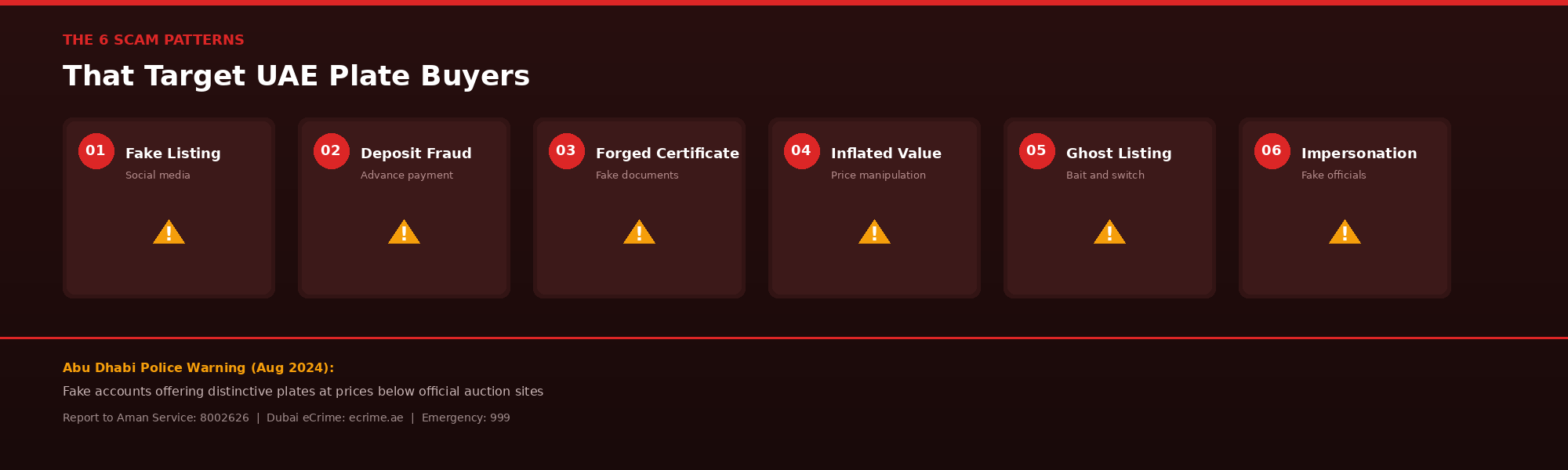
1. The Fake Social Media Listing
This is the pattern Abu Dhabi Police specifically warned about in 2024. A scammer creates an Instagram or Facebook account that looks like a plate dealership. The profile includes photos of desirable plates, often taken from real auction results or other legitimate listings. The prices are set below market value, just enough to seem like a deal without being obviously fake.
When a buyer reaches out, the scammer claims the plate is available for immediate purchase and asks for a deposit to "hold" it. Once the money is sent, the account goes silent or is deleted entirely. The plate either belongs to someone else, is not for sale, or does not exist at all.
How to spot it: The account has no verified identity, no physical business address, and no transaction history. The price is noticeably below what the same plate would fetch at auction or on established marketplaces. The seller cannot produce an RTA or TAMM ownership certificate on the spot.
2. The Deposit Advance Fraud
The seller appears legitimate. They may have a real plate to show, or at least real photos of one. The conversation feels professional. But at the point of commitment, the seller asks for a deposit, typically 10 to 30 percent of the asking price, before any official RTA transfer process begins. The justification varies: to "remove the listing," to "reserve the plate," or to "start the paperwork."
In the legitimate transfer process, no deposit is required before both parties appear at an RTA service centre or complete the transfer through the Dubai Drive app. A seller who requires cash or a bank transfer before any official step is either operating outside the system or has no intention of completing the sale.
How to spot it: Any request for payment before the RTA transfer process begins is a red flag. The official transfer fee is AED 120 (AED 100 ownership certificate plus AED 20 knowledge and innovation fee). That is the only payment required at the point of transfer. The plate price itself is exchanged between buyer and seller, but payment should happen at or near the point of official transfer, not days or weeks beforehand.
3. The Forged Ownership Certificate
This scam involves a seller presenting a fake or altered plate ownership certificate to prove they hold the plate. The document may look convincing, but it has no connection to the actual RTA or TAMM records. It is designed to give the buyer enough confidence to proceed with payment.
Under Article 14 of Federal Decree-Law No. 34 of 2021, forging an electronic document belonging to a government entity carries a fine of AED 150,000 to AED 750,000 and a prison sentence. Forging documents from non-government entities carries AED 100,000 to AED 300,000 in fines. Using a forged document knowingly carries the same penalty as creating one.
How to spot it: Never rely on a document the seller provides. Ownership must be verified through the RTA website, the Dubai Drive app, or an in-person visit to an RTA service centre. The RTA system sends an SMS verification code to the registered plate owner. If the seller cannot or will not facilitate this verification, the plate is not confirmed as theirs.
4. The Inflated Valuation Scam
Not all scams involve theft. Some involve manipulation. A seller presents comparable sales data that overstates the value of the plate they are selling. They may reference auction results for similar numbers but on different, more prestigious codes. They may cite prices from plates with repeating or sequential patterns while selling one with a random sequence.
A code V plate and a code A plate with the same digits are entirely different assets. A three-digit plate numbered 777 and one numbered 429 are in different universes of demand. Without understanding how code, digit count, pattern, and market timing interact, buyers can overpay by tens or hundreds of thousands of dirhams.
How to spot it: Use a plate valuation tool before negotiating. Check recent RTA auction results for comparable plates on the same code, with the same digit count. Ask the seller to justify their price with specific, verifiable comparables, not general claims about "what similar plates go for."
5. The Ghost Listing
A plate appears on a classifieds site or group chat. The buyer enquires. The seller responds. But when it comes time to proceed, the plate turns out to be unavailable. The seller then offers an alternative plate, usually at a different price point, and the cycle begins again. This is a bait-and-switch tactic designed to hook buyers emotionally and redirect them toward a different transaction that may itself be fraudulent.
How to spot it: If the plate you enquired about is suddenly unavailable but the seller has "something better," treat the entire interaction with scepticism. Legitimate sellers do not need to bait you with plates they do not have.
6. The Impersonation of Official Channels
In late 2024, a cybersecurity firm documented a large-scale campaign where scammers impersonated Dubai Police officers, calling residents to demand payments for fake traffic fines. The same template has been applied to plate transactions. Scammers pose as RTA officials, auction representatives, or government liaisons, claiming the buyer has won an auction or that a plate is being released at a special price, and requesting payment through unofficial links.
No UAE government entity will ever contact you by phone, WhatsApp, or SMS to ask for payment for a plate. RTA auctions are conducted through the official RTA website and the Emirates Auction platform. Payment happens through those systems, not through bank transfers to individuals.
How to spot it: Government agencies do not call to collect payments. They do not send WhatsApp messages with payment links. If someone contacts you claiming to represent the RTA or an auction house and asks for money, it is a scam. End the conversation and report it immediately.
How to Verify Plate Ownership Before You Pay
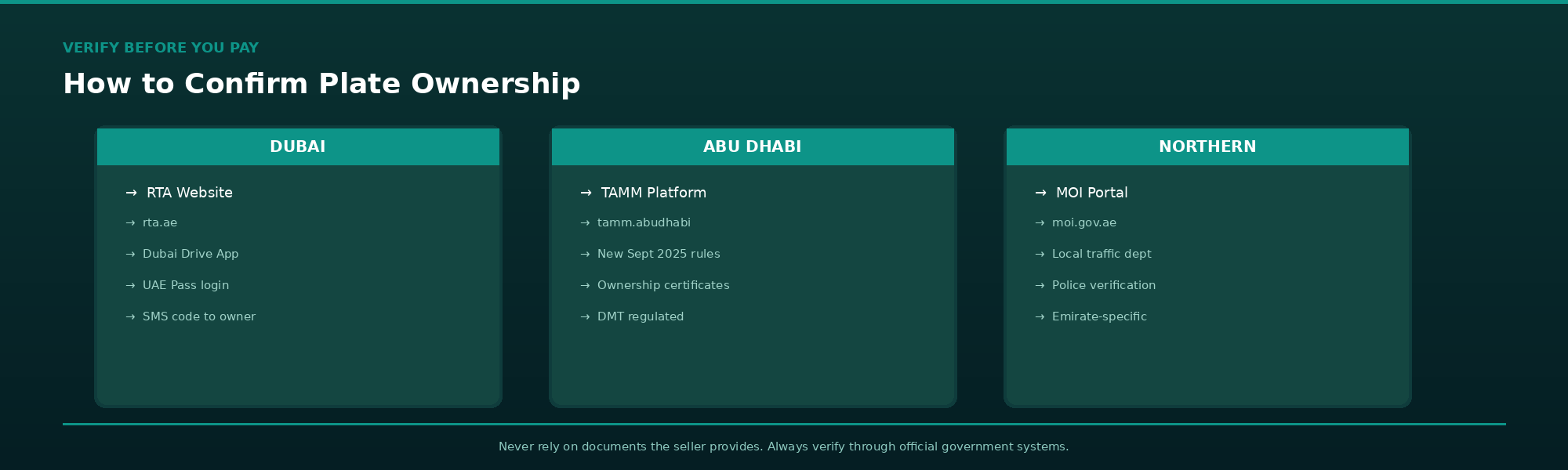
Every legitimate plate transaction in the UAE can be verified through official government systems. If a seller resists verification, that tells you everything you need to know.
Dubai Plates: RTA Verification
For plates registered in Dubai, the Roads and Transport Authority provides ownership verification through several channels. On the RTA website (rta.ae), navigate to the vehicle or plate ownership inquiry section. Enter the plate code and number. The system will display registration status and, for detailed ownership information, send an SMS verification code to the registered owner. If the seller is the genuine owner, they will receive this code and can share it with you to complete the check.
You can also verify through the Dubai Drive app (formerly the RTA Dubai app) using your UAE Pass login. For in-person verification, visit any RTA Customer Happiness Centre with both parties present and request a plate ownership check.
Abu Dhabi Plates: TAMM Verification
Abu Dhabi plates are managed through the TAMM platform (tamm.abudhabi). Since September 2025, the Department of Municipalities and Transport has implemented new rules specifically for distinguished plates, requiring clear ownership certificates and limiting transfers without proof of ownership. This is a direct response to fraud involving high-value Abu Dhabi plates.
Northern Emirates: MOI and Local Police
For plates registered in Sharjah, Ajman, RAK, UAQ, or Fujairah, verification goes through the Ministry of Interior portal or the respective emirate's traffic department. The process is similar: provide the plate details, and the system confirms registration status.
The non-negotiable rule: Never pay for a plate until ownership has been verified through an official government system. Not a screenshot. Not a PDF the seller emails you. Not a photo of a certificate. The actual live verification through RTA, TAMM, or MOI.
Check the certificate itself, not a copy of it. A PDF or a photo of an Emirates ID proves nothing on its own. Our step-by-step guide shows how to verify an RTA certificate before you pay on RTA's Document Validation Service, and why no deposit should move before you have done it.
What a Safe Plate Transaction Looks Like
Regardless of whether you buy through an auction, a private seller, or a marketplace platform, the actual mechanics of a legitimate transaction follow the same sequence.
Step 1: Verify ownership.
Use the official RTA, TAMM, or MOI system to confirm the seller is the registered plate owner. This takes minutes.
Use the official RTA, TAMM, or MOI system to confirm the seller is the registered plate owner. This takes minutes.
Step 2: Agree on price.
Compare the asking price against recent auction results, marketplace listings for comparable plates, and valuation tools. Understand how the plate's code, digit count, and pattern affect its market value.
Compare the asking price against recent auction results, marketplace listings for comparable plates, and valuation tools. Understand how the plate's code, digit count, and pattern affect its market value.
Step 3: Meet at the point of transfer.
For Dubai plates, both parties can complete the transfer digitally through the Dubai Drive app using UAE Pass, or in person at an RTA service centre. Either way, the transfer is recorded in the government system in real time.
For Dubai plates, both parties can complete the transfer digitally through the Dubai Drive app using UAE Pass, or in person at an RTA service centre. Either way, the transfer is recorded in the government system in real time.
Step 4: Exchange payment at or near the point of transfer.
Once the plate is officially transferred to the buyer's name in the RTA system, the transaction is complete. Payment should happen in close coordination with this step, not days before it.
Once the plate is officially transferred to the buyer's name in the RTA system, the transaction is complete. Payment should happen in close coordination with this step, not days before it.
Step 5: Confirm the transfer is recorded.
After the transfer, verify that the plate now appears under your traffic file in the RTA or TAMM system. Keep all documentation.
After the transfer, verify that the plate now appears under your traffic file in the RTA or TAMM system. Keep all documentation.
The total official cost of the transfer itself is AED 120 for the ownership certificate and knowledge fee. Everything else is the plate price negotiated between buyer and seller. There are no hidden government fees, no special processing charges, and no intermediary payments required.
Where to Report a Plate Scam in the UAE
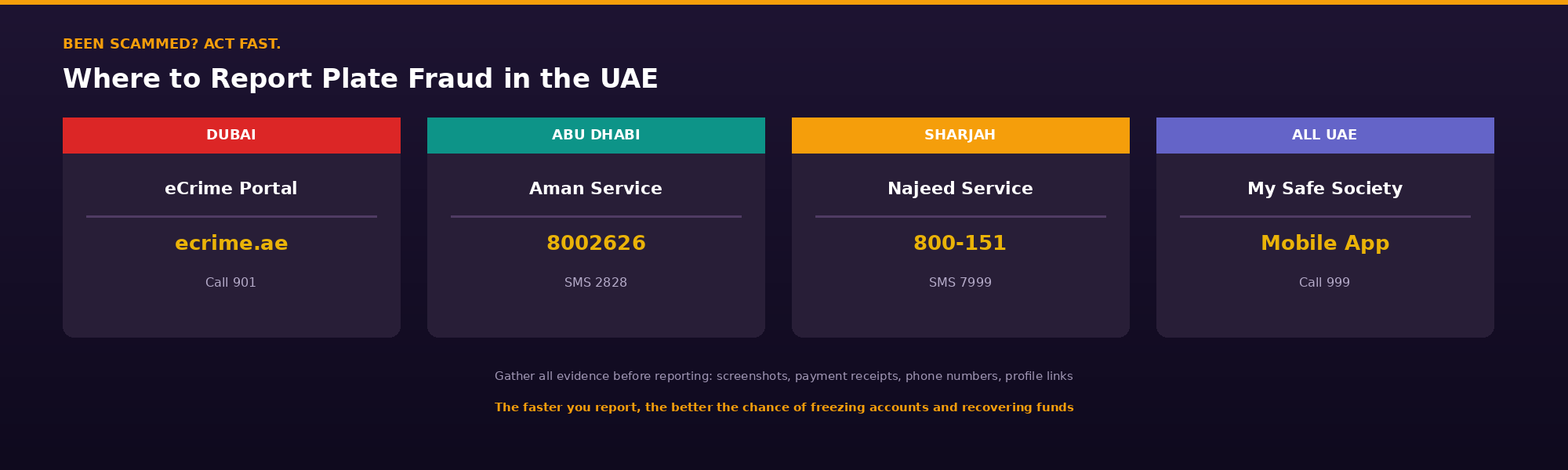
If you suspect fraud or have been a victim, the UAE has multiple dedicated channels for reporting. Speed matters. The sooner a report is filed, the more likely authorities can freeze accounts and trace funds.
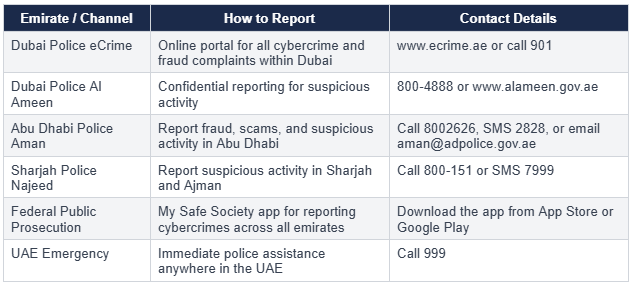
When filing a report, gather all evidence before contacting authorities: screenshots of conversations, payment receipts or bank transfer confirmations, the seller's phone number, any profiles or account links, and the plate number in question. The more detail you provide, the faster investigators can act.
Legal Consequences for Plate Fraud in the UAE
The UAE does not treat online fraud lightly. Federal Decree-Law No. 34 of 2021 on Countering Rumours and Cybercrimes establishes specific penalties that apply directly to plate scam scenarios.
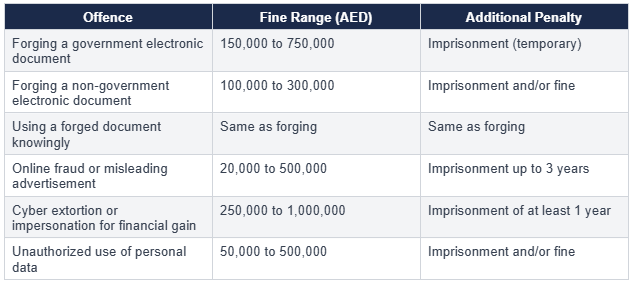
For foreign nationals convicted of cybercrime offences, deportation is frequently applied as an additional penalty. The UAE has also implemented blockchain-based evidence storage in 2025, making it harder for digital evidence to be disputed or tampered with during investigations.
Red Flags Checklist: When to Walk Away
Not every suspicious interaction is a scam, but patterns emerge. Here are the signals that should make any buyer pause and reconsider before proceeding.
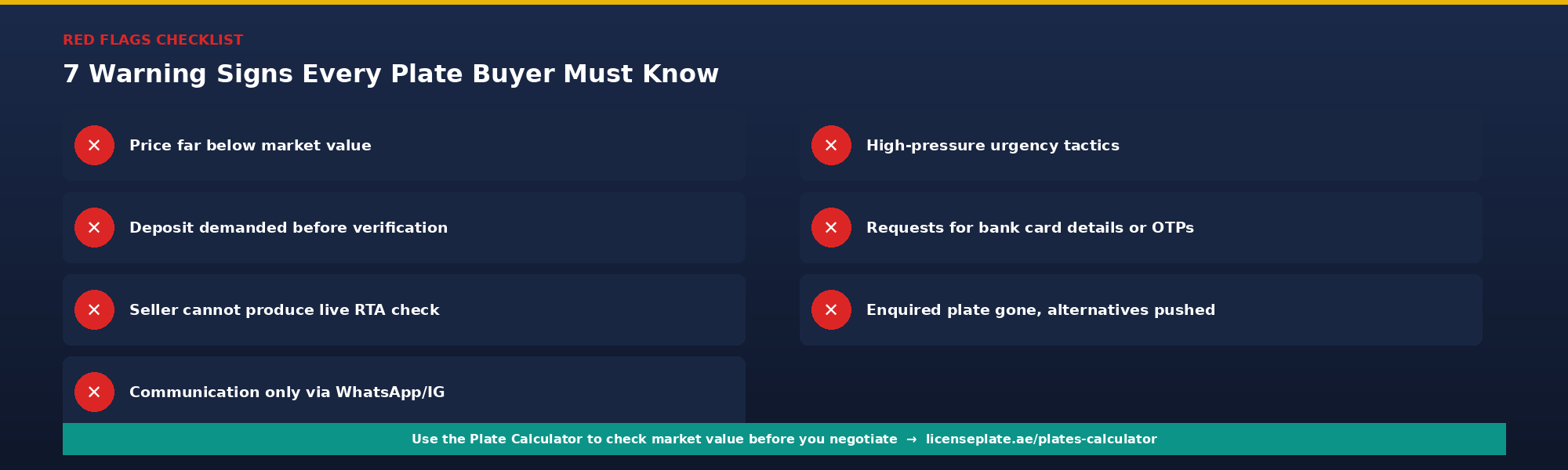
The price is significantly below market.
If a code A three-digit plate is listed at AED 800,000 when comparable plates sell for AED 2 million or more, the listing exists to attract attention, not to sell a plate.
If a code A three-digit plate is listed at AED 800,000 when comparable plates sell for AED 2 million or more, the listing exists to attract attention, not to sell a plate.
The seller demands a deposit before verification.
No legitimate transaction requires payment before ownership is confirmed through official systems.
No legitimate transaction requires payment before ownership is confirmed through official systems.
The seller cannot produce live RTA verification.
A genuine plate owner can verify their ownership in minutes through the RTA or TAMM system. Refusal or excuses are disqualifying.
A genuine plate owner can verify their ownership in minutes through the RTA or TAMM system. Refusal or excuses are disqualifying.
The communication is only through WhatsApp or Instagram DMs.
Legitimate sellers and platforms operate through identifiable channels with traceable business identities.
Legitimate sellers and platforms operate through identifiable channels with traceable business identities.
The seller pressures you with urgency.
"Someone else is about to buy it" and "the price goes up tomorrow" are social engineering tactics, not business realities.
"Someone else is about to buy it" and "the price goes up tomorrow" are social engineering tactics, not business realities.
The seller asks for bank card details or OTPs.
No seller ever needs your banking credentials. If they ask, it is a phishing attempt.
No seller ever needs your banking credentials. If they ask, it is a phishing attempt.
The plate you enquired about is suddenly unavailable, but alternatives are offered. Bait-and-switch is a classic fraud setup.
How Marketplace Platforms Reduce Risk
One of the reasons plate scams persist is that the majority of secondary market transactions happen through unstructured channels. Classifieds sites list plates without verifying that the person posting actually owns the plate. Social media accounts can be created and deleted in minutes.
Dedicated plate marketplace platforms address this by introducing layers of verification and structure that informal channels lack. On LicensePlate.ae, for example, listings are agent-managed, meaning a team reviews and coordinates listings rather than allowing unverified self-service posts. Sellers communicate through the platform rather than through personal WhatsApp numbers, which protects the privacy of both parties and creates a record of the interaction.
The platform also provides a plate calculator that gives buyers a price reference point before they negotiate. This directly counters the inflated valuation scam, because a buyer who knows the approximate market value of a plate is far less likely to overpay based on false comparables.
Marketplace platforms are not a guarantee against all risk. But they introduce accountability, price transparency, and communication structure that make fraud significantly harder to execute.
Frequently Asked Questions
How do I verify who owns a number plate in Dubai?
Use the RTA website or Dubai Drive app. Navigate to the plate or vehicle ownership inquiry, enter the plate code and number, and the system will confirm registration status. For detailed ownership verification, the RTA sends an SMS code to the registered owner, who can share it to complete the check.
Is it safe to buy a plate through WhatsApp or Instagram?
Buying through informal channels like WhatsApp and Instagram is significantly riskier than using official auctions or verified marketplace platforms. Abu Dhabi Police have specifically warned about fake social media accounts offering plates at below-market prices. If you do engage with a private seller through these channels, always verify ownership through the RTA or TAMM system before making any payment.
What should I do if I have already been scammed?
File a report immediately. In Dubai, use the eCrime portal at ecrime.ae or call 901. In Abu Dhabi, contact the Aman service at 8002626. Across all emirates, you can use the My Safe Society app from the Federal Public Prosecution. Gather all evidence before reporting: screenshots, payment receipts, phone numbers, and profile links. The faster you report, the better the chance of recovering funds.
Can I get my money back if I paid a scammer?
It depends on how quickly you report and the method of payment used. Bank transfers can sometimes be frozen if reported quickly enough. Cash payments are extremely difficult to recover. Filing a police report is mandatory for any potential recovery, and in some cases, court-ordered restitution may apply. Under UAE law, victims can pursue both criminal prosecution and civil compensation claims.
Does buying through an RTA auction guarantee safety?
Yes. RTA auctions conducted through the official RTA website or Emirates Auction platform carry zero scam risk. The plates are government-issued, the payment goes through official channels, and ownership transfer is immediate upon payment completion. The trade-off is a 5% VAT on the winning bid and a limited selection of plates. For a detailed comparison of auction versus private sale versus marketplace, see our full comparison guide.
Ready to browse verified plate listings?
Visit LicensePlate.ae to search plates across all seven emirates with price context, agent-managed communication, and verified sellers. Or use the Plate Calculator to check market value before you negotiate anywhere.
Delete Comment?
Are you sure you want to delete this comment? This action cannot be undone.
Delete Article?
Are you sure you want to delete this article? This will also delete all comments. This action cannot be undone.