

RTA Fixed-Price Number Plates in Dubai (2026): How to Buy a Plate Instantly Without an Auction
Last updated: 14 August 2026
Quick answer
Yes — you can buy a Dubai number plate at a fixed price without bidding in any auction. Dubai law calls this a Direct Sale, and it is one of only two sale methods the RTA is authorised to use under Administrative Resolution No. (916) of 2021. You browse available numbers on the RTA website or the Dubai Drive app, pay the listed price, and the plate number ownership certificate is issued to your traffic file — usually within minutes. Beyond the plate price you pay roughly AED 100 for the ownership certificate, AED 20 Knowledge and Innovation, plus VAT. There is no deposit, no security cheque and no ten-day payment deadline, because there is nothing to win.
Almost everything written about Dubai number plates is written about auctions. The AED 55 million P 7. The AED 38 million AA 9. The charity evenings where nine plates raise more than a billion dirhams. It is genuinely spectacular, and it is genuinely misleading — because it has left thousands of ordinary buyers believing that the only way to get a good Dubai plate is to raise a paddle against a billionaire.
It is not. The RTA sells plate numbers two ways, and the auction is the smaller, louder one. The other is a straightforward retail transaction: a number sits in a list with a price next to it, you pay the price, and the number is yours. No competitors, no deposit, no drama. This guide covers that channel in full — the legal basis, who qualifies, what it really costs, the exact purchase flow, and the specific situations where you should deliberately ignore it and go to auction instead.
Table of contents
- What "direct sale" actually means under Dubai law
- Direct sale vs auction: the two legal routes compared
- Who is allowed to buy — and the six-plate rule nobody mentions
- What a fixed-price plate actually costs
- How to buy a fixed-price plate, step by step
- What you actually receive when you pay
- Which numbers appear at fixed price — and which never will
- When fixed price is the wrong choice
- Seven mistakes that cost fixed-price buyers money
- Frequently asked questions
What "direct sale" actually means under Dubai law
This is not marketing language or an informal industry term. "Direct Sale" is a defined legal concept in Administrative Resolution No. (916) of 2021, the instrument that regulates the sale of vehicle plate numbers in the Emirate of Dubai. The resolution defines it precisely:
"The sale of Special Plate Numbers and Semi-special Plate Numbers directly to the public or Permit Holders without the need for them to participate in Auctions."
Article 3(5) of the same resolution gives the RTA the power to determine "the method for offering and selling Special Plate Numbers, Semi-special Plate Numbers, and Batches, whether through Direct Sale or an Auction." That single clause is the whole point of this article: the auction is not the default and the direct sale is not a loophole. They are two equally legitimate channels, and the RTA chooses which one a given number goes through.
Understanding the vocabulary matters, because the category a number falls into determines whether you will ever see it at a fixed price.
| Term | What Resolution 916 says it means | Why it matters to you |
|---|---|---|
| Special Plate Number | Numbers whose categories, codes and digit formulas are determined by the RTA, or that have unique formulas making them popular with the public. | The trophy tier. Overwhelmingly sold by auction. |
| Semi-special Plate Number | Private vehicle plate numbers in category (5), or classic plates in category (4) or (5), with semi-unique digit formulas that make them popular. | This is the direct-sale sweet spot — the tier most fixed-price listings come from. |
| Batch | A bundle of special or semi-special plate numbers offered together. | Aimed at traders, not individual buyers. |
| Permit Holder | A person licensed under Executive Council Resolution No. (31) of 2011 to trade in vehicle plate numbers in the Emirate. | A licensed plate dealer. They play by different quota rules than you. |
| Public Auction | A public process where the public or permit holders may bid. | The auctions you read about in the news. |
| Limited Auction | An auction restricted to permit holders or persons meeting prescribed requirements. | Trade-only. Not open to walk-up retail buyers. |
The practical takeaway: if you are hunting a two-digit number on an early code, you are in Special Plate Number territory and you should expect an auction. If you want a clean, memorable four- or five-digit number for a car you are buying next week, you are in Semi-special territory, and there is a very good chance the exact number is sitting in a fixed-price list right now.
Direct sale vs auction: the two legal routes compared
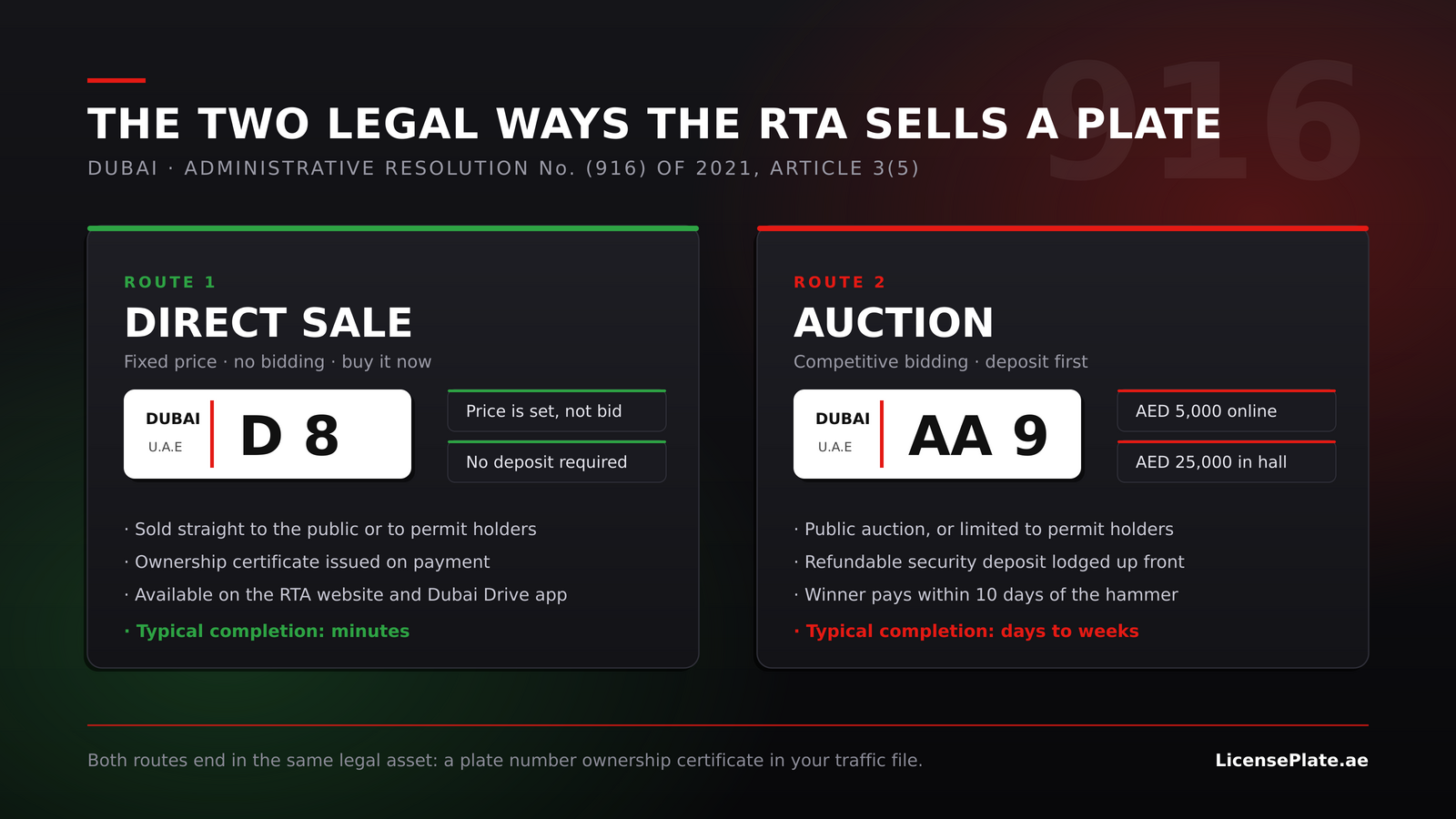
The difference is not prestige. It is price discovery, timing and cash requirements.
| Factor | Direct sale (fixed price) | Auction |
|---|---|---|
| How the price is set | Published by the RTA before you commit | Discovered by competitive bidding |
| Money up front | None — you pay only if you buy | Typically AED 5,000 (online) or AED 25,000 (hall) security, plus AED 120 participation |
| Certainty of outcome | Total. The number is yours on payment | None. You can lose after weeks of preparation |
| Payment deadline | Immediate, at checkout | Within 10 days of winning (Article 4(7)) |
| Typical time to complete | Minutes | Days to weeks |
| Ceiling on quality | Real — the headline numbers are held back | None — this is where records are set |
| Risk of overpaying | Low. The price is the price | High. Auction rooms manufacture urgency |
| Risk of underpaying | Also low — no bargain hunting | Real. Quiet auctions produce genuine value |
Note the last two rows, because they are the honest trade-off. Fixed price buys you certainty and removes the possibility of a bidding-war mistake. It also removes the possibility of a bargain. If your goal is a plate to own and enjoy, certainty is usually worth more. If your goal is a plate to flip, the auction floor is where the margin lives — which is exactly why our auction versus secondary market comparison reaches a different conclusion for investors than for drivers.
Who is allowed to buy — and the six-plate rule nobody mentions
Three gates stand between you and a fixed-price plate, and only the first is widely known.
Gate 1: eligibility
The RTA lists eligible buyers as UAE citizens, residents and diplomats. There is one restriction that catches people out constantly: if your residence visa was issued in another emirate, you may not be able to register a Dubai-purchased number on your vehicle through the standard service. Owning the number and registering it on a car are separate questions — see our expat eligibility guide for the full breakdown.
Gate 2: a Dubai traffic file
Article 4 of Resolution 916 requires purchasers to hold a traffic file. Without one, the transaction cannot complete regardless of how much you are willing to pay. If you do not have one, opening it is the genuine first step — our traffic file guide covers how, and how to find your number if you already have one.
Gate 3: the annual quota
This is the provision almost nobody publishes. Article 5 of Resolution 916 limits an ordinary person to purchasing no more than six (6) Semi-special Plate Numbers within a year. Permit Holders — licensed plate traders — are not subject to that restriction.
The consequence is worth thinking through carefully. If you are a private individual planning to accumulate fixed-price numbers as a portfolio, the law caps your rate of accumulation at six semi-special numbers per year. That is a deliberate anti-hoarding measure, and it quietly shapes the entire market: it is a structural reason why serious volume buyers hold trading permits, and why portfolio construction for private buyers has to be patient by design rather than by choice.
What a fixed-price plate actually costs
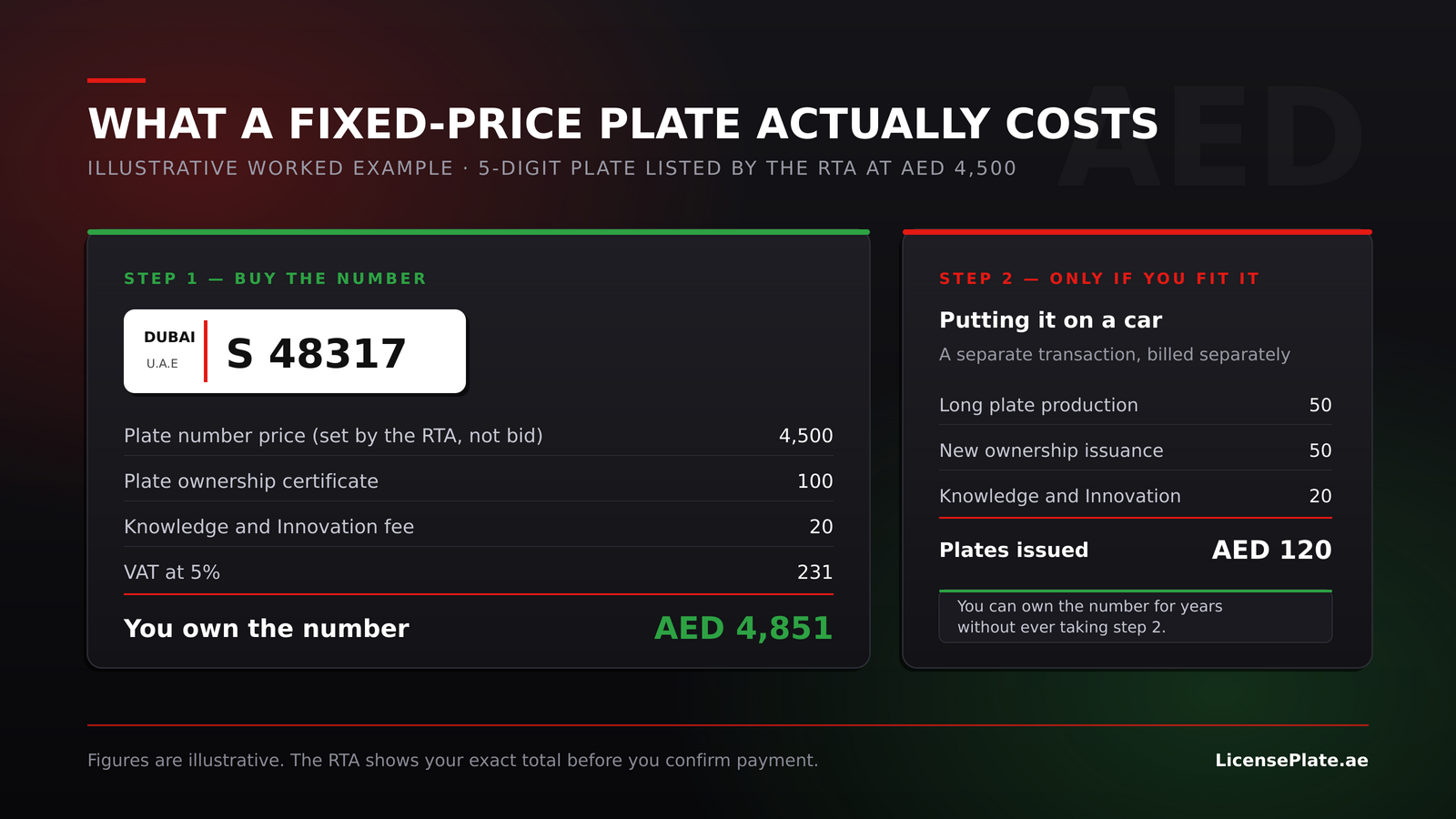
On a direct purchase you typically pay the plate number price, plus a Plate Ownership Certificate fee of AED 100, plus a Knowledge and Innovation fee of AED 20, plus VAT. That is the complete cost of owning the number.
Fitting it to a car is a separate transaction with its own fees, driven by the plate style you choose:
| Plate style | Production fee (AED) | Typical total incl. issuance + K&I (AED) |
|---|---|---|
| Short plate | 35 | 105 |
| Long plate | 50 | 120 |
| Classic (short or long) | 150 | 220 |
| Expo-branded | 100 | 170 |
| Dubai-branded | 200 | 270 |
| Luxury | 500 | 570 |
| Motorcycle | 25 | 95 |
A worked example. Say a five-digit number on a late code is listed at AED 4,500:
- Plate number price: AED 4,500
- Plate ownership certificate: AED 100
- Knowledge and Innovation fee: AED 20
- VAT at 5%: AED 231
- Total to own the number: AED 4,851
- Long plates issued later, if and when you fit it: AED 120
Two things follow from this structure. First, the fixed fees are trivial relative to the number price — so unlike a car purchase, there is no meaningful "cost of transacting" to amortise. Second, you can own a number for years without ever paying the production fee, because the certificate is the asset and the metal is optional. That is precisely how buyers secure a number before they have the car.
For where a given number should sit on the price ladder before you decide whether the RTA's listed price is fair, use our Dubai price guide by code and digit count and the full RTA fee table.
How to buy a fixed-price plate, step by step
- Confirm your traffic file is active. Do this first. Everything downstream fails without it.
- Open the RTA website or the Dubai Drive app. Both carry the same inventory; the app is generally faster on mobile.
- Log in with UAE Pass (or RTA account credentials). UAE Pass is the smoother path because identity is already verified.
- Go to Plates Services and choose "Buy New Plate Number". This is the direct-sale entry point, distinct from the auction section.
- Search by what you actually care about. You can filter by plate category (choose "private" for a normal passenger car), by plate code, and by digit count from one to five digits. You can also enter a specific number to test availability.
- Read the listed price. This is the number that will not move. If it is above your valuation, close the tab — there is no negotiation and no benefit to hesitating over a fixed price.
- Pay. The system shows your exact total including certificate, Knowledge and Innovation fee and VAT before you confirm. Card payment limits apply on the RTA platform, and larger purchases may require an alternative payment route.
- Collect your certificate. The plate number ownership certificate and receipts are issued to you, typically by SMS and email.
- Fit it — or don't. Assigning the number to a vehicle is a separate service with the fees in the table above.
One workflow nuance worth knowing: not every direct-sale purchase is instantaneous. Some numbers complete immediately at checkout; others route through an approval step before payment is taken, which can add a working day or two. Both are direct sales — neither involves bidding. Our general RTA buying guide maps how these routes sit alongside auctions and private transfers.
What you actually receive when you pay
You receive a plate number ownership certificate. Internalising this changes how you think about the whole transaction.
The certificate is the asset. It records that a specific number, on a specific code, in a specific category, belongs to you in the traffic system. The aluminium plates screwed to a car are a manufactured accessory that references the asset. This is why you keep your number when you sell the car, why the number survives the car being written off, and why a lost physical plate is replaced with the same number rather than a new one.
It is also why the certificate — not a photo of the plate, not a WhatsApp screenshot — is the only document that proves ownership in a private sale. If you later resell, the buyer's due diligence will centre on it, and so should yours when buying from anyone other than the RTA. Our verification checklist and the mulkiya field guide cover exactly what to inspect.
Which numbers appear at fixed price — and which never will
The RTA does not release its allocation logic, but the observable pattern across years of listings is consistent.
Reliably available at fixed price: five-digit numbers across most current codes; four-digit numbers on mid and late codes; ordinary digit patterns with no repetition, no ascending or descending sequence and no cultural loading. These are the semi-special tier, and they are the bulk of the market by volume.
Occasionally available: four-digit numbers on newly released codes. When the RTA opens a new code — it works through the alphabet, releasing codes to the public in sequence — a tranche of clean four-digit numbers enters direct sale at a set entry price before the market has formed an opinion about that code. Recent releases have seen four-digit entry points in the region of AED 95,000. This is the single best moment for a fixed-price buyer to act, because you are buying at an administratively set price rather than a market-discovered one.
Effectively never available: one, two and three-digit numbers; repeating patterns like 999 or 7777; double-letter codes such as AA, BB, CC and DD. These are Special Plate Numbers and they go to auction, where the competition is the point. If your heart is set on one of these, fixed price is not your channel — read the repeating-number guide and the double-letter code guide to understand what you are up against.
For what each letter signals about age, scarcity and resale, our A-to-Z code guide is the reference.
When fixed price is the wrong choice
An honest guide has to name the cases where its own subject is the weaker option.
When you want a trophy number. Short numbers and premium patterns simply are not sold this way. No amount of refreshing the listings will produce a two-digit plate.
When you are buying to resell. Fixed-price listings are priced at or near retail. Margin in this market comes from buying below market — which means auctions where attendance is thin, or private sellers under time pressure. Our negotiation playbook is built for that path.
When the specific number matters more than the channel. If you want a particular number and it is already owned by someone, the RTA cannot sell it to you at any price. The only route is the secondary market — which is exactly what a marketplace exists to solve, and where you can browse Dubai numbers currently for sale from private owners.
When cash flow is the constraint. A fixed price still has to be paid in full at checkout. If the number you want is meaningfully above your liquid budget, the RTA's own instalment mechanism under Resolution 917 may be the better structure — see our instalment plan guide.
Seven mistakes that cost fixed-price buyers money
- Budgeting the plate price only. The certificate, Knowledge and Innovation fee and VAT are small but real, and the physical plates are extra again.
- Assuming fixed price means cheap. It means certain. A listed price can still be above what the same number would fetch in a quiet auction.
- Buying the number before checking the emirate rule. A residence visa issued outside Dubai can block registration on your vehicle even after you own the number.
- Ignoring the code. Two five-digit numbers at similar prices can have very different resale trajectories depending on the letter in front. The code is half the asset.
- Forgetting the six-plate annual cap. Buyers building a position discover Article 5 at the point it blocks purchase number seven.
- Waiting on a new-code release. New-code four-digit tranches at administratively set prices do not last. Hesitation here is expensive in a way hesitation over a five-digit listing is not.
- Treating the certificate as paperwork. It is the asset. Store it as carefully as a title deed.
For the wider set of traps across every buying channel, see 10 expensive mistakes first-time plate buyers make.
Frequently asked questions
Can I really buy a Dubai number plate without an auction?
Yes. Direct Sale is one of the two sale methods the RTA is authorised to use under Article 3(5) of Administrative Resolution No. (916) of 2021. You pay a published price with no bidding and no deposit.
What is the difference between direct sale and fixed price?
They describe the same thing from different angles. "Direct Sale" is the legal term for selling to the public without an auction; "fixed price" describes the commercial reality that the price is set in advance rather than discovered by bidding.
How long does a fixed-price purchase take?
Usually minutes. Some numbers route through an approval step before payment, which can add a working day or two, but there is no bidding period in either case.
Do I need a deposit to buy at fixed price?
No. Deposits — typically AED 5,000 for electronic auctions and AED 25,000 for hall auctions — exist to secure bidding. There is nothing to secure when the price is fixed and payment is immediate.
What fees are added on top of the plate price?
Typically a plate ownership certificate fee of AED 100, a Knowledge and Innovation fee of AED 20, and VAT. The RTA displays your exact total before you confirm payment.
How many plates can I buy in a year?
Article 5 of Resolution 916 limits an ordinary person to no more than six semi-special plate numbers per year. Licensed permit holders are not subject to this restriction.
Can I buy a fixed-price plate without owning a car?
Yes. You are buying the plate number ownership certificate, not the physical plates. Fitting the number to a vehicle is a separate, later transaction.
Can expats and non-residents buy at fixed price?
The RTA lists citizens, residents and diplomats as eligible, and a Dubai traffic file is required. Non-residents face additional constraints — our non-resident guide covers the workable routes.
Are one, two and three-digit plates ever sold at a fixed price?
Effectively no. Short numbers are Special Plate Numbers and are sold through auction, where competitive bidding is the intended mechanism.
Is buying at fixed price cheaper than at auction?
Not necessarily. It is more certain. A quiet auction can produce a lower price; a competitive one can produce a much higher one. Fixed price removes both outcomes.
Where do I find fixed-price plates — the RTA website or the Dubai Drive app?
Both. They draw on the same inventory. Use "Buy New Plate Number" under Plates Services, and log in with UAE Pass.
Can I search for a specific number before buying?
Yes. You can enter a preferred combination and the system reports availability, and you can filter by plate code, category and digit count from one to five digits.
What happens if the number I want is already owned?
The RTA cannot sell it. Your only route is the secondary market — buying it from the current owner, with the ownership certificate transferred to you.
Does a fixed-price plate hold its value as well as an auction plate?
Value tracks the number and the code, not the channel you bought through. A clean four-digit number on a desirable code is the same asset whether it came from a listing or a hammer.
Can I pay for a fixed-price plate in instalments?
Direct-sale checkout expects payment in full. The RTA operates a separate instalment mechanism under Resolution 917, which is the structure to look at if cash flow is the constraint.
The bottom line
Dubai's plate market has two doors, and the spectacular one is not the one most buyers should walk through. The auction exists for numbers whose value can only be settled by competition. The direct sale exists for everything else — which, by volume, is nearly all of it.
If you want a specific, memorable number on your car within the hour, at a price you can see before you commit, with no deposit at risk and no chance of being outbid, the fixed-price channel is not a consolation prize. It is the mechanism the law built for exactly that buyer.
And when the RTA does not have your number, someone else already owns it. That is where we come in — browse plate numbers for sale across the UAE, or narrow straight to Dubai numbers.
Delete Comment?
Are you sure you want to delete this comment? This action cannot be undone.
Delete Article?
Are you sure you want to delete this article? This will also delete all comments. This action cannot be undone.