

Can Expats Buy Number Plates in UAE? Complete Eligibility & Buying Guide
25 February 2026
Dubai
LicensePlate.ae Team
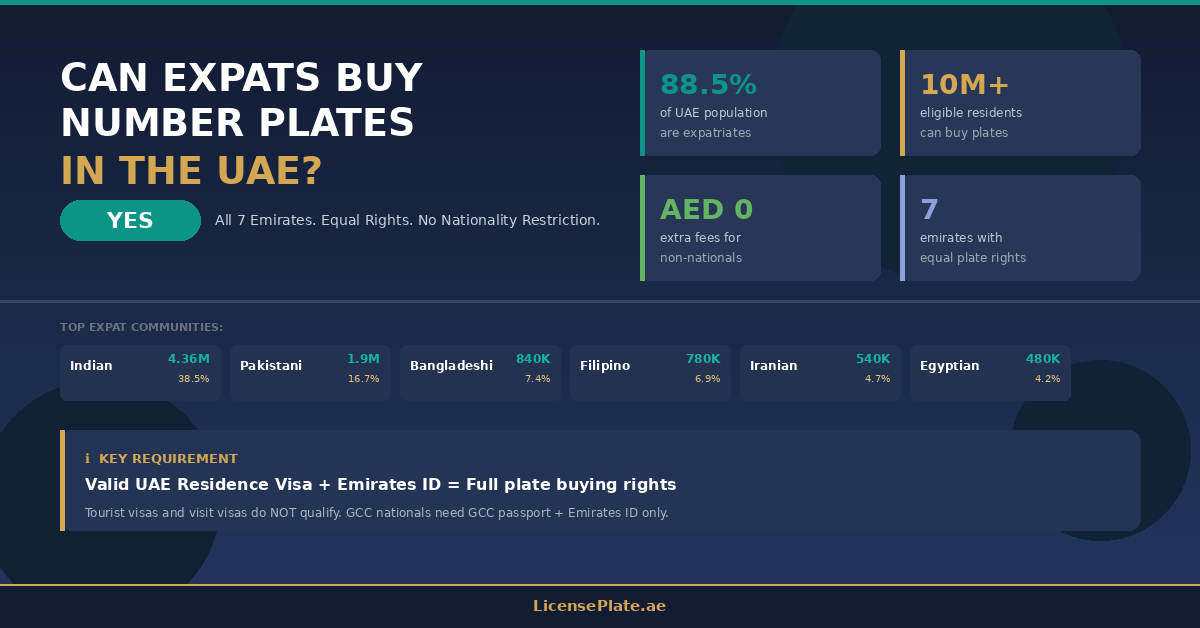
Short answer: yes, absolutely. If you hold a valid UAE residence visa and an Emirates ID, you can buy, own, sell, and transfer number plates in every single emirate. No nationality restriction. No special foreigner fee. No hidden catch.
The Roads and Transport Authority in Dubai, the Department of Municipalities and Transport in Abu Dhabi, and every other emirate's traffic authority treat residents and citizens identically for plate transactions. An Indian engineer on a two-year work visa has the same plate-buying rights as an Emirati national. A British entrepreneur on a Golden Visa can bid at RTA auctions alongside anyone else. A Filipino nurse in Sharjah can purchase a plate from a private seller and walk out with the transfer certificate the same afternoon.
That matters because the UAE is not a country where expats are a small minority. As of 2025, expatriates represent approximately 88.5% of the total population. That translates to more than 10 million people from over 200 nationalities. The Indian community alone accounts for nearly 4.36 million residents (38.45% of the total), followed by Pakistanis at 1.9 million (16.72%) and Bangladeshis at 840,000 (7.38%). Filipinos, Iranians, Egyptians, Nepalis, Sri Lankans, and Chinese nationals collectively add millions more. Every single one of these residents, provided they hold valid documentation, can participate in the plate market.
Yet there is no single, dedicated guide explaining how the process works for non-nationals. Most information is buried in FAQ snippets on insurance blogs or scattered across RTA service pages that assume you already know the system. This guide fills that gap. Over the next 5,000+ words, we will walk through eligibility rules for every emirate, the exact documents you need for each transaction type, what happens to your plates when your visa is cancelled (with four specific scenarios), how companies can own plates as corporate assets, why Golden Visa holders have a structural advantage, and the complete step-by-step roadmap for a first-time expat buyer going from zero to plate owner.
If you want to start browsing right now, LicensePlate.ae carries 60,000+ listings across all seven emirates.
1. The Legal Foundation: Federal Law Treats All Residents Equally
UAE Federal Traffic Law (Federal Law No. 21 of 1995, as amended by subsequent decrees) governs vehicle registration and plate ownership across all seven emirates. The law defines a vehicle owner simply as any natural or legal person whose name appears on the registration card. That definition does not include the word "citizen" or "national." It says "person." And in UAE legal terminology, a person with a valid Emirates ID qualifies.
The Ministry of Interior's official government portal reinforces this with a clear statement: "Any natural or artificial person can register a vehicle in his/her name in the UAE, if he/she is the owner of that vehicle." The word "artificial" covers companies, trusts, and other legal entities, which we will examine in Section 6. The word "natural" covers every individual with an Emirates ID, regardless of their passport.
What makes this particularly significant is context. The UAE is one of very few countries where expats outnumber citizens nearly 9 to 1. If the government restricted plate ownership to nationals, they would be excluding 88.5% of their driving population from a market that generated over AED 109 million in a single RTA auction in December 2025. That would make no economic sense. The framework was designed from the beginning to be inclusive.
There is one hard requirement that applies to everyone equally: you must hold an active UAE residence visa and a valid Emirates ID at the time of the transaction. Tourist visa holders, visit visa holders, and anyone without an Emirates ID cannot register vehicles or own plates. GCC nationals (citizens of Bahrain, Kuwait, Oman, Qatar, and Saudi Arabia) can register using their GCC passport plus Emirates ID without additional residency documentation. For the other 10 million expats, your residence visa is the key. It does not matter whether that visa is employment-based, investor-based, family-sponsored, or a Golden Visa. As long as it is active, you are in.
2. Eligibility by Emirate: Every Authority's Specific Requirements
Federal law sets the baseline, but each emirate's transport authority manages its own registration process with minor procedural differences. Here is the detailed breakdown for each.
Dubai (Roads and Transport Authority)
Dubai runs the most streamlined system in the country. For plate purchases, you need your Emirates ID and a valid residence visa. If you are buying at an RTA auction, add a security deposit of AED 5,000 (refundable if you do not win) and a non-refundable participation fee of AED 120. There is no separate "Dubai residency" requirement for plate purchases. You can live in Abu Dhabi, work in Sharjah, and still buy a Dubai plate at auction or from a private seller.
The exception is vehicle registration. If you want to assign a plate to a car registered in Dubai but your visa was issued in another emirate, you will need proof of Dubai residency: an Ejari tenancy contract or an official employer letter confirming your work location. This applies to the vehicle registration process, not the plate ownership process. You can own a Dubai plate in your traffic file without a vehicle attached.
The Dubai Drive app (available on iOS, Android, and Huawei) handles most transactions digitally. Plate ownership transfers happen entirely through the app using UAE Pass authentication. The seller opens the app, navigates to Vehicle Licensing, selects My Plates, and initiates a Transfer Plate Number Ownership request. The buyer receives a notification, confirms, and both parties digitally sign the Sales Purchase Agreement. The fee is AED 120. The entire process takes under 10 minutes from a couch. No visit to a Customer Happiness Centre required. Browse Dubai plate listings here.
Abu Dhabi (Department of Municipalities and Transport / ITC)
Abu Dhabi fundamentally changed its plate ownership framework on September 13, 2025. The Department of Municipalities and Transport issued an Administrative Decision that classified all Abu Dhabi plates into two categories: distinguished numbers (all single, double, triple, and quadruple-digit plates, plus certain five-digit combinations) and non-distinguished numbers. The Integrated Transport Centre (Abu Dhabi Mobility) now oversees implementation.
The headline for expats: citizens and residents can own unlimited distinguished plates, with no cap. You can buy them, link them to a vehicle or keep them on file without a car, and sell or transfer them freely at any time. The DMT explicitly stated this applies to both citizens and residents. The Abu Dhabi Media Office press release confirms the decision "enables both citizens and residents to obtain distinctive plate numbers through simplified procedures."
For the initial phase, plate ownership services are available in person at ITC customer centres. The TAMM digital platform will later integrate these services online. If you already use an Abu Dhabi plate that was registered without formal ownership documentation, the ITC will send you an SMS with details and the ownership cost. Once you complete the process, you receive an official ownership certificate that functions as proof of title.
This is a massive development for expat plate investors. Before September 2025, the ownership framework in Abu Dhabi was murky. Plates were tied to vehicles, and proving standalone ownership was legally ambiguous. Now there is a clear, documented, government-backed pathway to own plates as titled assets. If you are interested in Abu Dhabi's category system, our complete guide to Abu Dhabi plate categories 1 to 50 breaks down every tier with current market pricing.
Sharjah, Ajman, Ras Al Khaimah, Fujairah, and Umm Al Quwain
All five northern emirates operate under the Ministry of Interior's centralised vehicle registration system. The requirements are uniform: Emirates ID, passport copy, residence visa, and vehicle insurance (only if you are assigning the plate to a car). Plate purchases and transfers happen at the emirate's traffic department office or through the MOI smart application.
There are no additional residency conditions beyond your active visa. A resident with a Dubai-issued visa can buy a Sharjah plate. A Ras Al Khaimah visa holder can purchase an Ajman plate. Cross-emirate plate purchases are routine.
One practical advantage of the northern emirates: lower price floors. A three-digit Sharjah plate might sell for 20% to 40% less than a comparable Dubai plate with the same digit count. A five-digit Ajman or Fujairah plate can be found for under AED 2,000 on the secondary market. For expat buyers exploring plates for the first time, these emirates offer a lower-risk entry point. You can browse all seven emirates with current asking prices on LicensePlate.ae and filter by emirate, digit count, and price range.
3. The Complete Document Checklist: What You Need for Every Transaction Type
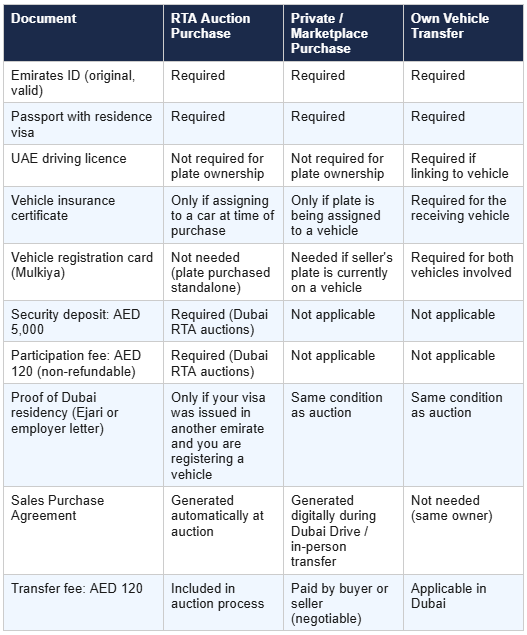
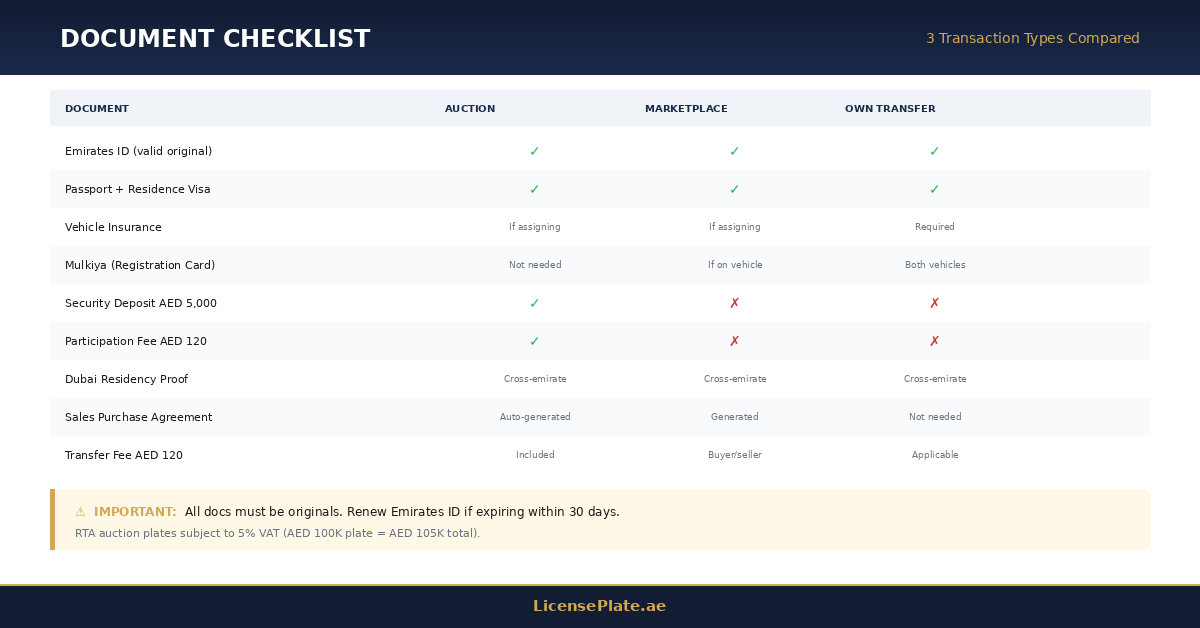
Every plate transaction requires a specific set of documents. The mix changes depending on whether you are buying at auction, purchasing from a private seller or marketplace, or transferring a plate between your own vehicles. Getting this wrong means a wasted trip to a service centre or a stalled digital transaction.
Here is the definitive reference table:
Practical notes that save you from wasted trips:
All documents must be originals. Photocopies and screenshots of your Emirates ID will not be accepted at any service centre. If your Emirates ID is expiring within 30 days, renew it before attempting any plate transaction. The renewal takes 2 to 5 business days through the ICP smart services portal.
Both buyer and seller must be present for in-person transfers, or both must complete their respective steps digitally through the Dubai Drive app (Dubai), the TAMM platform (Abu Dhabi), or the MOI application (other emirates). A Power of Attorney arrangement is possible but adds complexity and cost. For most transactions, the digital route is faster and eliminates scheduling headaches.
VAT matters for auctions. Plate sales through RTA auctions are subject to 5% VAT. A plate that sells for AED 100,000 at auction will cost you AED 105,000 at checkout. Private sales between individuals are generally not subject to VAT. If you are unsure about how fees stack up across buying channels, our complete comparison of auctions, private sales, and marketplaces details every cost line.
4. Yes, Expats Can Own Plates Without a Vehicle
This is the single most common misconception in the UAE plate market. You do not need to own a car, or even have a vehicle registered in your name, to buy and hold a number plate. Plates are standalone assets.
In Dubai, once you purchase a plate (at auction, from a private seller, or through a marketplace), the RTA registers it under your Emirates ID in your traffic file. The plate sits there as an unassigned asset. There are no annual holding fees. No renewal charges. No expiry date on the ownership itself. The plate stays registered to your name until you sell it, transfer it, or your residency status changes. You could hold a plate for five years without ever attaching it to a vehicle and the RTA would not send you a single notice.
Abu Dhabi formalised this even more explicitly with the September 2025 DMT decision. The Administrative Decision introduced a "link or hold" option. Buy a distinguished plate, and you choose: mount it on your car, or keep it on file. The Integrated Transport Centre issues a formal ownership certificate either way. This certificate is your legal title document. It can be used for asset verification, inheritance planning, or financial records.
For expat investors, this opens a clear strategy. You spot a plate at an attractive price point, perhaps a three-digit Abu Dhabi plate listed below recent auction comparables. You buy it, hold it in your traffic file, and sell it when the market shifts. No vehicle needed, no insurance required for the plate itself, and no recurring costs. The plate calculator on LicensePlate.ae estimates current market values so you can evaluate whether a plate is underpriced before committing.
One thing to keep in mind: owning a plate without a vehicle does not create a "phantom" traffic file. Your Emirates ID will already have a traffic file the moment you get a UAE driving licence or register any vehicle. The plate simply appears as an additional line item in that file. If you have never registered a vehicle or obtained a driving licence in the UAE, you may need to open a traffic file first, which is done at any RTA service centre with your Emirates ID. The process takes about five minutes and there is no cost.
5. What Happens to Your Plates When You Leave the UAE: Four Scenarios
This is the section that matters most for every expat plate owner. The intersection of visa status and plate ownership is where people lose money, so read this carefully.
Scenario A: You sell or transfer your plates before your visa is cancelled
The cleanest outcome. You know you are leaving, so you list your plate on a marketplace like LicensePlate.ae, find a buyer, and complete the transfer at a service centre or through the Dubai Drive app. The entire process can happen in a single day. You receive your payment, the plate moves to the buyer's traffic file, and you walk away clean. If you own a plate worth more than AED 10,000, start listing it at least 60 days before your expected departure. The plate market is liquid, but high-value plates require the right buyer at the right time. Rushing a sale in the final week before your visa cancellation will cost you negotiating power.
Scenario B: You transfer plates to a trusted person before leaving
If you want to retain the economic benefit of your plates without selling, you can transfer ownership to a family member, business partner, or trusted friend who holds a valid UAE residency. The transfer fee in Dubai is AED 120 through the Dubai Drive app. In Abu Dhabi, the September 2025 rules explicitly allow simplified transfers to first-degree relatives (parents, siblings, spouse, children) without requiring full ownership proof for the transferring party.
This approach works well for couples where one partner is staying in the UAE while the other relocates temporarily. Transfer the plate to the staying partner's Emirates ID, and it remains accessible and tradeable. When the relocating partner returns and reactivates their visa, the plate can be transferred back.
Scenario C: Your visa is cancelled and the plate is still in your name
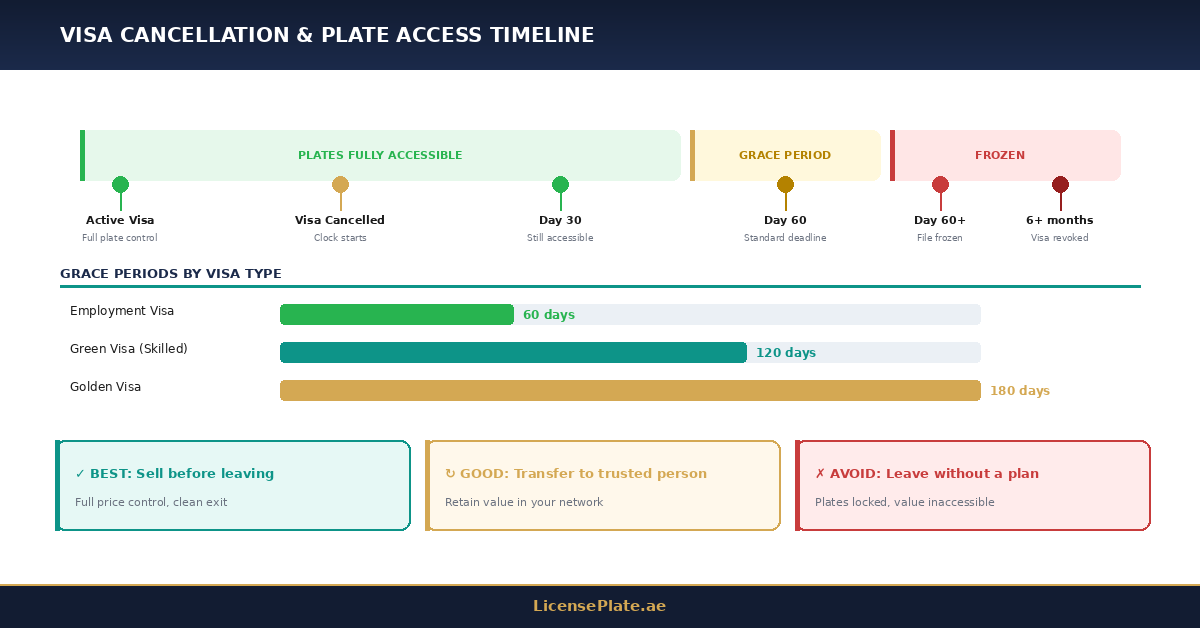
Now the clock starts ticking. When your residence visa is cancelled, you enter a grace period. For most employment visa holders, this is 60 days as of 2024. Skilled professionals classified as first or second level by MOHRE may receive 90 days. Golden Visa holders and certain special categories can receive up to 180 days. During the grace period, your Emirates ID remains functional. You can conduct plate transactions normally: sell, transfer, or reassign.
After the grace period expires without action, your situation deteriorates. Your Emirates ID becomes inactive, and your traffic file may be administratively frozen by the authority. Plates registered to your name are not confiscated or transferred to the government. They remain yours on paper. But you cannot sell them, transfer them, or do anything with them because the digital systems require an active Emirates ID to process transactions. Your plates become stranded assets.
To unlock them, you would need to return to the UAE, obtain a new residence visa, reactivate your Emirates ID, and then process the plate transactions. If you have been outside the country for more than six months, you will also need a re-entry permit through GDRFA (Dubai) or ICP (federal). This process can take weeks and involves additional fees. All of this is avoidable with 30 minutes of planning before you leave.
Scenario D: You leave the UAE without formally cancelling your visa
Staying outside the UAE for more than six consecutive months results in your residence visa being automatically revoked. At that point, your Emirates ID is deactivated by the system. Your plates are in legal limbo. You cannot access your traffic file remotely from abroad. You cannot authorise someone else to sell your plates without a notarised Power of Attorney that was arranged before your departure.
The compounding problem: if your visa was employer-sponsored and you left without proper cancellation, your employer may report you as absconding. That creates a travel ban and a flag on your immigration record. Re-entering the UAE becomes complicated, and resolving the plate situation becomes a multi-step legal process rather than a simple transfer.
The lesson is blunt: never leave the UAE without a plan for your plates. If you own anything worth more than a few thousand dirhams, sell it or transfer it during your grace period. If you are unsure about the process, our scam prevention guide covers safe transaction practices so you do not lose your plates to a fraudulent buyer in the rush to leave.
6. Company and Corporate Plate Ownership: The Smart Expat Strategy
Businesses registered in the UAE can own plates as corporate assets. This applies to mainland LLCs, free zone companies, and other legal entities with a valid trade licence. The plate registers under the company's traffic file instead of an individual's personal file. And that distinction creates a powerful advantage for expat entrepreneurs.
Here is why. If you own a UAE company (which is increasingly straightforward since the 2020 reforms allowing 100% foreign ownership of mainland companies), your company can hold plates regardless of what happens to your personal visa. If you leave the country and your personal visa is cancelled, plates registered to the company remain completely unaffected as long as the trade licence is active and renewed annually.
The practical setup is simple. You need the company's trade licence, the authorised signatory's Emirates ID, and a letter of authorisation if someone other than the owner is conducting the transaction. The plate appears in the company's traffic file, and all transfer rules follow the same procedures as individual ownership. The company pays the same fees as an individual buyer.
Some serious collectors and investors use this structure deliberately. They form a simple free zone company (costs as low as AED 5,750 to AED 15,000 annually depending on the free zone and visa package) and register their plate portfolio under the company. The trade licence gets renewed each year even if the owner is living in London, Mumbai, or Toronto. The company remains a valid legal entity, and the plates stay accessible. When the owner returns or wants to sell, the plates can be transferred out of the company's traffic file to a buyer with a standard transfer transaction.
This is not a loophole. It is a legitimate business practice that the traffic authorities accommodate. Companies own vehicles and plates routinely. The only additional step is maintaining the company's active status through annual licence renewal and, if applicable, keeping at least one visa allocation open. For someone with a plate portfolio worth AED 500,000 or more, the annual cost of maintaining a free zone entity is trivial insurance against visa-related disruption.
7. The Golden Visa Advantage for Plate Owners
The UAE Golden Visa, introduced in 2019 and expanded multiple times since, provides 5 to 10 year residency without the need for a national sponsor. For plate owners and investors, this visa category neutralises the single biggest risk of expat ownership: visa cancellation.
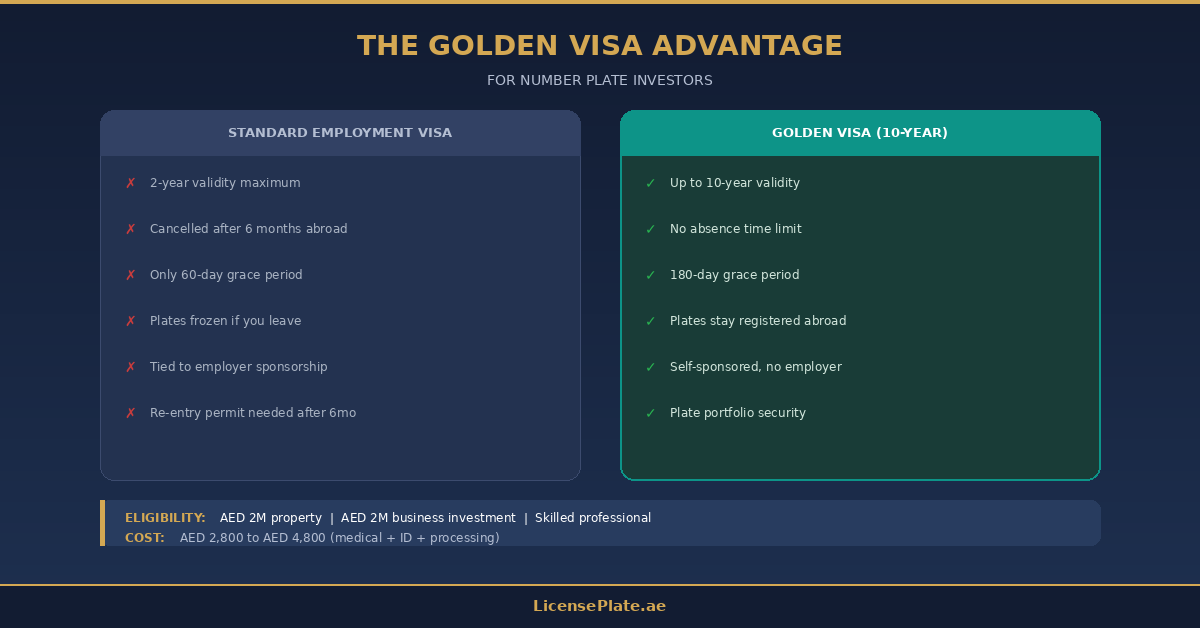
Standard residence visas have a six-month absence rule. If you leave the UAE for more than six consecutive months, your visa is automatically cancelled and your plate access freezes. Golden Visa holders are exempt from this restriction. You can buy plates in Dubai, travel to your home country for 14 months, and your plates remain safely registered in your name. No risk of cancellation. No re-entry permits needed. No administrative freezes.
The grace period difference is also substantial. A standard employment visa holder gets 60 days after cancellation to wrap up affairs. A Golden Visa holder who chooses to cancel receives up to 180 days. That is three times the window to sell or transfer plate assets.
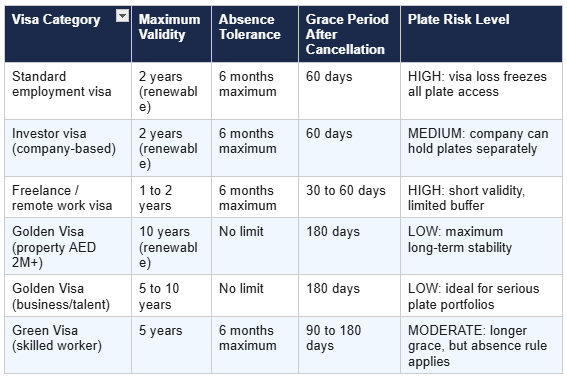
Eligibility thresholds for the Golden Visa are now well-established. Property investors need to own real estate worth AED 2 million or more. Business investors need AED 2 million in company capital or public investments. Skilled professionals in fields like medicine, science, engineering, and technology can qualify through employer nomination. The cost of obtaining the visa itself typically ranges from AED 2,800 to AED 4,800 including medical, Emirates ID, and processing fees.
For someone who already owns AED 500,000 or more in plates and is considering a property purchase in Dubai or Abu Dhabi, the Golden Visa is not just a residency tool. It is plate insurance. It removes the one structural vulnerability that makes expat plate ownership riskier than citizen plate ownership. And the combination of a property asset (generating rental yield) plus a plate portfolio (appreciating tax-free) creates a diversified UAE asset base that works across multiple time horizons.
8. First-Time Buyer Roadmap: From Zero to Plate Owner in 6 Steps
If you are an expat who has never bought a plate before and you want to start, here is exactly what to do. No steps skipped, no assumptions made.
Step 1: Confirm your eligibility
Verify that your Emirates ID is valid and your residence visa is active. If your ID is expiring within three months, renew it first through the ICP Smart Services portal. Check your visa status through the ICP website or GDRFA Dubai if you are based in Dubai. This takes two minutes online and eliminates the risk of a rejected transaction later.
Step 2: Open a traffic file (if you do not have one)
Most expats who drive already have a traffic file from their vehicle registration or driving licence. If you do not, visit any RTA service centre in Dubai (Umm Ramool, Al Barsha, or Deira are the busiest but most efficient) or any traffic department in your emirate. Bring your Emirates ID. The process takes five minutes and there is no charge. This file is where your plate will be registered.
Step 3: Research the market and set a budget
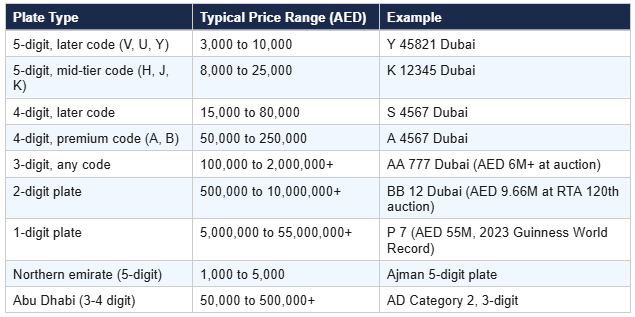
Before you spend anything, understand what plates cost. Use the plate calculator to estimate values based on emirate, letter code, and digit count. Here are real price ranges to calibrate your expectations:
Step 4: Choose your buying channel
You have three options. RTA auctions happen regularly and offer 300+ plates per event, but prices can escalate quickly in competitive bidding. The RTA's December 2025 auction (the 120th) generated AED 109 million in total sales, with the top plate (BB 12) selling for AED 9.66 million. Marketplaces like LicensePlate.ae carry 60,000+ listings from private sellers across all seven emirates, typically at prices below auction heat. Private direct sales offer the most negotiation room but carry higher fraud risk. Our detailed comparison of all three channels breaks down exactly when each option makes sense.
Step 5: Verify the plate and complete the purchase
Before transferring any money, verify that the plate is legitimately owned by the seller. Ask to see their Emirates ID and plate documentation. Check that the plate number matches what is listed. Never send money to a third-party account. The UAEFIU reported AED 1.2 billion in fraud losses between 2021 and 2023, and plate scams are a known category. Our scam prevention guide details every red flag and verification step.
Step 6: Complete the transfer and document everything
In Dubai, both parties authenticate via UAE Pass in the Dubai Drive app and complete the transfer digitally. The fee is AED 120. In Abu Dhabi, visit an ITC customer centre or use the TAMM platform. For other emirates, visit the local traffic department with both parties present. After the transfer, you receive a confirmation via SMS or email. Your traffic file updates to show the plate under your Emirates ID.
Save every document: the Sales Purchase Agreement, the transfer certificate, any payment receipts. If you purchased the plate as an investment, photograph the confirmation screen and file it with your financial records. These documents are your proof of ownership if any dispute arises.
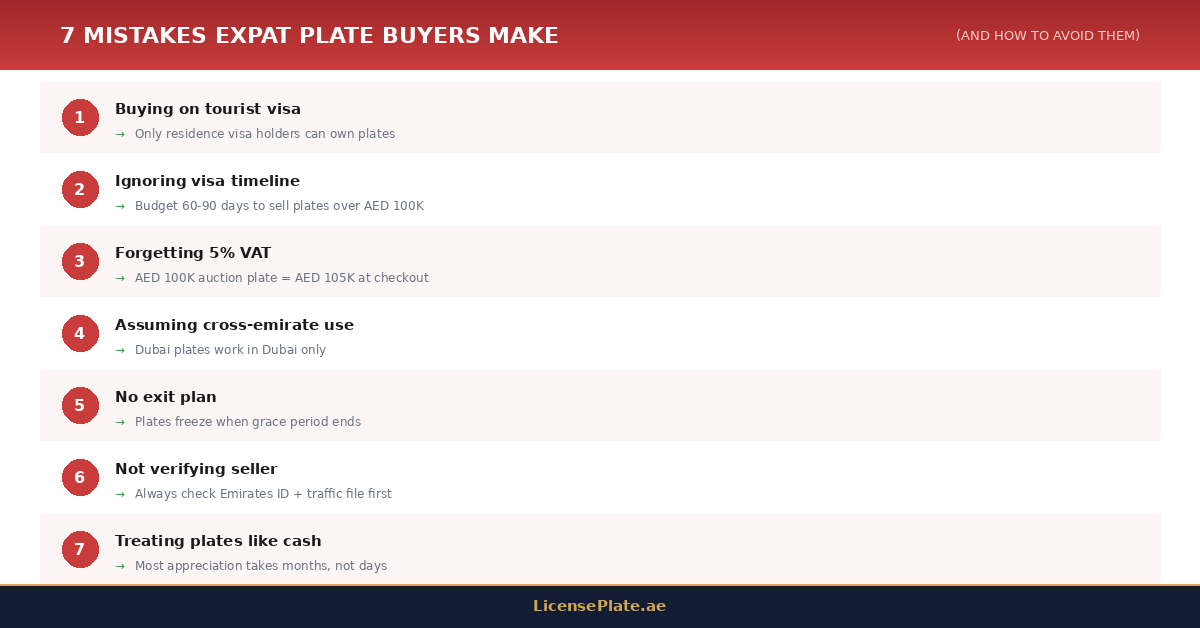
9. Seven Mistakes Expat Plate Buyers Make (and How to Avoid Them)
Having covered the entire process, here are the errors that cost real people real money.
Mistake 1: Attempting to buy on a tourist visa
It cannot be done. The registration system requires an active Emirates ID linked to a residence visa. If a seller or broker tells you they can "arrange" a purchase before your residency is processed, they are either confused or running a scam. Walk away.
Mistake 2: Ignoring the visa timeline
If your employment contract is ending in three months and you buy a plate worth AED 200,000, you have a window of roughly three months plus a 60-day grace period to sell. That sounds generous until you realise that high-value plates require finding the right buyer at the right price. Budget 60 to 90 days of listing time for plates over AED 100,000. Do not buy what you cannot sell within your remaining visa runway.
Mistake 3: Forgetting the 5% VAT on auction purchases
RTA auction prices are quoted before VAT. A plate that sells for AED 100,000 will cost AED 105,000 at checkout. For a AED 9.66 million plate like BB 12 at the December 2025 auction, that is an extra AED 483,000. Private sales between individuals do not attract VAT, which is one reason marketplace prices sometimes look lower than auction results for comparable plates.
Mistake 4: Assuming cross-emirate plate portability
A Dubai plate cannot be used on a vehicle registered in Abu Dhabi. A Sharjah plate cannot be used on a Dubai-registered car. If you relocate between emirates and want to keep driving the same car, you need to either re-register the vehicle in the new emirate (which involves exporting it from the old emirate and importing it to the new one) or sell the current plate and buy one in the new emirate. The plates themselves are permanently tied to their issuing emirate.
Mistake 5: No exit plan for plates
We covered this extensively in Section 5, but it bears repeating here because the financial consequences are severe. An AED 300,000 plate that becomes administratively locked because you left the country without transferring it is an AED 300,000 loss until you can re-enter the UAE and resolve it. Treat plates like any financial asset: have a liquidation or transfer plan before circumstances force your hand.
Mistake 6: Not verifying seller identity
Plate fraud exists in the UAE. The Federal Decree-Law No. 34/2021 on combating rumours and cybercrimes carries penalties up to AED 1 million and imprisonment for fraud. But penalties after the fact do not get your money back. Always verify the seller's Emirates ID, confirm the plate appears in their traffic file, and complete the transaction through official channels (RTA service centre, Dubai Drive app, or equivalent). Never pay a deposit to a WhatsApp number.
Mistake 7: Treating plates as liquid as cash
Plates appreciate over time. Three-digit plates have shown 5% to 8% annual growth historically. But they are not cash equivalents. Selling a plate takes days to weeks, not minutes. If you need liquidity in 48 hours, a plate is not the answer. Buy plates with money you can afford to have tied up for months or years. That patience is what generates the returns.
10. Frequently Asked Questions
Can a tourist buy a number plate in the UAE?
No. You must hold a valid UAE residence visa and Emirates ID. Tourist visa holders and visit visa holders cannot register vehicles or own plates in any emirate.
Do expats pay more for plates than UAE nationals?
No. Pricing is identical regardless of nationality. At RTA auctions, the bidding process is open and transparent. In private sales, price is negotiated freely. There is no surcharge, foreigner premium, or restriction based on passport.
Can I own plates in multiple emirates simultaneously?
Yes. Your Emirates ID works across all seven emirates. You can hold a Dubai plate, an Abu Dhabi plate, and a Sharjah plate at the same time. Each is registered in the respective emirate's traffic file, but all are linked to your single Emirates ID.
What is the cheapest plate an expat can buy?
Five-digit plates with later letter codes in Dubai (V, U, Y) start at AED 3,000 to AED 8,000 on the secondary market. Northern emirate plates (Ajman, Fujairah, UAQ) can be found for under AED 2,000. The price floor depends on the emirate, digit count, and letter code.
Can my spouse own a plate under my visa sponsorship?
Yes, as long as your spouse has their own Emirates ID. Dependents on family visas receive their own Emirates ID and can own plates independently. The plate registers under their individual traffic file, not yours. Children under 18 cannot own plates because they do not hold an independent Emirates ID.
What happens if my employer cancels my visa unexpectedly?
You retain plate ownership during the grace period (60 days for most employment visas, up to 180 days for Golden Visa holders). During this window, your Emirates ID remains active and you can sell or transfer plates normally. After the grace period, your traffic file may be frozen. Act quickly.
Can I buy a plate at auction and resell it immediately?
There is no mandatory holding period or resale restriction. Technically, you can buy a plate on Monday at auction and list it for sale on Tuesday. Whether you will find a buyer quickly at a higher price depends on the plate and market conditions. Most value appreciation occurs over months or years, not days.
Is plate ownership documented in a way that banks and authorities recognise?
Yes. In Dubai, the RTA maintains a digital record in your traffic file, accessible through the Dubai Drive app. In Abu Dhabi, the September 2025 reforms introduced formal ownership certificates for distinguished plates. These documents function as legal proof of ownership and can be used for asset declarations, inheritance planning, or financial due diligence.
Do I need a UAE bank account to buy a plate?
For RTA auctions, you need a payment method for the security deposit and final price (typically a UAE credit card or certified cheque). For private marketplace purchases, payment terms are negotiated between buyer and seller. International bank transfers are accepted by some sellers. A UAE bank account is practical but not strictly mandatory for every transaction type.
Delete Comment?
Are you sure you want to delete this comment? This action cannot be undone.
Delete Article?
Are you sure you want to delete this article? This will also delete all comments. This action cannot be undone.