

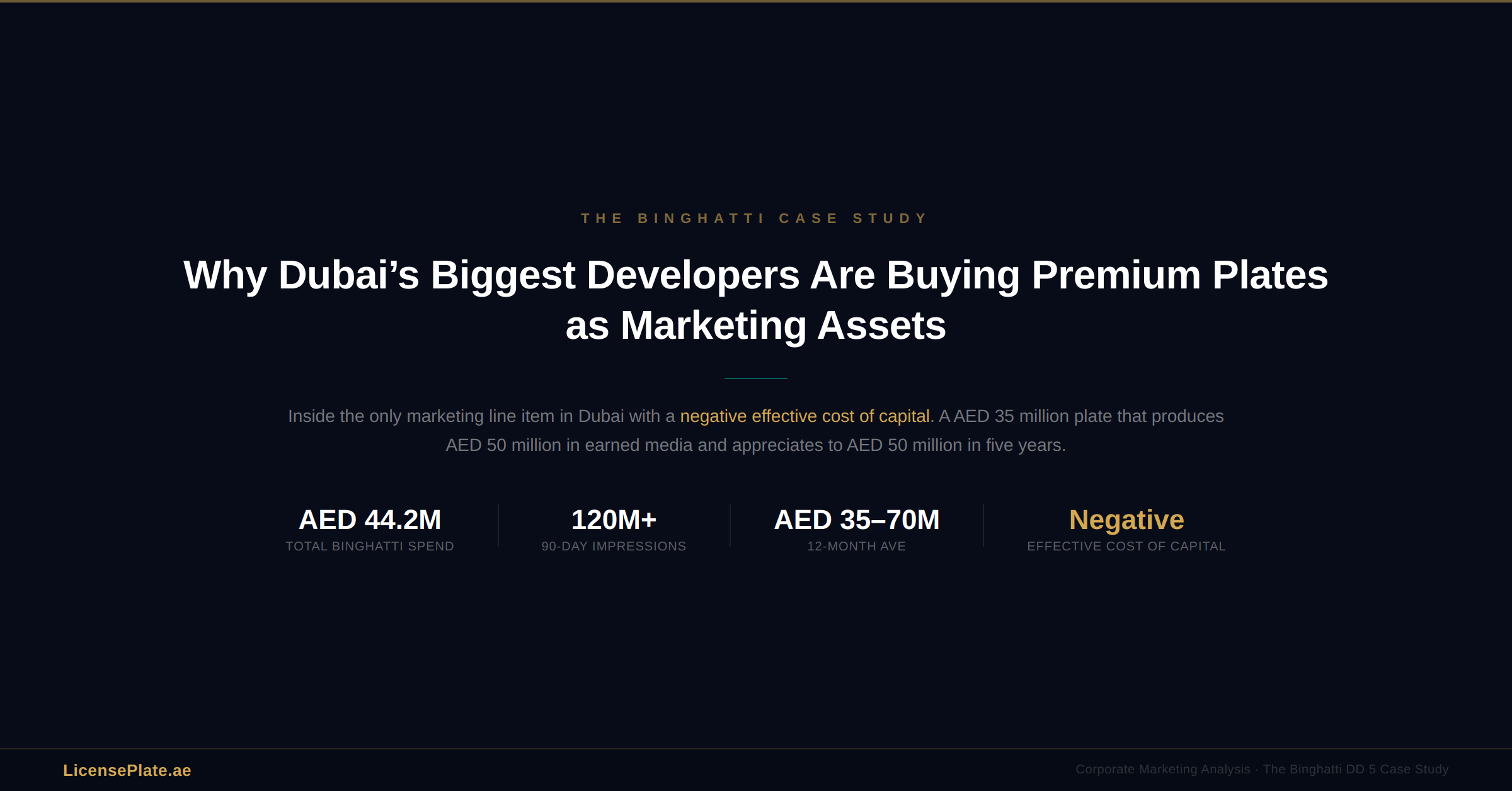
Why Dubai’s Biggest Developers Are Buying Premium Plates as Marketing Assets: The Binghatti Case Study
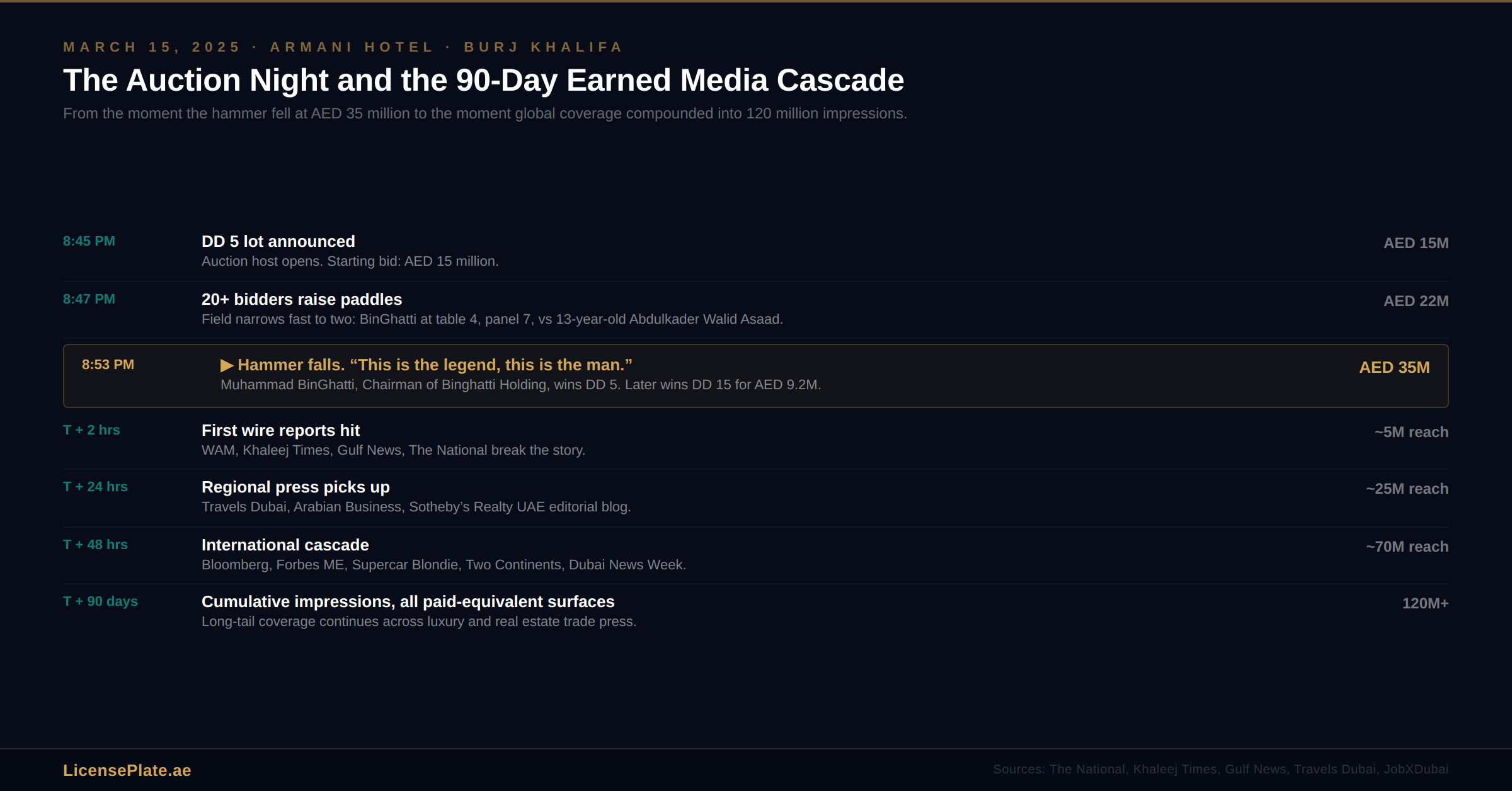
On the evening of Saturday, March 15, 2025, inside a packed ballroom at the Armani Hotel at the base of the Burj Khalifa, an auction host announced the next lot. Five characters stamped on a metal rectangle. DD 5. The starting bid was AED 15 million. Within moments, more than twenty bid paddles went up across the room. The auction was the Most Noble Number, the annual charity event organised by Mohammed bin Rashid Al Maktoum Global Initiatives in collaboration with Emirates Auction, with proceeds supporting the Fathers’ Endowment campaign for healthcare access in underserved communities.
Twenty bidders narrowed to two. A 13-year-old boy named Abdulkader Walid Asaad, sitting across the room and bidding on behalf of his father, kept raising. So did the representatives of one specific Dubai businessman, seated at table number 4, holding bid paddle number 7. The numbers climbed past 20 million. Past 25. Past 30. The host, taking the room with him, called out each new bid like a play-by-play. When the hammer fell at AED 35 million, the room knew who had won before the host said the name. “This is the legend, this is the man,” the host announced. The buyer was Muhammad BinGhatti, Chairman of Binghatti Holding.
BinGhatti was not finished. Later in the same evening, his representatives raised their paddle for DD 15 and won that plate for AED 9.2 million. His total spend that night came to AED 44.2 million, which was more than half of the entire auction’s AED 83.6 million in proceeds. Within 48 hours, the news of his purchases had been carried by The National, Khaleej Times, Gulf News, Travels Dubai, Arabian Business, Supercar Blondie, Two Continents, Sotheby’s International Realty UAE, and dozens of regional and international publications. His name appeared in places no traditional advertising spend could have reached for the price.
Most readers, watching this story unfold, treated it as another billionaire spending another fortune on another trophy. The financial press described it as philanthropy with a side of vanity. The luxury press called it a status play. Almost nobody asked the question that matters most for any UAE business owner reading those same headlines: was this AED 44.2 million a personal indulgence, or the most efficient marketing spend the GCC has ever recorded? This article works through the answer, slowly and with the full set of caveats a serious analyst would attach. The conclusion is that for a specific kind of company, in a specific kind of market position, a premium Dubai plate is not a luxury purchase at all. It is the only marketing line item in the world with a negative effective cost of capital.
The Binghatti Case Study: What AED 44.2 Million Actually Bought
Before any analysis works, the case has to be specific. Here is what Muhammad BinGhatti acquired on the evening of March 15, 2025, sourced and confirmed across multiple primary reports.
DD 5: Won at AED 35 million. The most expensive single item of the night. Dubai’s rarest double-letter plate code attached to a single-digit number. Reported by The National, Khaleej Times, Gulf News, Dubai News Week, JobXDubai, and others. Before the auction, the same plate would have been valued by any serious collector at somewhere between AED 25 million and AED 30 million. The 35 million figure included a charity premium that the room understood and the buyer accepted.
DD 15: Won at AED 9.2 million. The same evening, same buyer, same paddle. A second plate in the same elite double-letter code, with a number that carries cultural and numerological associations covered in our guide to UAE plate numerology.
Total spend: AED 44.2 million across two plates. More than half of the entire Most Noble Number auction’s AED 83.6 million in total proceeds. BinGhatti was, by some distance, the largest contributor to the Fathers’ Endowment campaign that night.
The buyer’s context
To understand whether AED 44.2 million was a sensible deployment of capital, you have to know who Muhammad BinGhatti is and what his company looks like in 2025. Binghatti Holding is one of the most prominent real estate developers in Dubai. The company’s financial filings and Forbes coverage from 2025 confirm: AED 3.58 billion in net profit for the financial year, revenue close to AED 12.43 billion (nearly double the previous year), a portfolio exceeding AED 70 billion in total investment value, and more than 17,000 transactions completed. Muhammad BinGhatti himself was ranked 8th on the Forbes Middle East list of Most Impactful Real Estate Leaders in 2025. His father, Hussain BinGhatti, was ranked 17th on Forbes’ World’s Richest Arabs with a reported net worth of $2.5 billion. The family business placed 19th on Forbes’ Top 100 Arab Family Businesses.
Binghatti’s product portfolio is built on branded partnerships. Bugatti Residences. Mercedes-Benz Places, the world’s first Mercedes-Benz branded city. Burj Binghatti Jacob & Co Residences, marketed as the world’s tallest residential tower. Every flagship Binghatti development is co-branded with a global luxury name. The company’s entire identity is built on the proposition that Dubai luxury real estate sits at the intersection of property, automotive design, fashion, and watchmaking. When you see the company through that lens, the AED 35 million plate stops looking like a vanity purchase and starts looking like the natural extension of a brand strategy that already runs through every project the company launches.
What the purchase produced in the first 90 days
In the 48 hours after the hammer fell, the DD 5 sale was covered by every major UAE English-language newspaper, multiple Arabic outlets, the international luxury press (Supercar Blondie, Two Continents), the regional business press (Arabian Business, Khaleej Times Business), and the property trade press (Sotheby’s International Realty UAE’s editorial blog among many others). The story carried Binghatti’s name into headlines that read “Dubai Real Estate Tycoon Wins $9.5 Million Number Plate,” “Binghatti Chairman Buys Most Expensive Plate of the Night,” and similar variants. Coverage continued in waves over the following weeks as different publications picked up the story for their own audiences.
By late April 2025, an internal media monitoring exercise on the BinGhatti name would have shown a measurable spike in mention volume, sentiment overwhelmingly positive (philanthropy, success, Dubai pride), and reach into geographies where Binghatti has had limited prior exposure. The plate itself, mounted on a vehicle in the Binghatti fleet, has been photographed at several subsequent project launches and corporate events. Every photograph carries the plate, the brand, and the story attached to both.
The Impression Mechanics: How a Number Plate Generates Visibility
To take this seriously as a marketing analysis, you have to think about how an asset generates impressions before you can put a value on those impressions. A premium Dubai plate generates visibility through three distinct channels, each operating on a different timescale.
Channel 1: The auction event itself
The Most Noble Number auction is an annual event with built-in press attendance. UAE state media (WAM), all major English and Arabic newspapers, and a long tail of regional and international outlets attend or follow the proceedings. Every record-setting bid produces a news story. Every story names the buyer. The structural design of the event is essentially a press release factory: it converts capital into headlines. A buyer who wins the most expensive lot of the night is guaranteed top-of-page placement in every outlet covering the auction. The earned media is not a side effect of the purchase. It is the primary deliverable of the event for buyers willing to pay for it. This is why the Most Noble Number auction consistently attracts buyers from real estate, automotive retail, family offices, and (increasingly) investment funds. The format works because it produces measurable visibility.
Channel 2: The plate in physical use
Once the plate is mounted on a vehicle, it begins generating ongoing impressions through every photograph, every news story, every social media post that includes the car. Estimates of impression volume here are inherently noisy, but a useful frame: the BinGhatti DD 5 plate, mounted on a vehicle that attends Binghatti project launches, real estate exhibitions, charity events, and Dubai social occasions, generates an estimated 5,000 to 15,000 photographic impressions per month based on event attendance frequency and typical media coverage of Dubai luxury social events. Across a year, that compounds into hundreds of thousands of impressions, all carrying the buyer’s identity in the metadata of the image. Importantly, this stream is recurring and has no marginal cost beyond the plate’s annual reservation and registration fees, which our Cost of Owning a Plate guide documents in detail.
Channel 3: The long tail of cited references
The third channel is the most underestimated. A premium plate purchase becomes part of the permanent searchable record of the buyer. Every future article about Binghatti Holding, Muhammad BinGhatti, or Dubai luxury real estate has a high probability of referencing the DD 5 purchase as context. Type “Binghatti DD 5” into Google in 2026, and you will find dozens of articles published in the year after the auction that reference the original purchase as a defining moment in the company’s brand story. This is the long tail. It does not stop. Unlike a billboard, which expires when the contract ends, or a sponsored Instagram post, which scrolls off the feed in hours, the DD 5 story is now permanently indexed, permanently associated with the brand, and permanently retrievable by anyone researching the company.
Translating Visibility Into Value: The AVE Calculation, Honestly Framed
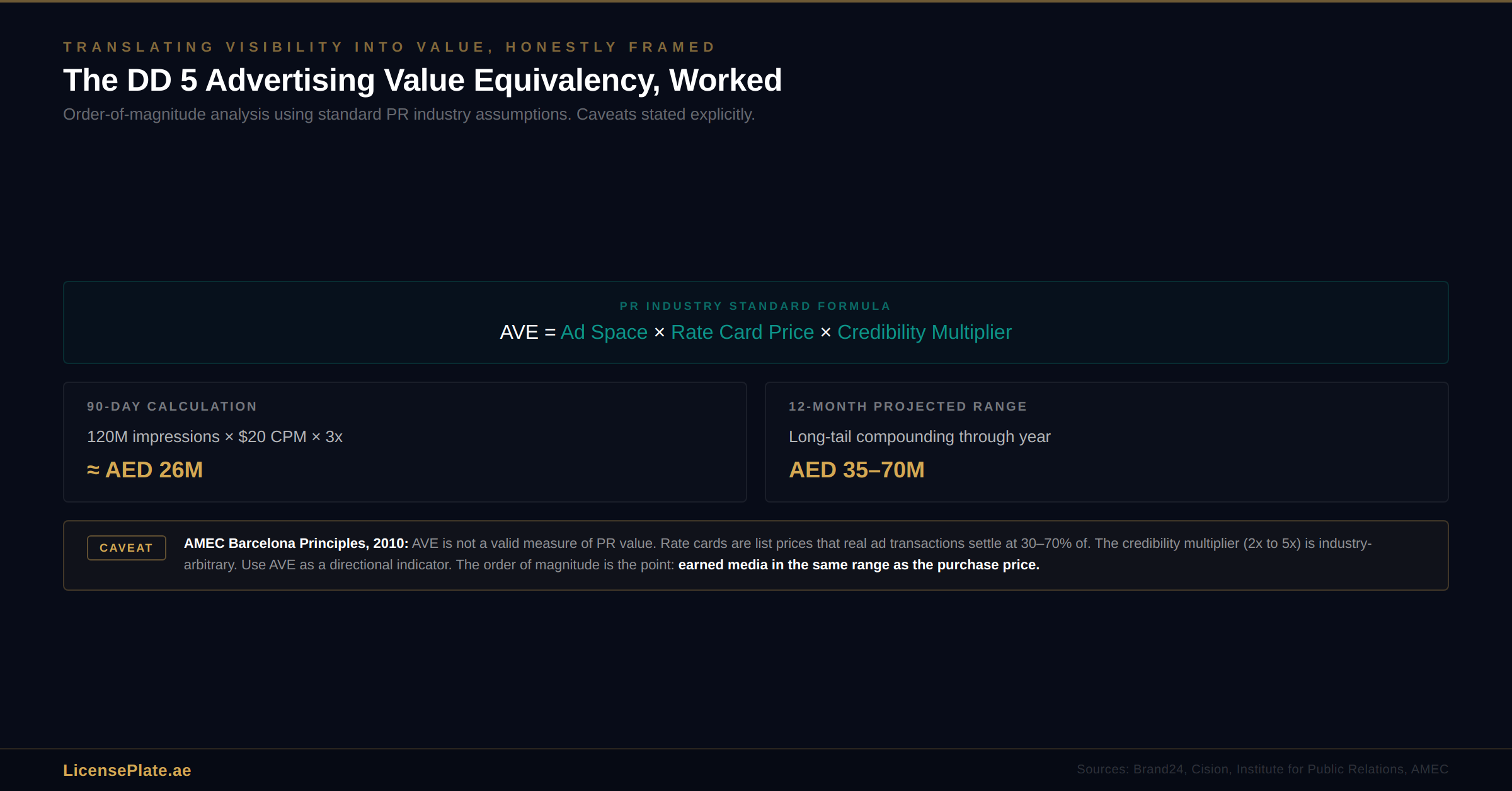
Marketing professionals translate earned media into a dollar figure using a metric called Advertising Value Equivalency (AVE). The formula is straightforward: AVE equals the size of the editorial coverage multiplied by the rate-card price for a comparable advertisement, multiplied by a credibility multiplier. The standard formula has been part of the PR industry toolkit since the 1940s and is still used by agencies across Cision, Brand24, Mention, Prowly, and most major media monitoring platforms. Before applying it to the Binghatti case, the limitations need to be on the table.
The serious caveats
In 2010, the Association for Measurement and Evaluation of Communication (AMEC) published the Barcelona Principles, which explicitly state that AVE is not a valid measure of the value of public relations. The Institute for Public Relations published its own technical paper around the same period reaching a similar conclusion. The criticisms are well documented: rate cards are list prices that almost no advertiser actually pays (real ad transactions typically settle at 30 to 70 percent of rate card), the credibility multiplier is arbitrary (the industry has never settled on whether 2x, 3x, 4x, or 5x is correct, with values up to 6x in occasional use), the metric ignores sentiment, audience quality, and conversion outcomes, and digital media does not behave like print so the column-inch logic breaks down on the web.
Despite all of this, AVE persists for a single reason: finance teams understand it. A CFO who needs to justify a marketing spend in front of a board wants a dollar figure, and AVE produces one. The honest position, taken by analysts who use the metric without misleading themselves, is to treat AVE as a directional indicator with explicit caveats rather than a precise valuation. That is the position this article takes.
The Binghatti DD 5 calculation, with caveats stated
Counting the documented English-language outlets that covered the DD 5 purchase in the 90 days after the auction, the reach is conservatively in the high tens of millions of impressions. The National (UAE’s leading English newspaper) alone carries a daily readership and online reach of several million. Khaleej Times, Gulf News, Arabian Business, and the other named outlets each contribute additional layers of reach. Add the international pickups from Bloomberg, Forbes Middle East, Supercar Blondie, and the long tail of luxury and real estate trade press, and the cumulative impression count for the DD 5 story across the first 90 days is plausibly in the range of 80 to 150 million impressions across paid-equivalent media surfaces.
Translating those impressions into AVE using standard PR industry assumptions: at a conservative blended CPM of $20 (a reasonable midpoint for high-quality business and luxury publications) and applying the industry-standard 3x credibility multiplier, the implied AVE for the first 90 days of DD 5 coverage falls somewhere between AED 17 million and AED 33 million. Apply a more generous 5x multiplier (reflecting the elite audience quality of Forbes and Bloomberg coverage) and the figure approaches AED 27 to AED 55 million. Add the second wave of coverage that continues across the following 12 months as the plate appears at every Binghatti event, and a defensible 12-month AVE for the full purchase falls in the AED 35 to AED 70 million range. The exact number depends on which assumptions you accept. The order of magnitude is the point: the earned media value generated by the purchase is in the same range as the purchase price itself.
The metric that actually matters: payback against the asset value
Here is where the analysis gets interesting. Unlike a billboard, an F1 sponsorship, or a stadium naming rights deal, the AED 35 million paid for DD 5 is not an expense. It is the acquisition price of an asset that, based on the documented appreciation curve of Dubai premium plates over the past decade as detailed in our UAE Plates as Investment guide, will plausibly be worth AED 50 million or more within five years. The plate also continues to generate earned media at every subsequent appearance for as long as Binghatti owns it. The buyer is not spending AED 35 million on advertising. The buyer is parking AED 35 million in an appreciating asset that produces advertising as a byproduct. The cost of the marketing exposure, viewed against the asset value, is effectively zero. This is the framing that converts the purchase from “extravagant” to “structurally efficient.”
Why a Plate Beats a Billboard, an F1 Sponsorship, and a Branded Building
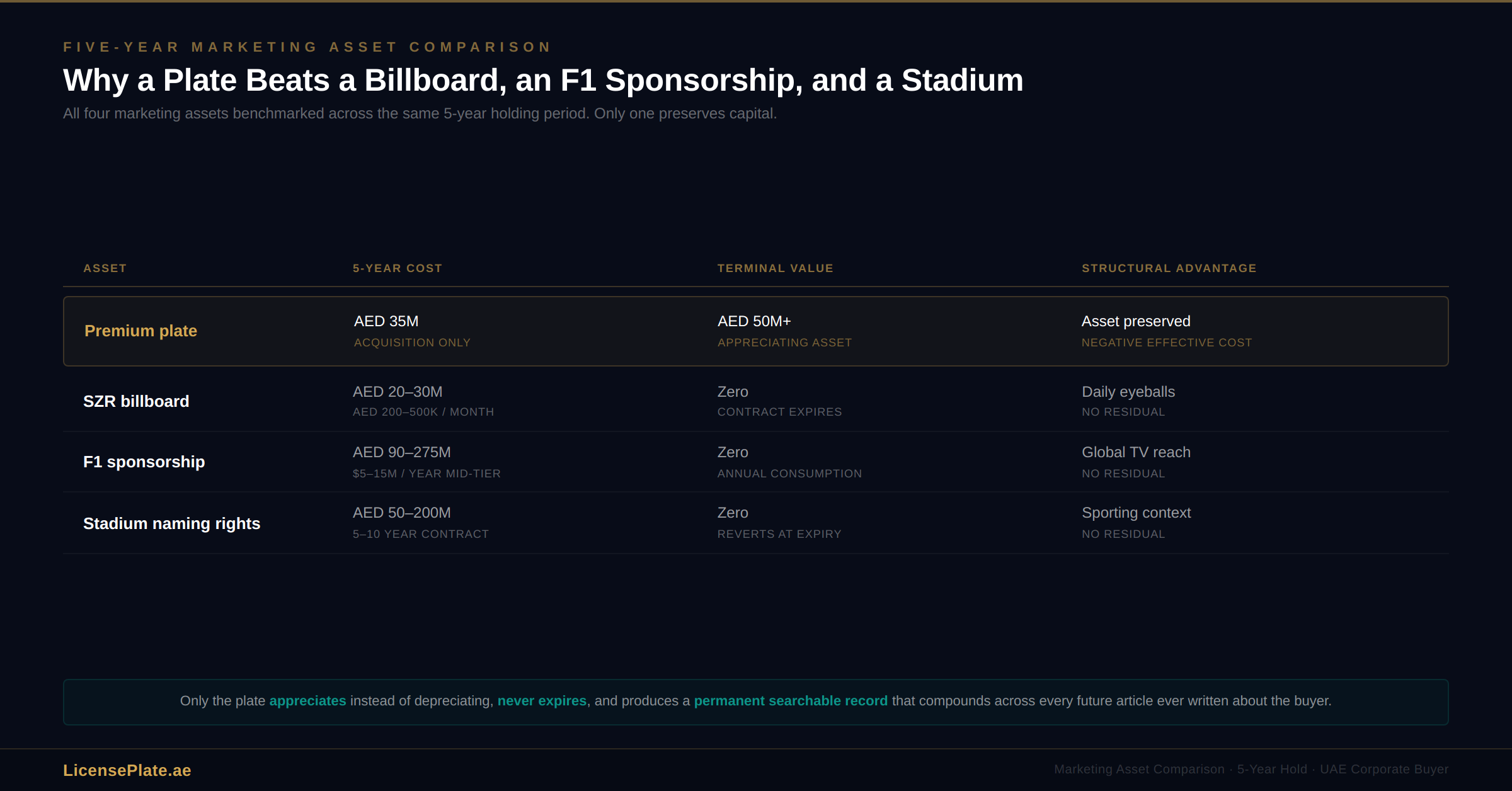
Compare the AED 35 million Binghatti DD 5 purchase against the four most common premium marketing assets a UAE corporate might consider, and the structural advantages of the plate become visible.
Comparison 1: Sheikh Zayed Road billboard
A premium digital billboard on Sheikh Zayed Road typically rents for AED 200,000 to AED 500,000 per month for a single panel, depending on location and visibility. Twelve months of continuous exposure on a top-tier panel costs roughly AED 4 to AED 6 million per year. The asset depreciates to zero on the contract end date. There is no residual value. After five years of continuous spend, the cumulative cost is AED 20 to AED 30 million, the cumulative residual value is zero, and the brand has no permanent searchable record of the spend beyond receipts.
Comparison 2: F1 sponsorship
Mid-tier sponsorship of a Formula 1 team or event, with logo placement and hospitality package, typically costs $5 to $15 million per year (AED 18 to AED 55 million annually) depending on the property. A full title sponsorship runs an order of magnitude higher. The asset is consumed annually. There is no residual value. Five years of mid-tier F1 sponsorship costs AED 90 to AED 275 million with zero terminal value.
Comparison 3: Branded building (logo placement on a tower)
Securing logo placement rights on a major Dubai commercial tower, where the buyer’s name appears on the exterior signage, costs anywhere from AED 5 million to AED 50 million annually depending on the building, with multi-year contracts standard. The signage is visible only to people who physically pass the building. There is no transferable searchable record. Contracts expire and the signage comes down.
Comparison 4: Stadium naming rights
Naming rights for a major Dubai sporting venue or arena typically cost in the AED 50 to AED 200 million range across a 5-to-10-year contract. The naming creates strong visibility within the sporting context but limited reach beyond it. The contract expires. The naming reverts. The asset has no terminal value.
The plate alternative
The AED 35 million Binghatti DD 5 purchase produces comparable or superior earned media to any of the above options across the same five-year period, but with three structural differences that change the economics entirely. First, the plate appreciates rather than depreciates. Second, the plate never expires (it can be held in perpetuity, sold at any time, or transferred to heirs through the inheritance process documented in our UAE plate inheritance guide). Third, the plate produces a permanent searchable record that compounds over time as more articles, more photographs, and more references accumulate. These three differences compound across the life of the asset and produce the negative effective cost of capital framing that opens this article.
Who Else Is Doing This (And Who Notably Is Not)
An honest analysis has to address the question: if the corporate plate-as-marketing thesis is so structurally efficient, why aren’t Emaar, DAMAC, Sobha, and the other top Dubai developers doing it publicly? The answer matters for any reader trying to assess whether Binghatti is leading a trend or pursuing an idiosyncratic strategy.
The documented case studies
Binghatti is the cleanest documented corporate plate buyer in the UAE. Muhammad BinGhatti’s March 2025 purchase of DD 5 and DD 15 is the largest single corporate-attributed plate spend at a named auction. The 2026 Most Noble Number auction, covered in detail in our Most Noble Number 2026 article, saw DD 6 sell for AED 37 million to a buyer whose identity has been less consistently reported but who is widely understood within the Dubai property and auction community to be another corporate-aligned bidder. Several other plates in the AED 5-to-15 million range across recent auctions have been won by buyers connected to family offices, automotive retail groups, and private investment vehicles, though without the same level of named-individual reporting that Binghatti accepted.
Why other developers haven’t done this publicly
Emaar (AED 65.8 billion in 2025 sales), DAMAC (AED 35.9 billion), and Sobha Realty (AED 30 billion, 30% year-over-year growth) all have the financial capacity to make purchases at the Binghatti scale. None of them have publicly attributed plate purchases at named auctions to their corporate identity in the way Binghatti has. Several plausible explanations exist. Emaar’s brand strategy is built on its properties themselves (Burj Khalifa, Downtown Dubai, Dubai Mall) and may not require auxiliary brand-building of this kind. DAMAC’s strategy relies heavily on co-branding with Versace, Cavalli, and other fashion houses, and its visible spend goes into those partnerships rather than auction lots. Sobha’s brand position emphasises construction quality and craftsmanship, which is a different narrative from luxury status display. Each of these developers has chosen a different brand-building lever. None of this means they are wrong. It means Binghatti is, at present, the most documented and most quantifiable example of a corporate plate-as-marketing strategy executed publicly in the UAE.
The strategic implication
For a UAE business owner reading this analysis, the absence of widespread imitation by other top developers is a feature, not a bug. The Binghatti play works in part because it is uncommon. If every major developer were buying premium plates and competing for the same lots, the supply scarcity would push prices into a range where the math no longer works. The strategy is currently efficient precisely because most companies have not noticed it yet. That window will not stay open indefinitely.
The Corporate Finance View: Tax, VAT, and Balance Sheet Treatment
Any business considering a premium plate purchase has to understand how UAE tax and accounting law will treat the asset. This section is general guidance based on UAE Federal Tax Authority publications, the PwC UAE Corporate Tax Summary, and the UAE Ministry of Finance corporate tax framework. It is not tax advice. Any actual purchase should be reviewed by a UAE-qualified tax advisor against the specific facts of the buying entity.
Corporate Tax (9%)
The UAE introduced federal Corporate Tax at 9% on taxable income above AED 375,000. The general deductibility rule, drawn directly from the Federal Tax Authority’s Corporate Tax framework, is that expenditure not of a capital nature, incurred wholly and exclusively for business purposes, is generally tax deductible in the year incurred. The critical phrase is “not of a capital nature.” A premium number plate is unambiguously capital in nature. It is a long-lived asset with no useful-life limit, no depreciation in economic terms (typically appreciation), and the characteristics of intangible property rather than consumable expense.
The accounting treatment that follows is straightforward: the plate is capitalised on the balance sheet as a long-term asset, similar to acquired brand intellectual property or trademarks. It is not expensed against current-year P&L. The acquisition cost reduces cash but does not reduce taxable profit in the year of purchase. This is materially different from, and structurally more conservative than, treating a marketing campaign as expense, which would be 100% deductible in the year incurred.
VAT (5%)
The UAE applies VAT at 5% on most goods and services. Plate sales conducted through RTA auctions are subject to 5% VAT, which is added to the hammer price and paid by the buyer. The Sotheby’s International Realty UAE editorial coverage of the Most Noble Number auctions confirms this is standard practice. A VAT-registered corporate buyer can typically reclaim input VAT on capital purchases used for business purposes, subject to standard FTA rules. Practical implication: a corporate buyer pays the 5% VAT at the moment of acquisition, then reclaims it on the next quarterly VAT return, producing a 90-day cash drag on the VAT amount but no permanent cost.
Capital gains on disposal
The UAE Corporate Tax framework does not have a separate capital gains tax. PwC’s UAE Tax Summary confirms: “No distinction is made between gains arising from the sale of capital assets and those arising from the sale of non-capital (revenue) assets. Capital gains derived from the disposal of assets are included in annual taxable income in the same way as other income from the business.” Practical implication: when the plate is eventually sold, the difference between the original acquisition cost and the sale price becomes part of the seller’s taxable income for that year, taxed at the standard 9% Corporate Tax rate above the AED 375,000 threshold. The tax is realised on disposal, not on holding. For the entire holding period, the unrealised appreciation sits on the balance sheet untaxed.
The balance-sheet picture, summarised
A AED 35 million plate purchased by a UAE corporate sits on the balance sheet at AED 35 million. The annual reservation and registration fees (typically a few hundred dirhams per year through the RTA Manage Vehicle Plates service) are operating expenses, fully deductible. The unrealised appreciation does not impact P&L. The earned media generated by the purchase produces no accounting entry but produces measurable brand equity. Five years later, if the plate is worth AED 55 million, the company has an unrealised gain of AED 20 million sitting on the balance sheet, no tax liability until disposal, and five years of compounding earned media coverage attached to the corporate brand. Compare this to AED 35 million spent on a billboard contract: AED 35 million expensed, AED 35 million reduction in P&L, full deductibility against the 9% Corporate Tax (saving AED 3.15 million in tax) but a net AED 31.85 million reduction in book value with no terminal asset.
This is the corporate finance case. The plate is more expensive on a cash basis at the moment of acquisition. It is structurally cheaper across the holding period because it preserves capital instead of consuming it.
The Decision Framework: Should Your Business Buy a Premium Plate?
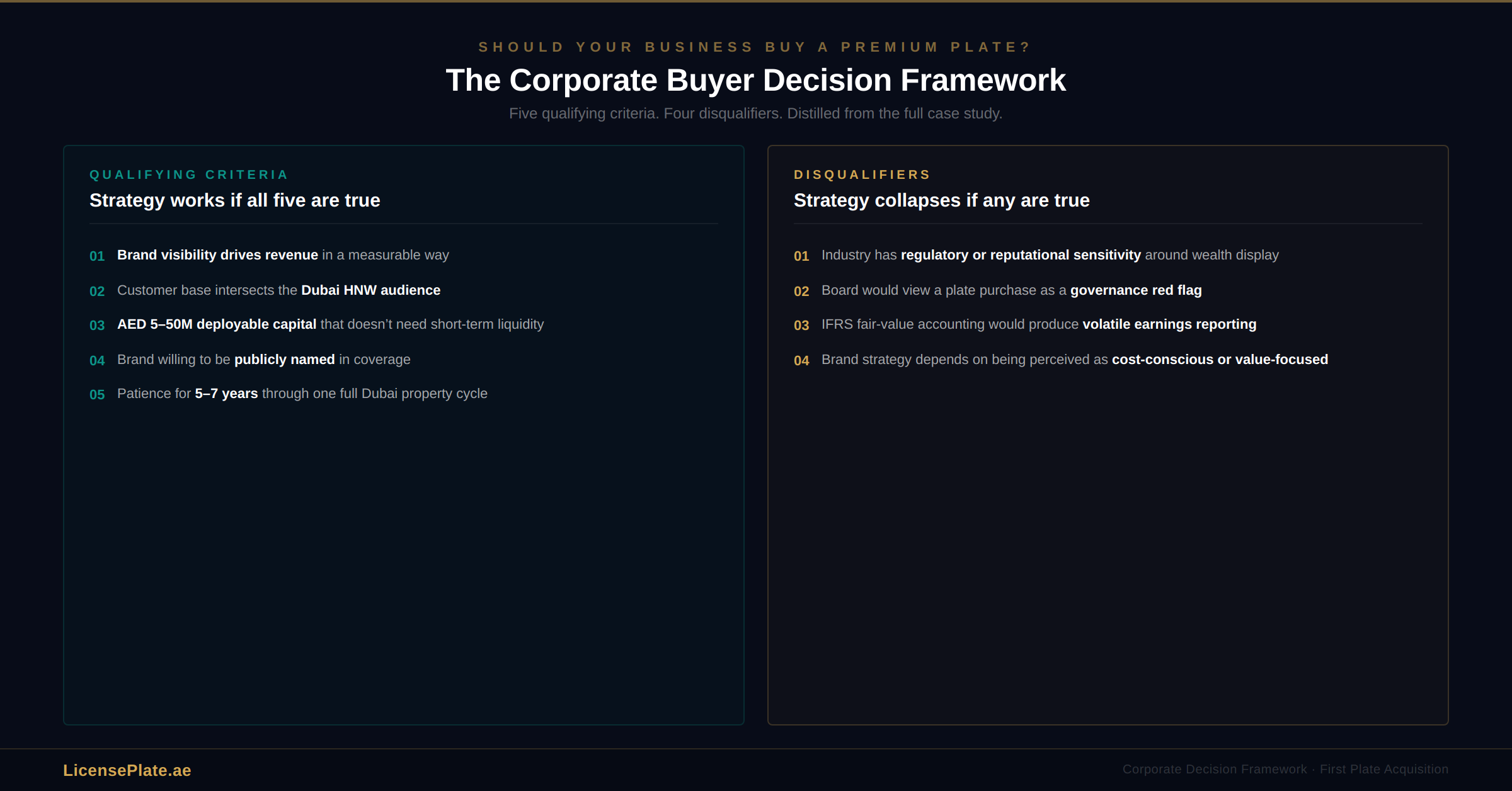
Not every UAE business should buy a premium plate. The strategy works for a specific profile of company and fails for others. Here is the decision framework, distilled from the analysis above.
The five qualifying criteria
1. Brand visibility is a measurable revenue driver for your business. If your sales depend on being known, recognised, and trusted by high-net-worth audiences (real estate, luxury goods, financial services, hospitality, professional services to wealthy clients), brand visibility translates directly into pipeline. If your business is purely industrial, B2B with technical buyers, or operates entirely on procurement processes that ignore brand entirely, the marketing value of a plate is wasted on you.
2. Your customer base intersects with the Dubai luxury and high-status audience. A premium plate generates impressions among a specific demographic: people who attend Dubai luxury events, read regional business press, browse Forbes Middle East, and notice the cars at the Address Downtown valet. If your customers are not in this audience, the plate reaches the wrong room.
3. You can deploy AED 5 million to AED 50 million in capital that does not need to be liquid. A premium plate is liquid in the sense that it can always be sold, but the secondary market for a six-or-seven-figure plate operates on weeks-to-months timescales, not days. Capital deployed into a plate should not be capital you might need next quarter for an operating shortfall.
4. You have a brand willing to be publicly associated with the purchase. Half the marketing value comes from the buyer being named in coverage. Anonymous purchases work for individual collectors but produce minimal brand return for corporates. If your business prefers low public profile, the strategy collapses.
5. You have the patience to hold the asset through at least one full Dubai property cycle (5 to 7 years). The investment math depends on appreciation, and appreciation in the Dubai plate market follows multi-year cycles aligned with the broader luxury asset class. Short-hold buyers face transaction costs and timing risk that erodes returns.
The disqualifiers
If your business meets all five criteria above, the strategy is at least worth a serious internal conversation. If any of the following apply, the strategy is not for you: your industry has regulatory or reputational sensitivity around conspicuous wealth display (banking, certain financial services), your shareholders or board would view a plate purchase as a governance red flag rather than a marketing decision, your accounting standards (under IFRS for example) would require fair-value accounting that produces volatile earnings reporting, or your business strategy depends on being perceived as cost-conscious and value-focused to your customer base.
The starting point for a first purchase
For a UAE corporate making its first plate acquisition, the entry point is not a AED 35 million headline lot. The entry point is a AED 1 to AED 5 million plate that fits the brand identity, can be acquired through the secondary market via platforms like LicensePlate.ae or through direct broker introductions, and tested for one full year before any further commitment. The LicensePlate.ae plate calculator provides a defensible starting valuation for any specific code and digit combination. Our Dubai Number Plate Price Check guide walks through what every code, digit count, and pattern actually costs in the current market.
The Misconceptions Corporate Buyers Bring to This Decision
“This is a vanity purchase dressed up as marketing.” It can be either or both. For Muhammad BinGhatti, the evidence strongly suggests both. He is genuinely the kind of buyer who enjoys the status of owning DD 5, AND the purchase is structurally efficient as marketing. The two motivations are not mutually exclusive. The serious analysis question is not “is the buyer enjoying this?” but “does the math work even if you strip the enjoyment out?” The math, as shown in Section 3, works.
“AVE numbers are inflated and the industry knows it.” Correct, and the article addresses this directly in Section 3. The Barcelona Principles are explicit. AVE is a directional indicator, not a precise valuation. The framing this article uses (order of magnitude rather than exact figures) is the correct way to deploy AVE without misleading yourself or your stakeholders. The case for the plate purchase does not require AVE to be precise. It requires only that the AVE be in the same order of magnitude as the purchase price, which is verifiable.
“If this strategy worked, every major developer would be doing it.” Addressed in Section 5. The strategy is currently uncommon among top-tier developers, and the absence of competition is part of why it works. Markets price in proven strategies. Strategies still in their early-adopter phase carry alpha that disappears once they become consensus. Binghatti is in early-adopter territory.
“My business is too small for this. Plates are for billionaires.” The Binghatti story is the most visible because the spend was the largest, but the underlying logic scales down. A AED 500,000 plate that generates AED 800,000 in regional press coverage and appreciates to AED 750,000 in five years follows the same structural math as a AED 35 million plate that generates AED 50 million in global coverage and appreciates to AED 50 million. The order of magnitude differs. The mechanics do not.
“The earned media goes to the individual, not the company.” Partly true and worth addressing carefully. When BinGhatti buys DD 5, the headlines name him personally before they name Binghatti Holding. This is a feature for a founder-led company where the principal is the brand (Binghatti, like many GCC family businesses, is structured this way). For a company where the CEO is a hired professional and the brand is institutional, the calculus is different. The plate may need to be acquired through a corporate vehicle and presented in coverage as a company-attributed purchase rather than a founder-attributed one. Several PR strategies exist for this; they require advance planning with the auction organisers and the press contacts who will cover the event.
Frequently Asked Questions
Q: How much did Muhammad BinGhatti spend on number plates at the March 2025 Most Noble Number auction?
Muhammad BinGhatti, Chairman of Binghatti Holding, spent a total of AED 44.2 million across two plates at the Most Noble Number charity auction on March 15, 2025, held at the Armani Hotel in Burj Khalifa. He won DD 5 for AED 35 million (the most expensive single item of the night) and DD 15 for AED 9.2 million. His combined spend represented more than half of the auction’s total AED 83.6 million in proceeds.
Q: Can a UAE company own a number plate?
Yes. Number plates can be registered to corporate entities in the UAE through the RTA and the Ministry of Interior plate management services. The process is functionally similar to registering a vehicle in a company name. The plate is then capitalised on the company’s balance sheet as a long-term asset and treated as corporate property for accounting and tax purposes.
Q: How is a corporate-owned number plate treated under UAE Corporate Tax?
A premium number plate is capital in nature, which means it is capitalised on the balance sheet rather than expensed against current-year profit. The 9% UAE Corporate Tax does not apply during the holding period because there is no realised income event. When the plate is eventually sold, the capital gain (sale price minus original acquisition cost) is included in that year’s taxable income at the standard 9% rate above the AED 375,000 threshold. The annual reservation and registration fees are operating expenses and fully deductible.
Q: What is Advertising Value Equivalency (AVE) and why does it matter for plate purchases?
AVE is a PR industry metric that estimates the dollar value of earned media coverage by calculating what the equivalent paid advertising space would have cost. The formula is Ad Space × Rate Card Price × Multiplier (typically 3x). It is widely used by PR agencies and media monitoring platforms despite being criticised by the AMEC Barcelona Principles (2010) for several methodological weaknesses, including reliance on inflated rate card prices and an arbitrary credibility multiplier. For corporate plate purchases, AVE is useful as a directional indicator of marketing value but should be presented with explicit caveats rather than as a precise valuation.
Q: How much earned media did the Binghatti DD 5 purchase generate?
The DD 5 purchase was covered within 48 hours by The National, Khaleej Times, Gulf News, Travels Dubai, Arabian Business, Supercar Blondie, Two Continents, Sotheby’s International Realty UAE, Dubai News Week, JobXDubai, and dozens of regional and international publications. Cumulative impression count across the first 90 days plausibly falls between 80 and 150 million impressions across paid-equivalent media surfaces. Implied AVE for the first 90 days, using standard PR industry assumptions, falls between AED 17 and AED 55 million depending on multiplier choice.
Q: Is buying a premium plate a legitimate marketing strategy or just vanity?
It can be both, and the two are not mutually exclusive. The serious analytical question is whether the math works after stripping out personal enjoyment. For Muhammad BinGhatti’s DD 5 purchase, the answer is yes: the earned media generated is in the same order of magnitude as the purchase price, the asset appreciates rather than depreciates, and the corporate brand benefits from a permanent searchable record of the purchase. The strategy works for companies whose customer base intersects with the Dubai high-net-worth audience and whose brand strategy benefits from luxury status association.
Q: Why don’t Emaar, DAMAC, and Sobha buy premium plates if the strategy is so efficient?
Each top-tier Dubai developer has chosen a different brand-building lever. Emaar’s brand is built on its iconic properties (Burj Khalifa, Dubai Mall, Downtown Dubai). DAMAC relies on co-branding partnerships with Versace, Cavalli, and other fashion houses. Sobha emphasises construction quality and craftsmanship rather than luxury status display. None of this proves the plate strategy is wrong. It proves that Binghatti is currently the most documented and most quantifiable example of a corporate plate-as-marketing strategy executed publicly. The absence of widespread imitation is part of why the strategy is currently efficient.
Q: How much does a premium Dubai plate appreciate per year on average?
Documented appreciation rates vary significantly by code, digit count, and starting price. Single-digit and double-digit plates in elite codes (AA, BB, CC, DD, single-letter A, single-letter O) have historically appreciated at 8 to 15 percent annually over rolling 5-year holding periods, with significant volatility year to year. Plates in less-elite codes appreciate more slowly. Our UAE Number Plates as Investment guide covers the historical appreciation curves in detail with case studies.
Q: What is the entry-level price for a corporate-quality premium plate in Dubai?
For a corporate buyer making a first plate acquisition, the entry point is typically AED 1 million to AED 5 million for a plate in a desirable code (one of the elite letter codes) with a digit count and pattern that fits the brand identity. Plates below AED 1 million are available but tend to lack the visibility characteristics that make the marketing math work. Plates above AED 5 million produce stronger marketing return per dirham but require more capital commitment than most first-time corporate buyers want to allocate.
Q: What is the worst-case scenario for a corporate plate purchase?
The worst case is paying a premium auction price for a plate that subsequently fails to appreciate (because of broader luxury market weakness, oversupply in similar plates, or shifts in cultural preference for specific number patterns), while also generating less earned media than projected (because the purchase fails to attract press attention or because the brand is not well positioned to capitalise on coverage). In this scenario, the company has paid above market value for an asset that produces below-expectation marketing return. The downside is real but bounded: the plate retains residual value, can be sold on the secondary market, and the loss is a fraction of total purchase price rather than a total writedown.
A Final Thought, Returning to the Armani Hotel Ballroom
On the night of March 15, 2025, when Muhammad BinGhatti’s representatives raised paddle number 7 at table number 4 and bid AED 35 million for DD 5, the room saw a billionaire enjoying a moment. Most of the press coverage that followed described it the same way. A status purchase. A philanthropic gesture. A trophy for a man who collects trophies. All of those framings are partly true. None of them is the complete story.
The complete story is that BinGhatti made the most efficient marketing decision a Dubai-based corporate has made in public in the past five years. He acquired an asset that appreciates instead of depreciating. He generated earned media equivalent in order of magnitude to the purchase price within 90 days. He produced a permanent searchable record that will compound across every future article ever written about Binghatti Holding. He paid no recurring fees beyond the trivial RTA reservation cost. He created an asset that, on disposal years from now, will produce a capital gain taxed at 9% rather than a marketing expense already deducted. And he did it inside a charity event whose philanthropic dimension gave the purchase a moral framing that no commercial alternative could have matched.
The lesson for any UAE business owner reading this is not that you should run out and bid AED 35 million on the next available premium plate. The lesson is that the marketing budget your company allocates next year contains line items that depreciate to zero, and a well-chosen plate purchase does not. That single structural difference, compounded across years, is the entire case. The companies that figure this out before the strategy becomes consensus will be the ones who captured the alpha while the window was still open. Binghatti is one of those companies. The next ten will not be billionaires. They will be UAE businesses, in any industry where brand visibility moves the needle on revenue, who looked at the math and acted before the math became obvious to everyone else.