

What Happens to a Number Plate When the Owner Dies: The UAE Inheritance Guide for Heirs and Current Owners
A widow walks into the RTA Customer Happiness Centre in Umm Ramool with three documents in a plastic folder: her late husband’s Emirates ID, a copy of his death certificate, and a printout of a marketplace listing showing a Dubai plate registered in his name with an asking price of AED 240,000. She sold their car six months ago. The plate stayed under his traffic file, where her husband had left it parked while he looked for the right buyer. He passed in his sleep at 54.
She is calm. She has read enough Khaleej Times articles to know that her husband’s estate falls under Federal Decree-Law No. 41 of 2022, the personal status law for non-Muslims that the UAE introduced in 2023. She knows about the equal-shares default. She has the marriage certificate at home. What she does not know, and what nobody at the front desk has told her in the language she needs to hear it in, is that none of this will help her transfer the plate today. The RTA does not adjudicate inheritance. The RTA executes court orders. And the court order she needs has not been issued yet.
This guide covers what happens between the moment of death and the moment a plate is legally back in someone’s name. It is written for two readers: heirs who are facing this situation right now, and current plate owners who want to spare their families the friction. Plate values have crossed the threshold where inheritance matters. DD 5 sold for AED 35 million in 2025. DD 6 sold for AED 37 million in 2026. Even a mid-market three-digit plate trades around AED 200,000. The asset is meaningful. The process is solvable. Most people only learn the order of operations after they have already missed a step.
How UAE Inheritance Law Actually Treats a Number Plate in 2026
A number plate is personal property. It is registered in the deceased’s traffic file as an asset under their name, transferable, valued, and movable on death like any other titled asset. The legal framework governing its devolution depends on two things: whether the deceased was a Muslim or a non-Muslim, and whether they had a registered will.
For Non-Muslim Expats (the Reform Most People Missed)
Until February 2023, non-Muslim expats faced an awkward default. UAE law presumed Sharia inheritance principles would apply unless the heirs actively requested the application of the deceased’s home country law under Article 17(1) of the Civil Transactions Law (Federal Law No. 5 of 1985). That request had to be filed with the court, supported by translated and attested documents from the home country, and adjudicated. It worked, but it took time, and many families never knew the option existed.
Federal Decree-Law No. 41 of 2022, effective February 1, 2023, changed the default. Under Article 11 of the new law, in the absence of a registered will, half of the deceased non-Muslim’s UAE estate now devolves to the surviving spouse, and the other half is distributed equally among the children with no distinction between sons and daughters. The Library of Congress recorded this as a substantive shift away from the Sharia framework that previously applied by default to non-Muslim expats.
This is the change most expats have not absorbed yet. The new default for non-Muslims is structurally similar to common-law intestacy rules in many home countries, and significantly more favourable to surviving spouses and daughters than the previous default. A non-Muslim widow whose husband owned a plate worth AED 200,000 receives AED 100,000 of value under the new default. Their two daughters and one son share the remaining AED 100,000 equally, AED 33,333 each. The pre-2023 default would have given the wife one-eighth and split the remainder along Sharia lines.
For Muslim Owners and Estates
UAE Muslims, and Muslim expats who do not opt to apply home country law, remain governed by the Personal Status Law and Sharia inheritance principles, now consolidated under Federal Decree-Law No. 41 of 2024 on the issuance of the Personal Status Law. The basic structure: a surviving wife with children receives one-eighth of the estate, a surviving husband with children receives one-quarter, and the remainder is distributed among the children with sons receiving twice the daughters’ share, alongside fixed shares for surviving parents where applicable. A registered will can allocate up to one-third of the estate to non-heirs or charity. The remaining two-thirds remains subject to the prescribed shares.
The Critical Detail Both Groups Share
Whatever inheritance regime applies, the RTA does not perform the calculation. The RTA waits for a court-issued document, called variously a succession certificate, an inheritance certificate, or a judicial inheritance notice depending on the issuing court, that names the heirs and identifies their respective shares. Until that document exists, the plate sits in the deceased’s traffic file, untransferable. This is the procedural reality that catches most families off guard. The plate transfer guide describes the standard person-to-person transfer process. Inheritance transfers do not use that process.
The Heir's Sequence: From Death Certificate to Plate in Your Name
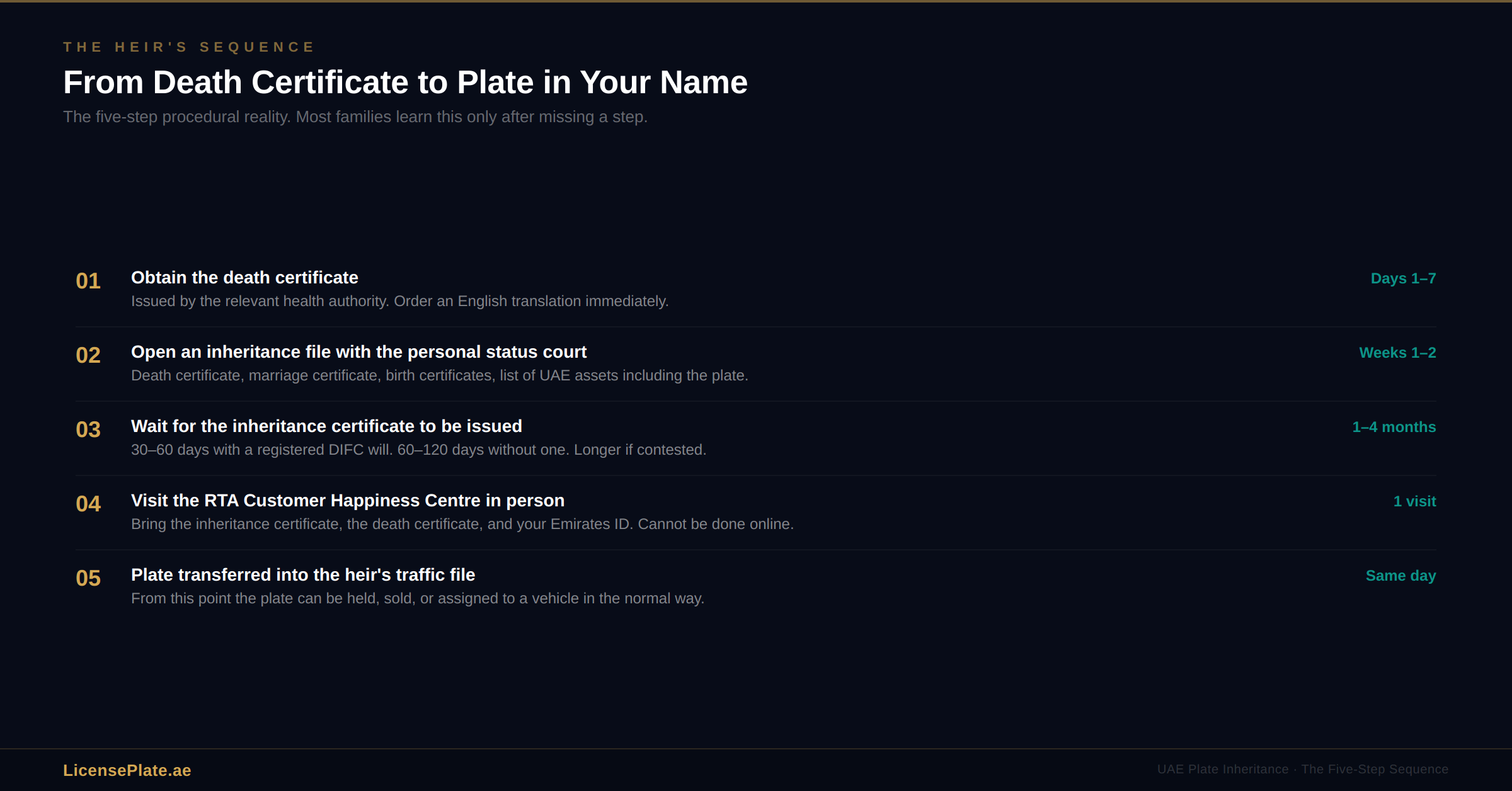
Most articles describe inheritance in legal terms. Heirs need it described in physical terms: which building, which floor, which document, in what order. Here is the sequence as it actually runs in Dubai. The other emirates follow parallel processes through their own personal status courts.
Step 1. Obtain the death certificate
Issued by the Ministry of Health and Prevention or by the relevant emirate-level health authority. If the death occurred in a hospital, the hospital initiates the certificate. If at home, a doctor is called to confirm the death and the certificate follows from there. The certificate is issued in Arabic. An English translation is required for almost every subsequent step and is best ordered at the same time.
Step 2. Open an inheritance file with the competent court
In Dubai, this is the personal status circuit of Dubai Courts. For non-Muslim expats, there is now a dedicated non-Muslim personal status division within Dubai Courts established under the Federal Decree-Law No. 41 of 2022 framework. For Abu Dhabi residents, the Abu Dhabi Judicial Department’s personal status division handles the equivalent process. The northern emirates each maintain their own personal status courts under the Ministry of Justice.
Documents required typically include the death certificate, the deceased’s passport and Emirates ID, the marriage certificate (translated and attested), birth certificates for children (translated and attested), and a list of UAE assets, which is where the plate appears. If the deceased held a registered will at the DIFC Wills Service Centre or the Abu Dhabi Judicial Department Wills Registry, the will is submitted at this stage. The court verifies the documents, identifies the heirs, and issues the succession certificate.
Step 3. Wait. This is the part nobody warns you about.
A straightforward inheritance file with all documents complete, no disputed heirs, and a registered DIFC will typically resolves within 30 to 60 days. Without a registered will, expect 60 to 120 days. With a contested heir, missing documents from the home country, or assets that require valuation, the process can extend beyond a year. During that time, the plate remains frozen in the deceased’s traffic file. It cannot be transferred, listed for sale, or assigned to a vehicle.
Step 4. Take the inheritance certificate to the RTA Customer Happiness Centre
Once the certificate is issued, an heir attends an RTA Customer Happiness Centre in person. This step cannot be completed online through the Dubai Drive app, even though most other plate transfers can. The reason is straightforward: the RTA staff need to verify the original court document, confirm the identity of the attending heir against the certificate, and process a one-time inheritance transfer rather than a standard ownership transfer. Documents required: the inheritance certificate (original and copy), the death certificate, the heir’s Emirates ID, and the deceased’s Emirates ID if available.
The RTA processes the transfer of the plate from the deceased’s traffic file into the heir’s traffic file. There is no standard transfer fee (the AED 120 ownership certificate fee that applies to person-to-person transfers does not apply in the same way to inheritance transfers, though processing fees vary by case). The plate is now in the heir’s name. From this point forward, it can be held, listed for sale on the marketplace, or assigned to a vehicle in the normal way. The verification guide notes briefly that this process exists but does not walk through the sequence. This guide does.
Step 5. If multiple heirs share the plate
This is where most disputes arise. A plate cannot be physically divided. If the inheritance certificate names a wife and three children as joint heirs, the family must decide what to do with a single asset that legally belongs to four people in defined shares. The three options: one heir buys out the others at the plate’s appraised value (use the plate calculator as the starting reference), the family lists the plate for sale and divides the proceeds according to their shares, or the family agrees to keep the plate registered in one heir’s name with a private agreement documenting the others’ financial interests. The third option creates legal exposure if the agreement is not properly drafted, and is generally the worst choice for plates above AED 100,000 in value.
The Insight Most Plate Owners Miss
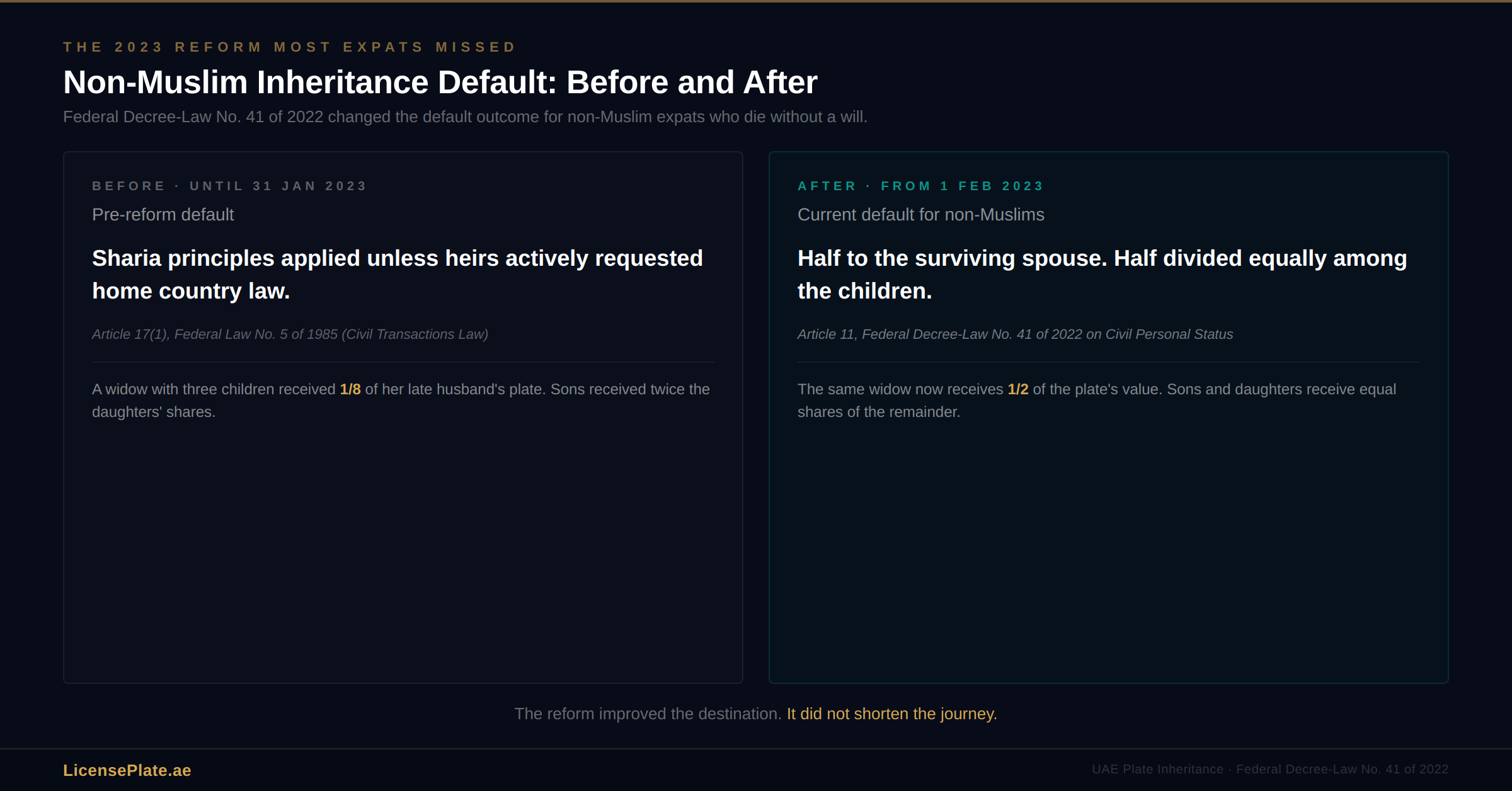
The Federal Decree-Law No. 41 of 2022 reform was significant, but it did not eliminate the need for estate planning. It changed the default outcome for non-Muslim expats who die without a will, but it did not change the procedural friction at the RTA, the bank, or the Land Department. The court-issued certificate is still required. The processing time is still measured in months. The bank accounts are still frozen during the process, including any account the plate sale proceeds would eventually flow into.
Here is the practical consequence. A non-Muslim expat plate owner who dies without a will now benefits from the equal-shares default, which is genuinely better than the pre-2023 framework. But the heirs still wait three to six months before they can do anything with the plate. A non-Muslim expat plate owner who dies with a registered DIFC will benefits from the same equal-shares principle (or any custom distribution they specified), and the heirs typically wait 30 to 60 days. The new law improved the destination. It did not shorten the journey.
For plate owners whose plates are worth meaningfully more than AED 100,000, that journey-length difference is the entire argument for registering a UAE will. The cost of ownership guide documents that the holding cost of a plate is essentially zero. The cost of not having a will is measured in the months your family cannot access the value of an asset they will eventually receive anyway.
The Three Will Options for UAE Plate Owners, Compared
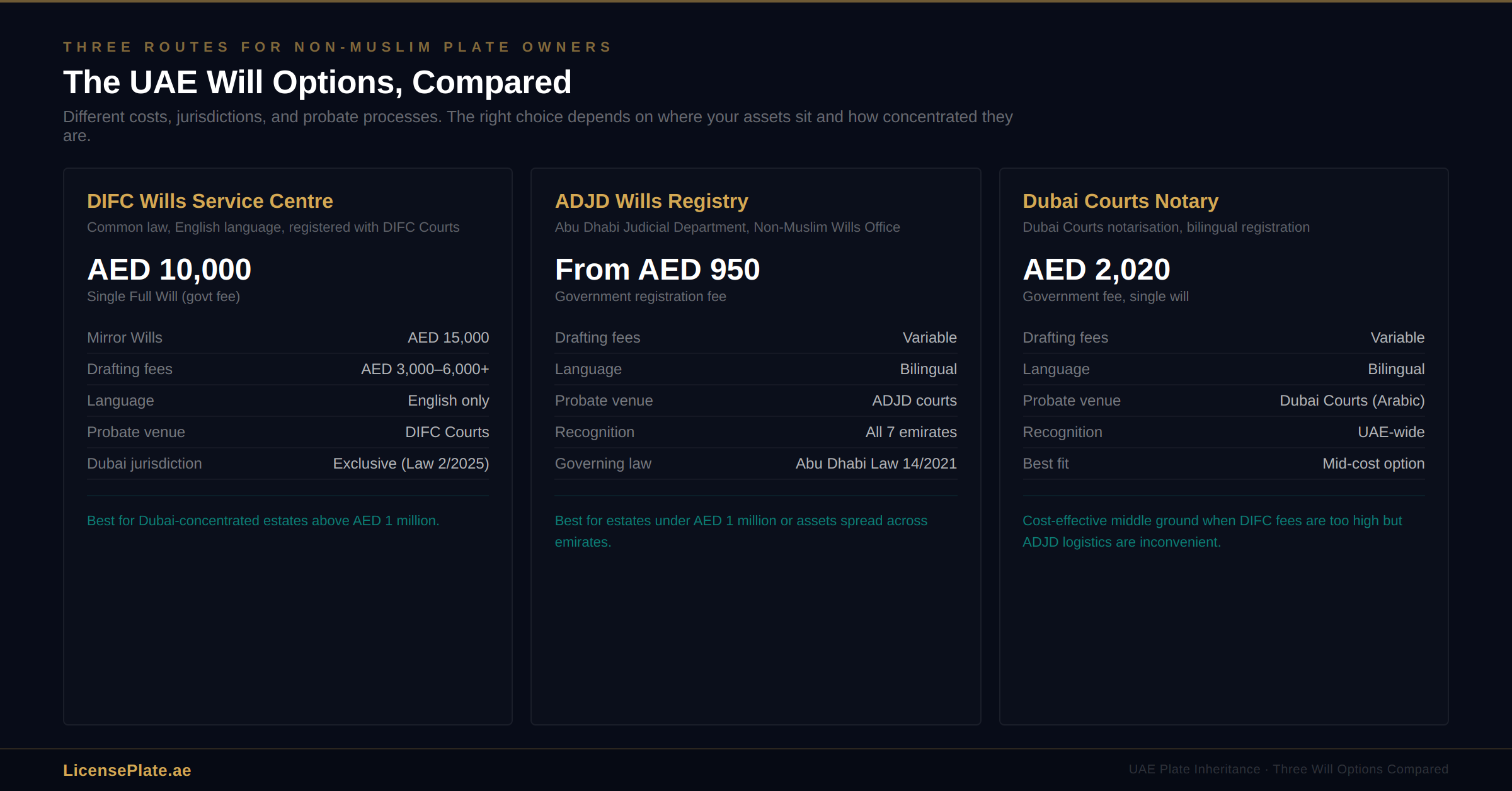
There are three main routes for non-Muslim plate owners to register a will in the UAE. Each has different costs, jurisdictions, and probate processes. The right choice depends on the plate owner’s overall asset profile, where they live, and how concentrated their UAE assets are.
DIFC Wills Service Centre
Established in 2015 as a joint initiative between the Government of Dubai and the DIFC Courts, the DIFC Wills Service Centre allows any non-Muslim over 21 to register a will in English under common-law principles. A Single Full Will costs AED 10,000 in registration fees, payable directly to DIFC. Mirror Wills (two wills written together for a married couple) cost AED 15,000 combined. Legal drafting fees by registered practitioners are additional and typically range from AED 3,000 to AED 6,000 or more depending on complexity.
Under Dubai Law No. 2 of 2025, DIFC wills now have exclusive jurisdiction and direct enforcement for assets located in Dubai. This means a DIFC-registered will can be enforced directly through DIFC Courts without needing to pass through Dubai Courts first, a procedural advantage that materially shortens probate. The will is registered in English, the probate process runs in English, and the court can issue probate orders and grants of representation in English. For non-Arabic speakers managing an inheritance under emotional pressure, this matters.
Abu Dhabi Judicial Department (ADJD) Wills Registry
The ADJD Wills Registry, governed by Abu Dhabi Law No. 14/2021 on Civil Marriage and its Effects, allows non-Muslims to register wills with significantly lower government fees. The registration fee starts from approximately AED 950, less than one-tenth of the DIFC equivalent. The will is bilingual (English and Arabic), is registered through Abu Dhabi’s Non-Muslim Wills Office, and is recognised across all seven emirates under federal law. ADJD wills are increasingly common among UAE residents whose primary assets are concentrated outside Dubai, or who prioritise cost over the procedural speed of the DIFC route.
Dubai Courts (Notary Public Wills)
Dubai Courts Notary Public registration is the third route, with government fees of approximately AED 2,020 for a single will. The will is registered bilingually and is recognised across the UAE. The probate process runs in Arabic at Dubai Courts, which adds friction for non-Arabic-speaking heirs but represents a meaningful cost saving over DIFC. This route is most often used by Muslim residents whose wills cannot be registered at the DIFC (which is restricted to non-Muslims) or by non-Muslims with smaller estates.
How to Choose for a Plate of Significant Value
For a plate owner whose total UAE estate sits between AED 200,000 and AED 1 million, the ADJD route at AED 950 is the most cost-efficient option. For a plate owner whose total UAE estate exceeds AED 1 million, particularly if those assets are concentrated in Dubai (a freehold property, multiple bank accounts, several plates), the DIFC route at AED 10,000 is usually worth the higher cost because of the Dubai Law No. 2 of 2025 enforcement advantage and the English-language probate. The decision should be made with a qualified UAE estate-planning lawyer. Both routes are valid. Both protect the heirs.
The Current Owner’s Setup Checklist
If you are reading this as a current plate owner rather than as an heir, the action items are straightforward. They take a weekend to complete and prevent months of friction for your family later.
1. Document what you own. Take a screenshot of your plate as it appears in the Dubai Drive app or the relevant emirate’s vehicle licensing platform. Save the image somewhere your spouse or executor can find it. Most heirs do not even know the plate exists at the time of death because the asset is invisible to anyone outside the traffic file system. The how to verify a plate guide describes how to view your plates in the Dubai Drive app under Vehicle Licensing > My Plates.
2. Get an honest valuation. Use the plate calculator to establish a current market range. Save the result alongside your plate documentation. This gives your family a starting reference point if they need to value the asset for the inheritance file or decide between selling and retaining.
3. Register a UAE will if you have not. DIFC if your assets are concentrated in Dubai and exceed AED 1 million. ADJD if your estate is smaller or spread across emirates. Either route is dramatically better than the default. The can expats buy plates guide covers how plate ownership intersects with broader UAE residency rules and is a useful companion if you are still in your first few years of UAE residency.
4. If you hold the plate without a vehicle, double-check your traffic file is current. A plate held in a traffic file under an expired residence visa creates additional complications for heirs. The cost of ownership guide notes that plates can be held indefinitely at zero recurring cost, but this assumes the underlying traffic file remains in good standing.
5. Have the conversation. Tell at least one family member that the plate exists and where to find the documentation. The most expensive plate inheritance dispute documented in the UAE involves heirs who did not know an asset existed until they stumbled across an old marketplace listing months after probate had begun. The plate, the screenshot, the calculator estimate, and the will registration certificate should all live in the same folder. Physical or digital. Both is better.
Common Misconceptions That Cost Heirs Time and Money
"My home country will is enough." It might be, but only after the heirs translate it, attest it through the home country’s competent authority, attest it through the UAE diplomatic representation, attest it through the UAE Ministry of Foreign Affairs, and submit it to the competent UAE court for recognition. That process can take longer than registering a fresh DIFC will would have taken in the first place. A home country will is a fallback, not a primary instrument for UAE assets.
"My spouse and I have a joint bank account, so the money will be available immediately." It will not. Under Article 379(4) of Federal Decree-Law No. 50 of 2022 on Commercial Transactions, the surviving joint account holder must inform the bank of the death within ten days. Once notified, the bank freezes the account until the court determines the heirs’ shares. There is no UAE equivalent of the Western "right of survivorship" that automatically transfers the entire balance to the surviving joint holder. The same logic applies to plates: joint registration does not exist in the way many expats assume.
"The plate is in my husband’s traffic file, so I just go to the RTA with the death certificate." The death certificate alone is not sufficient. The RTA requires the court-issued inheritance certificate identifying the heirs and their shares before processing any inheritance transfer. The death certificate is one document on a longer list. Showing up with only the death certificate is the most common reason a widow leaves the Customer Happiness Centre on her first visit without resolving anything.
"The new 2023 law means I do not need a will." The new law improved the default for non-Muslim expats who die intestate, which is genuinely positive. It did not eliminate the procedural friction. Heirs of an intestate non-Muslim expat still wait three to six months for the inheritance certificate. Heirs of a non-Muslim expat with a registered DIFC will typically wait one to two months. The will shortens the journey by months. That is what you are paying for.
"The plate has no real value, so it is not worth the trouble." Run the actual valuation before deciding this. The plate calculator routinely returns five-figure valuations for plates the owner thought were unremarkable. A 4-digit Dubai plate on an early code can carry an AED 30,000 to AED 200,000 valuation that the original buyer never tracked. A plate from the AED 200K to AED 500K tier covers the cost of the will registration thirty times over.
When Heirs Disagree: The Honest Picture
The hardest cases involve plates of meaningful value and heirs who want different outcomes. One sibling wants to keep the plate as a family heirloom, the others want to liquidate. A surviving spouse wants to retain the plate to register on a future vehicle, the children want their share in cash. These disputes are not rare and they are not solved by reading articles. They are solved by mediation, by family agreement, or in the worst cases by court adjudication.
The only useful general advice is procedural. First, get the inheritance certificate and the official valuation in place before any family conversation about what to do with the plate. Disputes that begin with subjective opinions about emotional value usually end in stalemate. Disputes that begin with a documented market value and a specific buy-out figure usually end in resolution. Second, do not let the plate sit unresolved indefinitely. UAE plate prices are not static, and a plate held in legal limbo for two years while the family argues is a plate that may or may not be worth what it was worth at the time of death. Third, if the family cannot agree, listing the plate for sale on the open market through the LicensePlate.ae marketplace and dividing the proceeds according to the inheritance certificate shares is the cleanest resolution. The marketplace becomes the neutral mechanism that ends the argument.
Frequently Asked Questions
Q: What happens to a UAE number plate when the owner dies?
The plate remains in the deceased's traffic file until a court-issued inheritance certificate is obtained from the personal status court of the relevant emirate. Once the certificate is issued, an heir attends the RTA Customer Happiness Centre in person with the certificate, the death certificate, and their Emirates ID to transfer the plate into their name.
Q: Can a wife automatically inherit her husband's number plate in the UAE?
No automatic transfer occurs. For non-Muslim expats under Federal Decree-Law No. 41 of 2022, the wife receives half of the estate by default in the absence of a registered will. For Muslims under the Personal Status Law, a wife with children receives one-eighth. In both cases, the actual transfer of the plate requires the inheritance certificate from the court, and the RTA does not process inheritance transfers without it.
Q: Do I need a will to leave my number plate to my family?
You are not legally required to have one, but registering a UAE will (DIFC, ADJD, or Dubai Courts) shortens the inheritance process from three-to-six months down to one-to-two months and gives you control over how the plate is distributed. For plates worth more than AED 100,000, the cost of the will is recovered many times over in time savings and friction reduction.
Q: How much does it cost to register a will in the UAE?
DIFC Single Full Will: AED 10,000 government fee plus AED 3,000-6,000+ in legal drafting fees. DIFC Mirror Wills (married couple): AED 15,000 combined. ADJD Wills Registry: from approximately AED 950. Dubai Courts Notary Public will: approximately AED 2,020. Costs vary by complexity and whether you use a registered will draftsman.
Q: What is a succession certificate in the UAE?
A succession certificate (also called an inheritance certificate or judicial inheritance notice) is a court-issued document that names the legal heirs of a deceased person and identifies their shares of the estate. It is issued by the personal status division of the relevant court (Dubai Courts, ADJD, or the equivalent in other emirates) and is required by the RTA, banks, and the Land Department before any asset can be transferred to heirs.
Q: How long does it take to inherit a number plate in the UAE?
With a registered DIFC will, typically 30 to 60 days from death to plate transfer at the RTA. Without a registered will, typically 60 to 120 days. Contested estates, missing documents from the home country, or disputed heirs can extend the process beyond one year.
Q: Can heirs sell a number plate before completing the inheritance process?
No. The plate cannot be listed, transferred, or assigned to a vehicle until the inheritance certificate has been issued and the plate has been transferred from the deceased's traffic file into an heir's traffic file. Marketplace listings on LicensePlate.ae require the seller to be the registered owner of the plate they are listing.
Q: What happens if a plate owner dies without any heirs?
Under Article 11(3) of the Federal Decree-Law No. 41 of 2022 (for non-Muslims) and the Civil Transactions Law (for the broader framework), if a foreign person has no heirs, their UAE assets pass to the government. This is rare but legally established.
Q: Does Sharia law still apply to non-Muslim expats in the UAE?
Not by default. Federal Decree-Law No. 41 of 2022, effective February 1, 2023, established that non-Muslim residents and citizens are governed by the Civil Personal Status Law unless they specifically opt to apply the law of their home country. This was a substantive shift from the pre-2023 default, where Sharia principles applied to non-Muslim estates in the absence of a will.
Q: Can I transfer a plate to my children while I am still alive to avoid inheritance issues?
Yes. A standard plate transfer between family members follows the normal process described in the plate transfer guide: AED 120 ownership certificate fee, both parties present (online via Dubai Drive app or in person at a Customer Happiness Centre), and immediate transfer. This is the simplest way to control the future of a plate, though the recipient becomes the legal owner immediately and the original owner loses control of the asset.

A Final Thought, Returning to the Customer Happiness Centre
The widow at the start of this article is not a hypothetical. Versions of her sit in front of RTA staff in Umm Ramool, in Deira, in Al Barsha every week, holding the wrong combination of documents and learning that the asset they came to recover is procedurally inaccessible to them today. The staff are kind. The system is not cruel. It is just designed for a process the family did not know existed.
Her husband’s plate will eventually be transferred. The Federal Decree-Law No. 41 of 2022 framework will give her the half-share she is entitled to and her children the equal-shares portion they are entitled to. The court will issue the inheritance certificate. The RTA will execute the transfer. The plate she came in for will, in three or four months, finally appear under her name in the Dubai Drive app.
The cost of those three or four months, measured in legal fees, in delayed asset access, in family stress at the worst possible time, is exactly the cost a registered DIFC or ADJD will would have eliminated. Most expat plate owners reading this article will close it, mean to act on it, and not act on it. The ones who do act will be the ones whose families never have to read this article in the first place.