

We Analysed 50,710 UAE Number Plate Listings. Half of Them Ask Under AED 10,000.
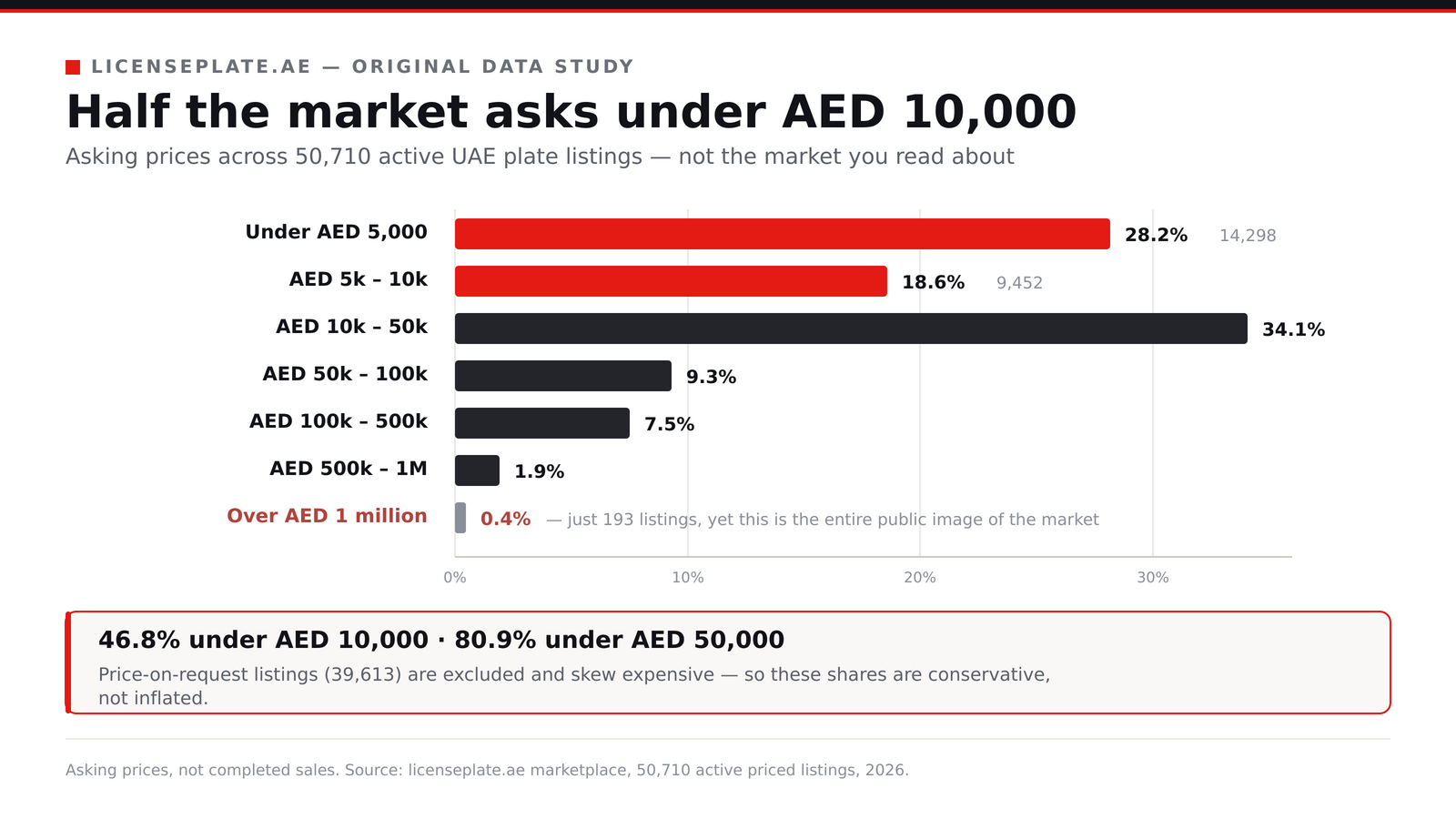
We analysed 50,710 live UAE number plate listings on our own marketplace. Nearly half of them — 46.8% — ask under AED 10,000. Only 0.4% ask more than a million. That is the opposite of what the coverage of this market suggests. Every headline is a AED 55 million charity lot, and the impression left behind is that a distinctive plate is a billionaire's toy. The data from an actual working inventory says something far more useful: the median Dubai listing asks AED 8,500, and the most expensive emirate by median is not Dubai at all. This is what the UAE plate market looks like when you count it instead of quoting it.
The 30-second answer.
- Sample: 50,710 active, priced listings from the licenseplate.ae marketplace.
- 46.8% ask under AED 10,000. 80.9% ask under AED 50,000.
- Only 0.4% ask over AED 1 million — the tier that produces every headline.
- Median Dubai listing: AED 8,500 — the lowest median of any emirate.
- Highest median: Abu Dhabi at AED 41,000, nearly 5× Dubai.
- The digit cliff: median goes AED 7,000 (5-digit) → 38,000 (4-digit) → 556,000 (3-digit).
- Caveat: these are asking prices on one marketplace, not completed sales.
What this study covers
- How we counted — and what we excluded
- Finding 1: half the market is under AED 10,000
- Finding 2: Dubai is the cheapest emirate by median
- Finding 3: the digit cliff is brutal and non-linear
- Finding 4: the letter code moves the price less than you think
- Why the headlines mislead
- How to use this data as a buyer
- How to use it as a seller
- What this data cannot tell you
- FAQ — 14 questions answered
How we counted — and what we excluded
Transparency first, because a data study is only as good as its exclusions.
We took every active listing on the licenseplate.ae marketplace and kept those with a real asking price between AED 500 and AED 100 million. That left 50,710 listings out of 90,529 active ones.
| Excluded | Count | Why |
|---|---|---|
| Price on request (price = 0) | 39,613 | No number to analyse |
| Under AED 500 | 205 | Placeholder entries, not real asks |
| Over AED 100 million | 1 | A AED 4.6 billion entry — the plate number typed into the price field |
Two methodological choices worth stating plainly:
- We report medians, not averages. A single junk entry of AED 4.6 billion dragged the Abu Dhabi mean to AED 630,350 — a figure that describes nothing real. The median is immune to that, which is why every headline number here is a median.
- Price-on-request listings skew expensive. Sellers hide the price on high-value plates far more often than on cheap ones. If anything, including them would push the medians up — so the affordability finding below is conservative, not inflated.
Finding 1: half the market is under AED 10,000
Direct answer: 28.2% of priced listings ask under AED 5,000, and 46.8% ask under AED 10,000. Only 0.4% ask more than AED 1 million.
| Asking price | Listings | Share | Cumulative |
|---|---|---|---|
| Under AED 5,000 | 14,298 | 28.2% | 28.2% |
| AED 5,000–10,000 | 9,452 | 18.6% | 46.8% |
| AED 10,000–50,000 | 17,293 | 34.1% | 80.9% |
| AED 50,000–100,000 | 4,724 | 9.3% | 90.3% |
| AED 100,000–500,000 | 3,782 | 7.5% | 97.7% |
| AED 500,000–1M | 968 | 1.9% | 99.6% |
| Over AED 1 million | 193 | 0.4% | 100% |
Sit with that last row. 193 listings out of 50,710 carry the price tag that defines this market in the public imagination. The other 50,517 are ordinary transactions between ordinary people — the plate equivalent of a used-car classifieds page.
If you have been assuming a distinctive UAE plate is out of reach, the data disagrees. Our guide to the cheapest plates under AED 5,000 covers that bottom quartile in practical detail — and the numbers here confirm it is 28% of the whole market, not a rounding error.
Finding 2: Dubai is the cheapest emirate by median
This is the most counterintuitive result in the dataset.
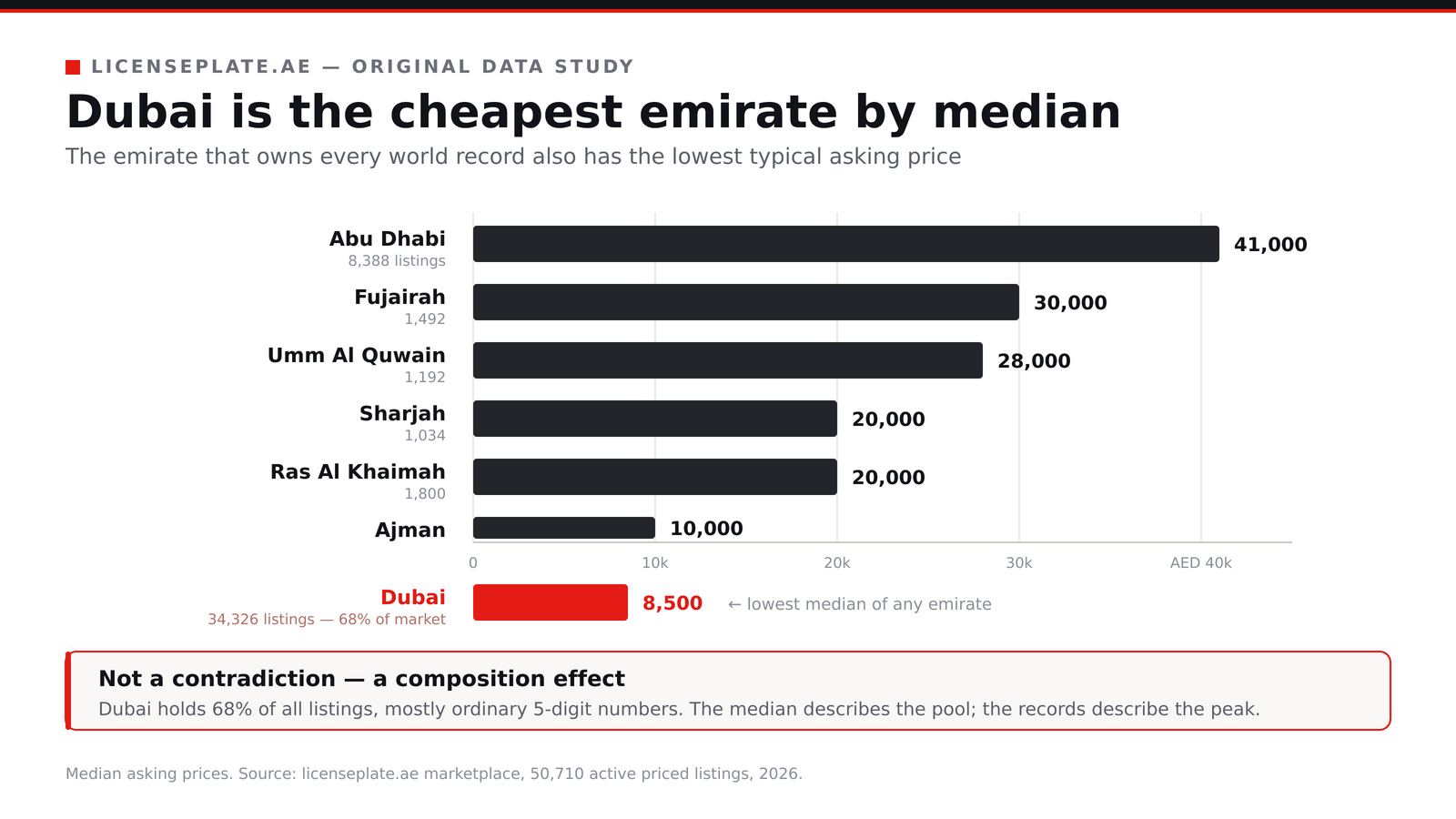
Direct answer: the median Dubai listing asks AED 8,500 — the lowest median of any emirate. Abu Dhabi's median is AED 41,000, nearly five times higher.
| Emirate | Listings | Median ask (AED) |
|---|---|---|
| Abu Dhabi | 8,388 | 41,000 |
| Fujairah | 1,492 | 30,000 |
| Umm Al Quwain | 1,192 | 28,000 |
| Sharjah | 1,034 | 20,000 |
| Ras Al Khaimah | 1,800 | 20,000 |
| Ajman | 2,086 | 10,000 |
| Dubai | 34,326 | 8,500 |
Why the "cheapest" emirate is also the most expensive one. This is not a contradiction, it is a composition effect. Dubai holds 34,326 of the 50,710 listings — 68% of the entire market — and the overwhelming majority are long five-digit numbers that trade for a few thousand dirhams. Dubai simultaneously owns the global record book and the deepest pool of cheap plates. The median describes the pool, not the ceiling.
Abu Dhabi is the mirror image: far fewer listings, weighted toward shorter and more collectible numbers, so its median sits five times higher. If you are comparing emirates, our seven-emirate price comparison explains the structural reasons behind these gaps.
The practical consequence: if you want the cheapest entry into plate ownership, Dubai's own inventory is where the volume is — the opposite of the conventional advice to look at the northern emirates for bargains.
Finding 3: the digit cliff is brutal and non-linear
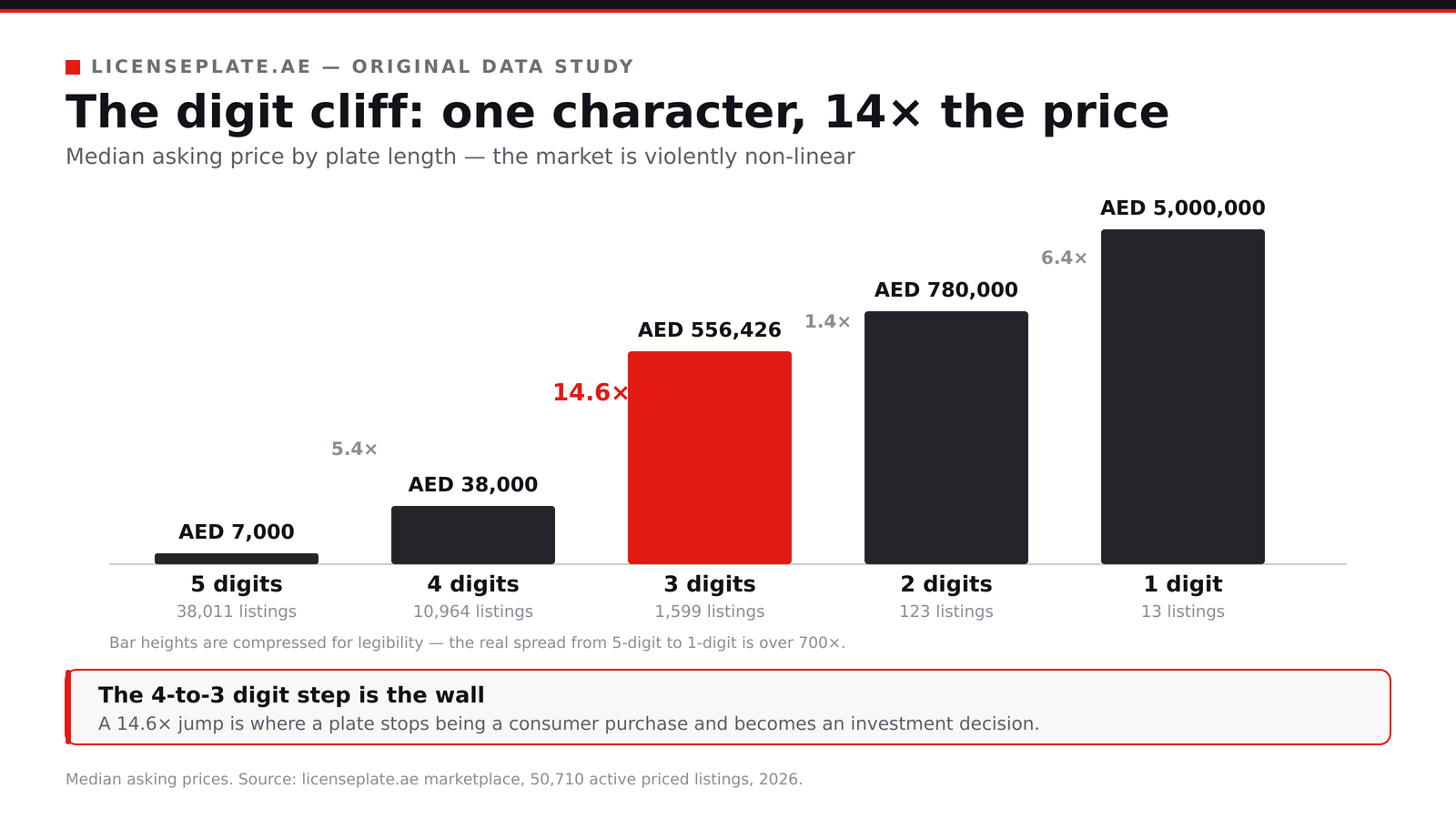
Direct answer: removing one character from a plate does not add a percentage to the price — it multiplies it. The median goes AED 7,000 for five digits, AED 38,000 for four, and AED 556,426 for three.
| Digits | Listings | Median ask (AED) | Step up |
|---|---|---|---|
| 5 digits | 38,011 | 7,000 | — |
| 4 digits | 10,964 | 38,000 | 5.4× |
| 3 digits | 1,599 | 556,426 | 14.6× |
| 2 digits | 123 | 780,000 | 1.4× |
| 1 digit | 13 | 5,000,000 | 6.4× |
Three things this table tells you that no price guide does:
- The 4-to-3 digit jump is the real wall. A 14.6× median step is where the market stops being a consumer purchase and becomes an investment decision. Most buyers who "just want something shorter" discover this wall the hard way.
- The 3-to-2 step is comparatively small (1.4×) — because by then you are already in a thin, negotiated market where individual number quality matters more than length alone.
- Supply collapses faster than price rises. There are 38,011 five-digit listings and 13 single-digit ones. That is a 2,900-fold difference in availability, which is the actual engine behind the pricing.
Our 2, 3 and 4-digit price guide breaks down each tier qualitatively; this is the quantitative backbone underneath it.
Finding 4: the letter code moves the price less than you think
Conventional wisdom says the code letter is a major value driver. In the volume market, the data only partly supports that.
Direct answer: across Dubai codes with meaningful sample sizes, the median asking price clusters tightly between roughly AED 12,900 and AED 15,000. Code V leads the letter codes at a median of AED 15,000.
| Dubai code | Listings | Median ask (AED) |
|---|---|---|
| V | 1,297 | 15,000 |
| H | 942 | 14,350 |
| L | 951 | 13,800 |
| C | 982 | 13,000 |
| F | 903 | 13,000 |
| M | 1,247 | 13,000 |
| I | 1,003 | 12,900 |
The spread between the top and bottom of that list is about 16%. Compare that to the 460% jump from a five-digit to a four-digit plate, and the hierarchy becomes obvious: length dominates, code is a modifier.
An important qualifier: this measures the volume market, where most listings are long numbers. At the top of the market — the double-letter AA/BB/DD territory that produces record sales — the code absolutely is a primary driver. Our guide to double-letter plates covers that tier, and Dubai plate codes A to Z covers the meaning of each letter. The finding here is narrower and more useful for ordinary buyers: do not pay a large premium for a code letter on a five-digit plate.
Why the headlines mislead
Nothing in the reporting on this market is false. AED 55 million really was paid for P 7. The problem is selection: only the top 0.4% is ever newsworthy, so the public sees a market composed entirely of its own extreme tail.
Two distortions follow, and both cost people money:
- Buyers self-exclude. People who would happily pay AED 8,000 for a nicer number never look, because they believe the entry point is six figures. That is 46.8% of the market they are walking past.
- Sellers over-anchor. Owners of ordinary five-digit plates price against charity-auction headlines and then wonder why nothing sells. Our selling guide makes the same point qualitatively; this dataset is the evidence.
It is worth being precise about the record figures too. Most of them — including the world record — were set at charity auctions, where the bid contains a donation. They are real, but they are not comparables. We covered that distinction in the AED 109 million auction analysis.
How to use this data as a buyer
- Set your budget by digit count, not by aspiration. AED 7,000 buys a median five-digit plate. AED 38,000 buys a median four-digit. Decide which side of that wall you are on before browsing.
- Do not overpay for a code on a long plate. A 16% spread across codes is not worth a large premium at five digits.
- Search Dubai for volume and value. It holds 68% of listings and the lowest median — more choice and more competition among sellers.
- Treat any listing above AED 1 million as a different asset class. That is 0.4% of the market with its own dynamics, thin liquidity and negotiated pricing.
- Benchmark before you offer. Use the medians here as your anchor, then apply the valuation framework for the specific number.
How to use it as a seller
The single most common pricing mistake is anchoring on the wrong tier. Three corrections the data supports:
- If your plate is five digits, your competition is 38,011 other listings with a median ask of AED 7,000. Pricing at AED 50,000 because the number "looks nice" puts you in the top 10% of the entire market with an ordinary plate.
- Shortness is your only large lever. If you hold a four-digit plate you are in a pool of 10,964 with a median of AED 38,000 — a genuinely different market from five digits.
- Price-on-request is a signal, not a strategy. Nearly 40,000 listings hide their price; buyers largely skip them. If you want volume interest, publish a number.
For the mechanics of listing and closing, see how to sell a number plate in the UAE.
What this data cannot tell you
A study is more trustworthy when it states its own boundaries, so here are ours.
- These are asking prices, not sale prices. We can measure what sellers want, not what buyers paid. Realised prices are typically lower, and we do not claim to know by how much.
- It is one marketplace. A large one, but it is not a census of every UAE plate transaction, and it excludes RTA primary auctions entirely.
- Price-on-request listings are missing. 39,613 of them, and they skew expensive — so the medians here likely understate the full market.
- It is a snapshot. Inventory changes constantly; these figures describe the market at the time of analysis, not a long-run trend.
- Listing quality varies. We removed obvious junk, but a marketplace dataset is not laboratory data.
None of that undermines the headline findings — a 46.8% share under AED 10,000 is not going to reverse because of measurement noise — but it does mean these figures are a map of asking prices, not a valuation oracle.
Frequently asked questions
How much does a number plate actually cost in the UAE?
On our marketplace, the median asking price is around AED 8,500 in Dubai and AED 41,000 in Abu Dhabi. Nearly half of all priced listings — 46.8% — ask under AED 10,000.
Are most UAE number plates expensive?
No. Only 0.4% of priced listings ask more than AED 1 million, and 80.9% ask under AED 50,000. The multi-million headlines represent the extreme tail of the market, not the market.
Which emirate has the cheapest number plates?
By median asking price, Dubai at AED 8,500 — because it holds by far the largest pool of long five-digit plates. Ajman follows at AED 10,000.
Which emirate has the most expensive plates?
By median asking price, Abu Dhabi at AED 41,000 — roughly five times Dubai's median, because its listings skew toward shorter numbers.
Why is Dubai both the cheapest and the most expensive?
Composition. Dubai holds 68% of all listings, most of them ordinary five-digit numbers, which pulls its median down. It also holds the record-breaking short plates, which set the global ceiling. The median describes the pool; the records describe the peak.
How much more does a 4-digit plate cost than a 5-digit one?
About 5.4× at the median — AED 38,000 versus AED 7,000. The jump from four digits to three is far larger again, at roughly 14.6×.
What is the biggest price jump between plate lengths?
Four digits to three digits, a 14.6× median step. That is the wall where a plate stops being a consumer purchase and becomes an investment decision.
Does the letter code affect the price?
Much less than length does, at least in the volume market. Across Dubai codes with large samples, medians cluster between about AED 12,900 and AED 15,000 — a spread of roughly 16%, against a 460% jump for removing one digit.
Which Dubai code is the most expensive?
Among letter codes with large sample sizes, V has the highest median at AED 15,000, followed by H at AED 14,350. The differences between codes are small relative to digit count.
Can I buy a UAE number plate for under AED 5,000?
Yes. 28.2% of priced listings — 14,298 of them — ask under AED 5,000. It is the single largest price bracket at the entry level.
Are these real sale prices?
No. These are asking prices on active marketplace listings. Realised sale prices are typically lower, and this dataset cannot measure that gap.
How many plates were analysed?
50,710 active, priced listings, drawn from 90,529 active listings after excluding price-on-request entries, sub-AED 500 placeholders and one impossible outlier.
Why use medians instead of averages?
Because a single junk entry of AED 4.6 billion pushed the Abu Dhabi mean to AED 630,350 — a number describing nothing real. Medians are unaffected by extreme outliers.
Does this include RTA auction plates?
No. This is secondary-market listing data only. Primary-market RTA and Emirates Auction sales are a separate channel with different dynamics.
The bottom line
The UAE plate market has a public image built entirely from its own top 0.4%. Counted properly, it is a broad, accessible market where nearly half of everything on offer asks less than AED 10,000, and where the single biggest determinant of price is simply how many characters you are willing to live with.
The record plates are real and they are extraordinary. They are also almost completely irrelevant to what you will actually pay. If you have been treating this market as closed to you, the numbers say otherwise.
See the live inventory for yourself: browse Dubai plates — where the volume and the value both sit — or the full UAE marketplace. If you want a valuation before you offer, start with how to check a plate's real value.
Delete Comment?
Are you sure you want to delete this comment? This action cannot be undone.
Delete Article?
Are you sure you want to delete this article? This will also delete all comments. This action cannot be undone.