

Number Plate on a Financed Car in the UAE (2026): The Bank's Lien Is on the Car, Not on Your Number
Last updated: 24 August 2026
Quick answer
A bank mortgage on your car does not freeze your number plate. The RTA's own published service page for Manage Vehicle Plates answers the question directly: "Do I need an NOC from the bank to change the plate number if my vehicle is under mortgage? — No." The listed requirement for the service is an Emirates ID and cleared traffic fines, nothing else. What the mortgage does block is the other transaction entirely: you cannot transfer the vehicle's ownership to a buyer until the bank sends an electronic mortgage release to the RTA. The bank's security is a first-degree hypothecation over the car. Your number sits on a separate document — a Vehicle Plate Number Ownership Certificate — and follows separate rules. Almost every guide on the internet blurs these two transactions into one and tells you that you are stuck. You are not.
Most premium plates in this country are bolted onto cars that somebody is still paying for. That is not a criticism; it is arithmetic. A four-digit Dubai plate can cost more than the vehicle carrying it, and vehicle finance is the default way cars are bought here. So the situation is extremely common: an owner holds a number worth AED 300,000 on a car with AED 80,000 of outstanding finance, wants to change cars, sell the plate, or simply understand what happens if the payments stop — and finds that nobody has written about it.
The advice you can find is written by people selling cars, not numbers. It is accurate about the car and wrong about the plate, because it treats the two as one asset. That mistake goes in both directions and both are expensive. Some owners believe they are frozen and quietly leave a valuable number sitting on a financed vehicle for years. Others assume the plate is theirs to do whatever they like with and physically unscrew it before a handover — which is a criminal offence under UAE federal traffic law, not an administrative one.
This guide separates the three legal objects that sit inside one financed car, shows exactly which of them the bank's security attaches to, and sets out what the RTA will and will not process while a mortgage is registered. Every procedural claim here is taken from the RTA's own published service pages and from the federal legislation, not from market commentary.
Table of contents
- The answer in one table: four actions, four verdicts
- Three legal objects, one car
- What the bank's security actually is
- What the RTA's own page says about plates and mortgages
- What the mortgage genuinely does block
- The line you must not cross: Article 34
- Moving your number off a financed car, step by step
- If the payments stop: what happens to the number
- Buying a plate from someone whose car is financed
- What we cannot tell you
- Six mistakes that cost financed owners money
- Frequently asked questions
The answer in one table: four actions, four verdicts
Direct answer: the mortgage blocks transactions that change who owns the car. It does not block transactions that change which number is on it. Four things a financed owner might want to do, and what actually happens to each:
| What you want to do | Blocked by the mortgage? | What the RTA requires |
|---|---|---|
| Change the plate number on your financed car | No | Emirates ID, all traffic fines paid, old plates handed back within 14 days |
| Reserve your old number instead of returning it | No | Selected during the same transaction; reservation runs for one year and is renewable |
| Sell the car to a buyer | Yes | Electronic mortgage release from the bank, listed as a required document |
| Unscrew the plates yourself and move them | Criminal offence | Prior approval of the Licensing Authority is mandatory in every case |
Read the first two rows again, because they contradict most of what is published on this subject. The RTA does not ask a mortgaged owner for a bank letter to change a plate number, and it lets that owner keep the outgoing number in reserve. Those two facts together are the whole toolkit.
Three legal objects, one car
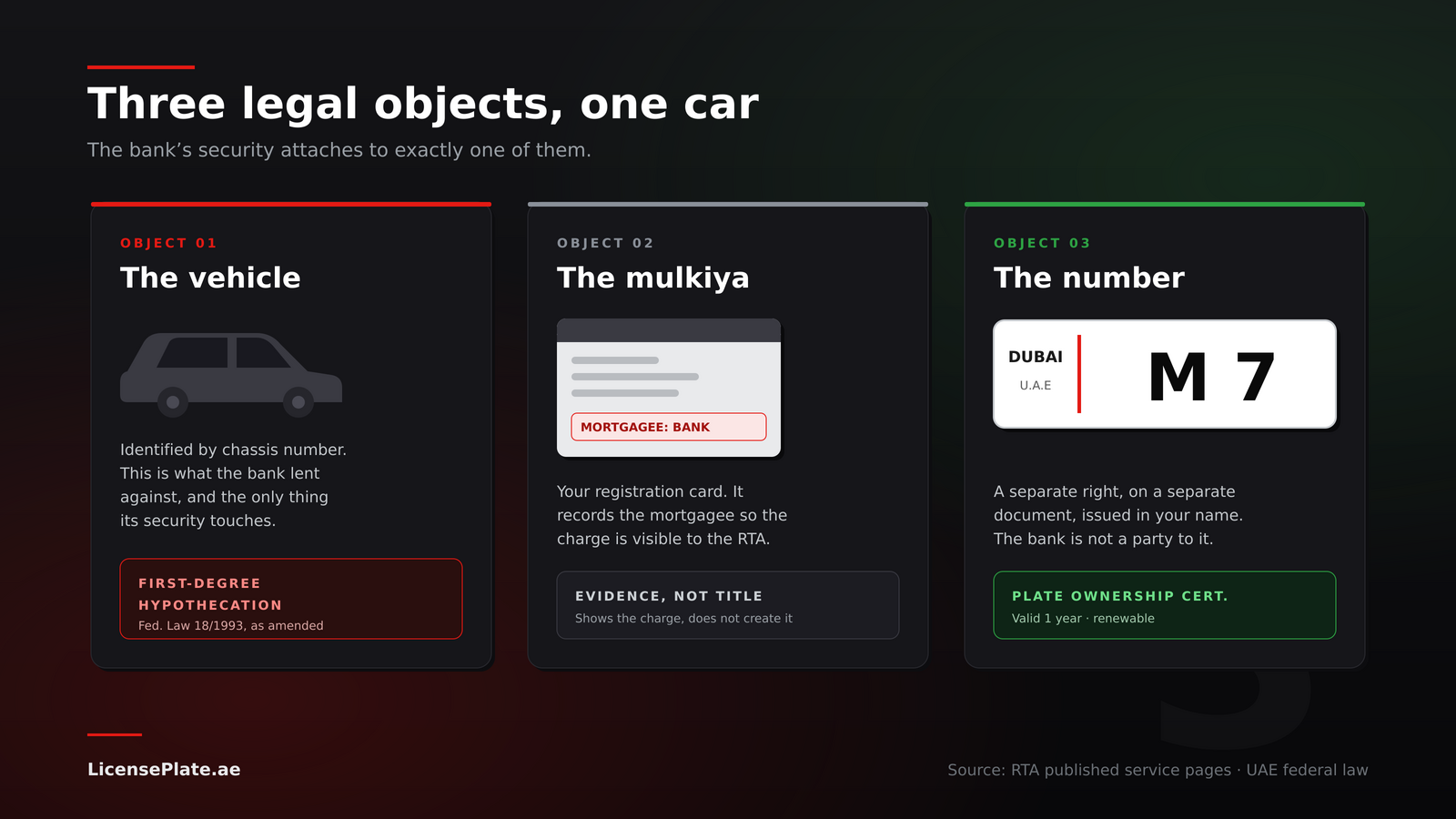
When you finance a car and put a premium number on it, you are holding three distinct things that people habitually collapse into one.
The vehicle. A physical asset with a chassis number. This is what the bank lends against and this is what its security attaches to. Nothing else in the transaction is collateral.
The mulkiya. Your vehicle registration card, which records the vehicle, its owner, and — when finance is in place — the mortgagee. The mulkiya is evidence of the arrangement, not the arrangement itself. Our field-by-field guide to the mulkiya walks through what each line on that card does and does not prove.
The number. A separate right, evidenced by a separate document. The RTA's Manage Vehicle Plates service lists its output explicitly as a "Vehicle Plate Number Ownership Certificate, valid for 1 year, and both vehicle plate numbers." That certificate is issued to you. It is not issued to the bank, it does not name the bank, and the bank does not countersign it.
This separation is not a technicality we have invented for the sake of an argument — it runs right through UAE law. Our analysis of VAT on UAE number plates reaches the same split from the tax side: the car is goods, the aluminium plate is goods, but the number is the granting of a right, which UAE VAT law treats as a supply of services. Two different areas of law, examined independently, land on the same conclusion. The number is its own object.
Once you hold that distinction, the rest of this article is mostly bookkeeping. A charge registered against object one does not automatically reach object three.
What the bank's security actually is
UAE auto finance does not work by the bank owning your car. It works by hypothecation — a registered security interest that leaves you as the owner while giving the lender a ranked claim if you default.
When a bank grants a vehicle loan here it takes a first-degree hypothecation over the car, registered with the competent licensing authority. The framework sits in Federal Law No. 18 of 1993, the Commercial Transactions Law, as amended by Federal Decree-Law No. 14 of 2020. The contractual terms themselves follow the standard auto loan agreement format approved by the UAE Central Bank under Notice No. 3692/2012.
Three consequences follow, and each one is narrower than people assume:
- The charge is registered against the vehicle record. That is why the mortgagee appears on your mulkiya and why the RTA can see the status electronically without anyone producing a piece of paper.
- You remain the owner throughout. A hypothecation is a security interest, not a transfer of title. This is precisely why the RTA still lets you manage the vehicle's plates — you are exercising an owner's rights over your own registration.
- The security covers the collateral described in the agreement. Standard UAE auto finance agreements describe the vehicle by make, model and chassis number. They are not drafted around a plate number, because the plate number on a car at signing may be gone a week later — which, as the next section shows, is a transaction the RTA performs routinely.
None of that makes the mortgage weak. It makes it specific. And specificity is the entire point: a lien that attaches to a car attaches to a car.
What the RTA's own page says about plates and mortgages
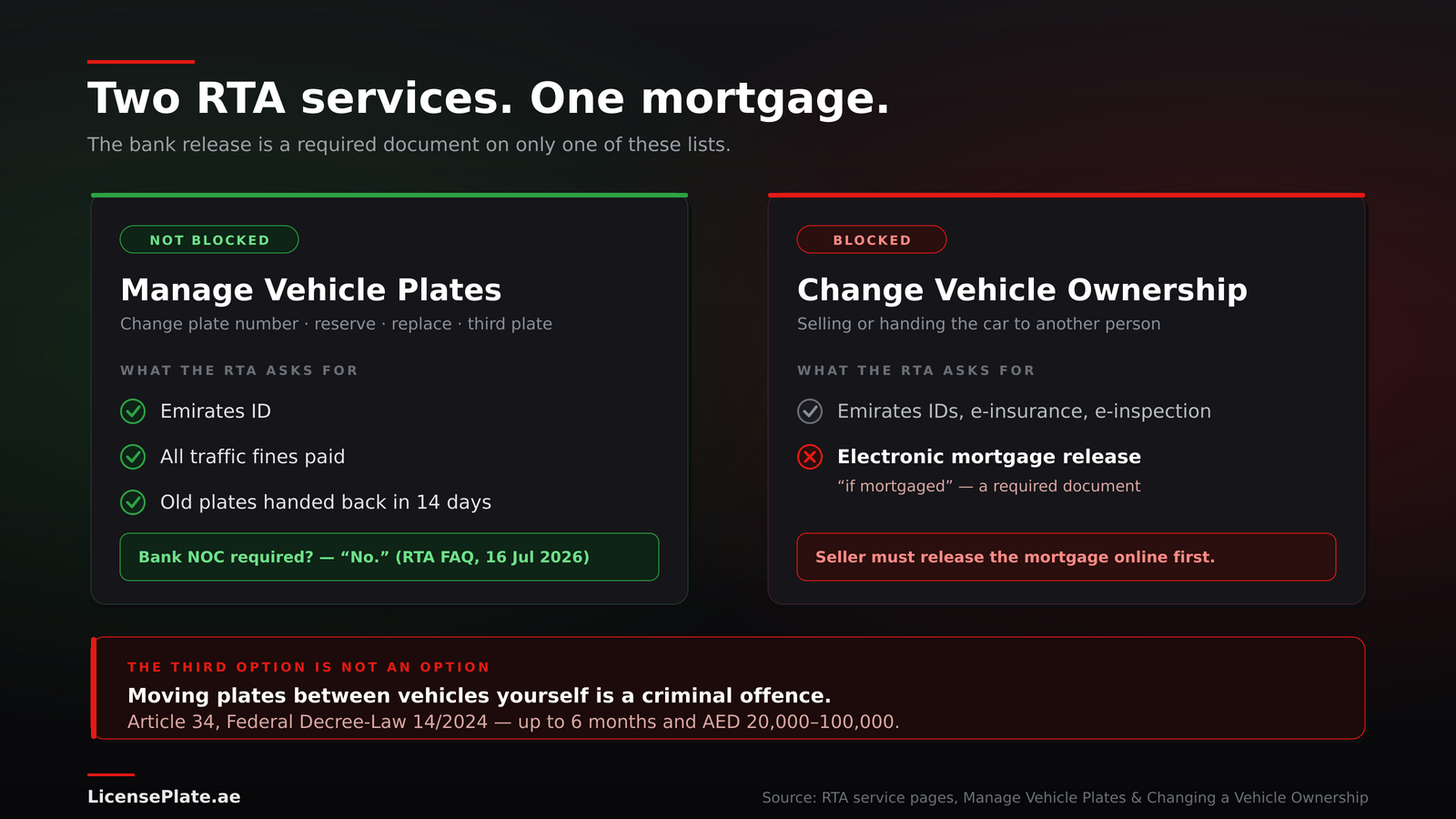
The RTA publishes a service page for Manage Vehicle Plates, covering four sub-services: Change Plate Number, Renew the Reservation of a Plate Number, Third Plate Number for Light Vehicle, and Replace a Lost or Damaged Plate Number. At the bottom of that page sits a two-question FAQ. The first question is the one this entire article exists to answer, and the answer is one word:
Q: Do I need an NOC from the bank to change the plate number if my vehicle is under mortgage?
A: No.
— RTA, Manage Vehicle Plates service page, last updated 16 July 2026
The rest of the page is consistent with that answer. Under Service Requirements the RTA lists exactly one document: Emirates ID. Under You Should Do it lists one obligation: pay all your traffic fines. There is no mulkiya requirement, no mortgage release, no bank letter, no lender consent form. Eligible categories are citizens, residents and GCC nationals. Service time is listed as instantly. The full mechanics of the transaction are covered in our RTA Vehicle Plate Management guide.
The fees are the standard plate-manufacturing fees, unchanged by the presence of finance:
| Plate type | Plate | Ownership issuance | Knowledge & Innovation | Total |
|---|---|---|---|---|
| Short plate | AED 35 | AED 50 | AED 20 | AED 105 |
| Long plate | AED 50 | AED 50 | AED 20 | AED 120 |
| Classic plate (short or long) | AED 150 | AED 50 | AED 20 | AED 220 |
| Dubai-branded plate | AED 200 | AED 50 | AED 20 | AED 270 |
| Luxury plate | AED 500 | AED 50 | AED 20 | AED 570 |
| Motorcycle plate | AED 25 | AED 50 | AED 20 | AED 95 |
One detail on that page matters more than the fees. In the Dubai Now channel, the RTA's own step list includes: "Specify if you want to return the plates to RTA or reserve them for future use", and then "Select a plate number from your owned or reserved plates." That is the retention mechanism stated in the government's own words. Your outgoing number does not have to go back into the pool. It can sit in your account waiting for the next car. Our guide to reserving a plate number before you buy the car covers how that reservation behaves over time.
What the mortgage genuinely does block
Now the other service. Apply for Changing a Vehicle Ownership is the transaction you use when a car changes hands, and its requirement list is completely different. Alongside the Emirates IDs of buyer and seller, electronic insurance and electronic technical inspection, the RTA lists one more required document:
"Electronic mortgage release (if mortgaged)."
And in the service conditions: sellers must release the mortgage online before proceeding with the ownership transfer. There is no route around it, no manual override, and no version of the transaction where the buyer takes the car and settles the finance afterwards. The RTA will not process the change of ownership while the charge is live.
The mechanics, as reported by lenders and service centres, run roughly like this: you settle the outstanding balance, the bank updates its systems and pushes an electronic release to the RTA, the RTA reflects it against the vehicle record, and you receive an SMS or email confirming the release. Reported timelines cluster around two to five working days for the bank side, with the RTA side following within about a day of receiving confirmation. Treat those as market observations rather than a published service level — they are not part of the RTA's stated processing time, and they vary by lender.
The fees for the ownership transfer are separate from anything above: AED 350 for a light vehicle, AED 200 for a motorcycle, AED 300 for a bus of 14 to 26 passengers, plus AED 50 for the Sale and Purchase Agreement, AED 20 Knowledge and Innovation, and plate fees of AED 35 to 500 depending on type. The online Sale and Purchase Agreement is valid for 14 days. Our complete Dubai costs and fees guide sets out how these stack in a real transaction.
So the picture resolves cleanly. Two RTA services, two requirement lists, and the mortgage appears on exactly one of them.
The line you must not cross: Article 34
There is an obvious-looking shortcut here, and it is the single most dangerous idea in this whole subject. If the plate is separate from the car, and the buyer is coming on Thursday, why not just unscrew the premium number, put the old plates back on, and hand the car over?
Because that is a crime.
Federal Decree-Law No. 14 of 2024 on Traffic Regulation, in force since March 2025, contains a plate-specific criminal provision at Article 34. It carries imprisonment of up to six months and/or a fine of not less than AED 20,000 and not more than AED 100,000 for five enumerated acts. The fourth of them is transferring a plate from one vehicle to another without the prior approval of the Licensing Authority.
Read that carefully, because the trap is in what it does not say. It does not say "without owning the plate." It does not say "with intent to deceive." Owning the number, owning both cars, and having every honest intention in the world does not put you outside it. The offence is completing the move without the authority processing it. Our full breakdown of UAE plate offences, fines and seizure sets out how this criminal tier differs from the AED 400 administrative ticket for an unclear plate, and why competitors routinely blur the two.
The distinction that matters for a financed owner is therefore not car versus plate. It is processed versus unprocessed. Everything in the next section is legal precisely because the RTA performs it and records it. The same physical outcome, achieved with a screwdriver in a car park, sits in a different chapter of the law.
Moving your number off a financed car, step by step
Here is the sequence, using only transactions the RTA publishes and only requirements it lists.
Step 1 — Clear your traffic fines. This is the one gate that will actually stop you, and it applies whether or not there is finance. The service page states it plainly under You Should Do. Check the position first; our guide to checking UAE traffic fines by plate number covers every emirate's portal.
Step 2 — Open Manage Vehicle Plates and select Change Plate Number. Available through the RTA website, the RTA Dubai app, Dubai Now, customer happiness centres and vehicle registration and inspection centres. You are changing the number on the financed car, which is the transaction the RTA has confirmed needs no bank NOC.
Step 3 — Choose to reserve, not return. At the point where the system asks what should happen to the outgoing plates, select reservation rather than surrender. This is the step that preserves the asset. Miss it and your number goes back to the RTA.
Step 4 — Take a replacement number for the financed car. The car still needs a valid registration, so it receives a different number. A standard short or long plate is the cheap option at AED 105 or AED 120 all-in.
Step 5 — Hand over the old plates within 14 days. The RTA gives you 14 days to surrender the physical plates at a service centre or via the delivery service, or the application is cancelled. Plates are manufactured on the spot at centres that have plate factories.
Step 6 — Assign the reserved number to your next car. When the new vehicle is registered, run Change Plate Number again and select from your owned or reserved plates. The number lands on the new car through a processed transaction, which is exactly what Article 34 requires.
Step 7 — Renew the reservation if there is a gap. The certificate runs for one year and Renew the Reservation of a Plate Number exists as its own sub-service. If your next car is more than a year away, diarise it.
Two honest caveats before anyone acts on this. First, the RTA's published position is clear, but a specific service-centre agent may still ask for a bank letter; if that happens, the service page and its FAQ are the reference to point at. Second — and this is the more important one — the RTA governs what the authority will process. Your finance agreement is a separate contract between you and your lender, and this article does not tell you what is in yours. Read it, and if it contains anything about the vehicle's registration particulars, ask your bank before you act. Doing this on a healthy loan is ordinary asset management. Doing it while already in default, to put value out of a creditor's reach, is a different conversation and one to have with a lawyer, not a blog.
If the payments stop: what happens to the number
This is the scenario nobody plans for and the one where the difference between the car and the number becomes worth real money.
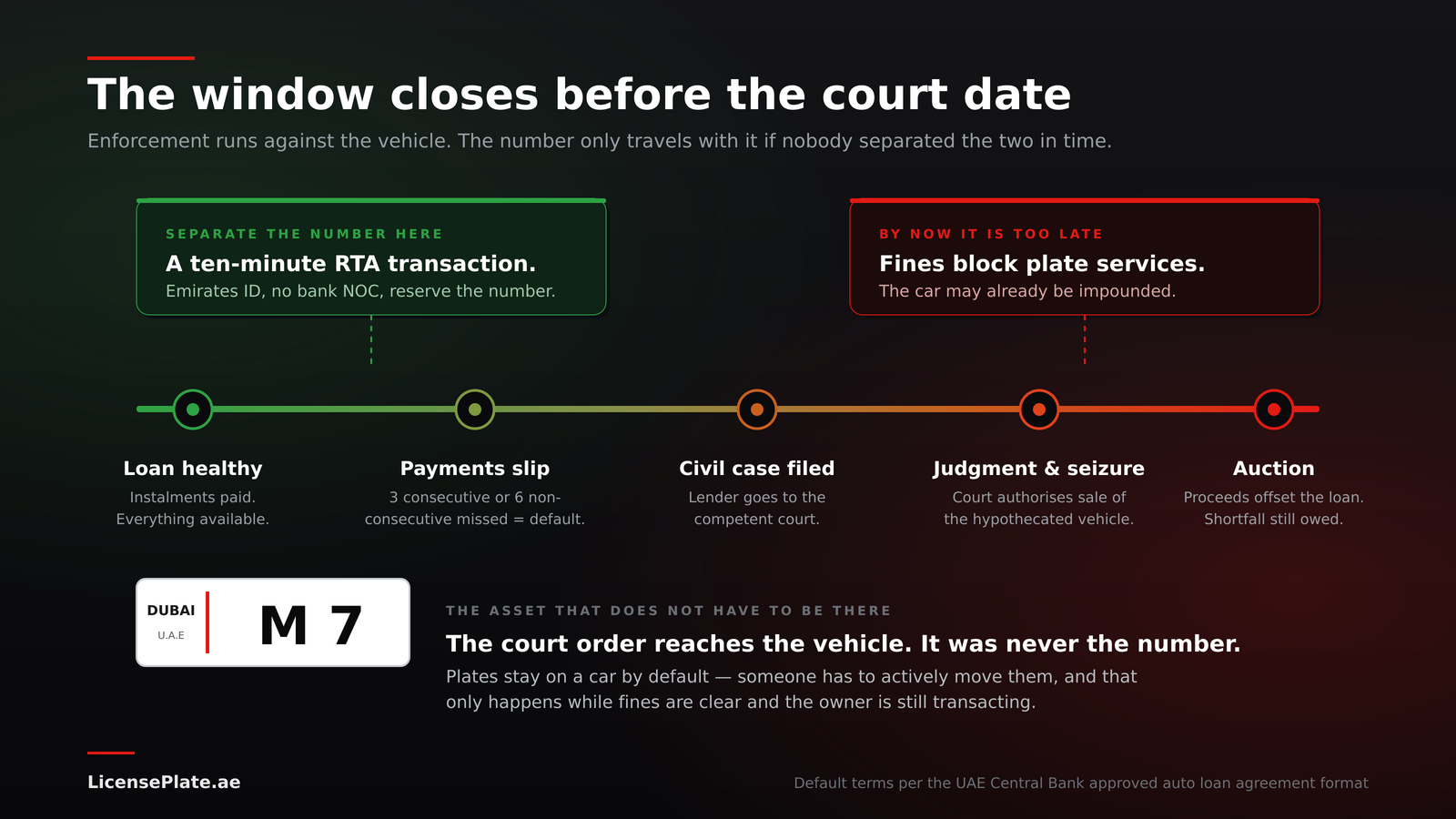
Under the Central Bank's approved auto loan agreement format, default is triggered when a borrower misses three consecutive instalments, or six non-consecutive instalments, without the bank's approval. From there the lender does not simply take the car. It files a civil case in the competent court, obtains a judgment authorising seizure of the hypothecated vehicle, and sells it at auction. Bank vehicle auctions in Dubai are held at the Al Aweer used-car complex under official supervision. Proceeds go against the outstanding balance, and if the sale falls short, the borrower still owes the difference. Separately, dishonoured security cheques can trigger civil execution proceedings under Article 635 of the amended Commercial Transactions Law, and travel bans are available to the courts.
Now apply the three-objects framework. The judgment authorises the sale of the vehicle. That is what was hypothecated and that is what the court is dealing with. The number is not the collateral.
But here is the practical problem, and it is a timing problem rather than a legal one. Plates stay with the vehicle unless somebody actively separates them — that is the default behaviour we cover in what happens to your number plate when you sell your car. An owner who reaches the seizure stage has usually stopped transacting with the RTA altogether: fines have accumulated, which blocks plate services at step one; the car may already be impounded; and the person is rarely in a position to walk into a customer happiness centre and calmly run a plate change. The window in which the separation was easy closes long before the court date.
Which produces the single most useful sentence in this article: the time to think about your number is when the loan is healthy, not when it isn't. If you are carrying a five- or six-figure number on a financed car and your income situation is changing, moving that number onto a car you own outright — or into reservation — is a ten-minute transaction today and an impossibility later. Our guide to plate financing in the UAE covers the related question of borrowing against a plate, and the RTA's own instalment scheme under Resolution 917 covers paying for one over time.
Buying a plate from someone whose car is financed
Flip to the other side of the table. You have agreed a price for a number and the seller's car is under finance. What is your exposure?
Less than you would think, but only if the deal is structured in the right order. The seller is not blocked from separating the number — that is the whole point of everything above. What can bite you is a seller who has not done it yet, has unpaid fines, and cannot complete step one.
A workable buyer checklist:
- Verify the number, not the car. The Plate Ownership Certificate is the document that matters, and it is issued in the seller's name. Our pre-purchase verification workflow sets out every official check, and the due diligence checklist covers what each one proves.
- Ask about fines before you ask about price. Outstanding fines block the seller's ability to transact at all. They are the seller's problem, and they should be cleared before, not after, you pay.
- Do not accept "I'll swap the plates over." If a seller offers to physically move plates rather than process a transfer, walk. That is Article 34 territory and you would be a participant.
- Separate the two questions in writing. Whether the seller's car is mortgaged is irrelevant to your purchase of the number. Whether the seller can clear fines and complete an RTA transaction is entirely relevant. Ask the second question.
Once the number is on a clean footing, the transfer itself is the ordinary process described in transferring a number plate in Dubai and in the anatomy of a plate transaction. Nothing about the seller's car finance changes what you sign or what you pay.
What we cannot tell you
Three honest limits, because this subject attracts confident answers that are not supported by anything.
We cannot tell you what your finance agreement says. The RTA's requirements are published; your loan contract is not. UAE auto finance follows a Central Bank-approved format, but lenders add their own terms. If your agreement contains a covenant about the vehicle's registration particulars, that is a contractual obligation to your bank regardless of what the RTA will process for you. Nobody writing about this topic — including us — has read your contract.
We cannot tell you how a court would treat a separation made in the run-up to default. There is no published UAE judgment we can point to on whether moving a valuable plate number off a hypothecated vehicle shortly before enforcement could be challenged by a creditor. The law on the plate is clear; the law on that specific sequence of events is not something we can source. Anyone who tells you confidently either way is guessing.
We cannot tell you what an individual service-centre agent will ask for. The published requirement is an Emirates ID. Front-desk practice varies, and a request for extra documents is not the same as a rule. If it happens, the service page is the reference — but expect the occasional friction.
What we can tell you is what the RTA publishes, what the federal law says, and how the three legal objects relate. That is the part that is actually verifiable, and it is more than anyone else in this niche has written down.
Six mistakes that cost financed owners money
Mistake 1: Assuming the mortgage freezes everything. The most expensive error on this list, because it is silent. Owners leave premium numbers parked on financed cars for years believing they have no options, then discover at the worst possible moment that a ten-minute transaction was always available.
Mistake 2: Reading car-sale advice as plate advice. Guides about selling a mortgaged car are correct and irrelevant. They describe the ownership transfer, where the mortgage release genuinely is mandatory. Applying that conclusion to plate management is how the myth started.
Mistake 3: Surrendering the outgoing number instead of reserving it. The reservation option appears inside the same transaction and is easy to click past. Return the plate and the number goes back to the RTA — for a valuable combination, that is a five-or-six-figure mistake made in one screen.
Mistake 4: Ignoring fines until the counter. Fines are the actual blocker, and they are the one the RTA states explicitly. Clear them first; the transaction fails at the start otherwise.
Mistake 5: Doing it with a screwdriver. Article 34 carries up to six months and AED 20,000 to AED 100,000 for moving a plate between vehicles without the Licensing Authority's prior approval. Owning both cars is not a defence.
Mistake 6: Letting the reservation lapse. One year, renewable, with a dedicated sub-service for the renewal. If the next car is delayed, the certificate is what protects the number in the meantime.
Frequently asked questions
Do I need a bank NOC to change my number plate if my car is on finance in Dubai?
No. The RTA's Manage Vehicle Plates service page answers this directly in its own FAQ: an NOC from the bank is not required to change the plate number when the vehicle is under mortgage. The listed service requirement is an Emirates ID, and all traffic fines must be paid.
Can I sell my car while it is under bank mortgage?
Not until the mortgage is released. The RTA lists an electronic mortgage release as a required document for changing vehicle ownership, and its service conditions state that the seller must release the mortgage online before proceeding. This is the transaction the mortgage genuinely blocks.
Can I move my premium number to another car I own while the first car is financed?
Yes, through the RTA. It is done as processed plate transactions: change the number on the financed car and reserve the outgoing number, then assign that reserved number to your other vehicle. Both steps go through Manage Vehicle Plates. What you must not do is move the plates physically without the transaction.
Does the bank own my number plate?
No. The bank holds a first-degree hypothecation over the vehicle, registered against the vehicle record. The number is evidenced by a separate Vehicle Plate Number Ownership Certificate issued in your name, valid for one year. The bank is not a party to that certificate.
What happens to my plate if the bank repossesses the car?
The court judgment authorises sale of the hypothecated vehicle. In practice, plates stay with a vehicle unless someone actively separates them beforehand, and by the seizure stage an owner usually has accumulated fines that block plate services anyway. The realistic protection is separating the number while the loan is still healthy, not after default.
What counts as default on a UAE car loan?
Under the Central Bank's approved auto loan agreement format, missing three consecutive instalments or six non-consecutive instalments without the bank's approval. The lender then files a civil case, obtains a judgment, seizes the vehicle and sells it at auction, and any shortfall remains owed by the borrower.
How much does it cost to change a plate number on a financed car?
The same as on any other car — finance changes nothing. AED 105 total for a short plate, AED 120 for a long plate, AED 220 for a classic, AED 270 for a Dubai-branded plate, AED 570 for a luxury plate and AED 95 for a motorcycle plate. Each total is the plate fee plus AED 50 ownership issuance plus AED 20 Knowledge and Innovation.
How long can I keep a reserved plate number?
The Vehicle Plate Number Ownership Certificate is valid for one year. The RTA runs Renew the Reservation of a Plate Number as a dedicated sub-service, so the reservation can be extended rather than allowed to lapse.
Is it illegal to unscrew my plates and put them on my other car?
Yes. Article 34 of Federal Decree-Law No. 14 of 2024 makes transferring a plate from one vehicle to another without the Licensing Authority's prior approval an offence carrying imprisonment of up to six months and/or a fine of AED 20,000 to AED 100,000. Owning the number and both vehicles does not change this.
How long does a mortgage release take?
Reported market timelines cluster around two to five working days on the bank side once the loan is settled, with the RTA reflecting it within roughly a day of receiving the electronic confirmation, followed by an SMS or email notification. These are observed timelines rather than a published RTA service level, and they vary by lender.
Do unpaid traffic fines block plate services?
Yes. The RTA states under You Should Do that you must pay all your traffic fines. This applies regardless of finance and is the requirement most likely to actually stop your transaction.
Can I buy a number plate from someone whose car is under bank finance?
Yes. The seller's car finance does not restrict their ability to deal with the number. What matters is whether the seller can complete an RTA transaction, which mainly comes down to cleared fines. Verify the Plate Ownership Certificate rather than the car's finance status.
Does the mortgage appear on my mulkiya?
Yes — the mortgagee is recorded on the vehicle registration card, which is how the arrangement is visible to the RTA and to anyone running a check. The card evidences the charge; it does not create it.
Does changing the plate number affect my car insurance?
Your policy follows the vehicle, but the plate number is part of the registration particulars that insurers record. Notify your insurer after the change so the policy details match the new mulkiya, and check the position with your lender's insurance requirements if the car is financed.
Where can I find out what my number is actually worth before deciding?
Run it through the plate value calculator for a market-anchored range, then read the complete pricing framework for the reasoning behind the number. If the plate on your financed car is worth more than the outstanding balance, that fact alone should change how you think about the next twelve months.
The one-line version
The chain is on the car. Your number is on a certificate with your name on it. The RTA has said in writing that it does not need your bank's permission to move that number, and it has built a reservation mechanism specifically so the number does not have to go anywhere while you sort the rest out. The only thing that turns any of this into a problem is doing it yourself with a screwdriver, or waiting until the fines have piled up and the court date is set.
If you are carrying a valuable plate on a financed car, the useful question is not can I? It is why haven't I?