

UAE Number Plate Financing 2026: Can You Get a Bank Loan or Installments for a Premium Plate?
You've found the plate. It's an AA 5-digit that clears at AED 320,000. Your car budget was AED 250,000. Your emergency fund is not touchable. And every article about UAE plates you've read assumes you're arriving at the RTA with a manager's cheque already in hand. This is the question the plate coverage keeps skipping: Can you actually finance a UAE number plate? And if so, how — without turning a five-year asset appreciation into a five-year liability nightmare.
Short answer: yes. Not through a "plate loan" (no UAE bank offers one), but through three legitimate financing paths that owner-buyers have been using for years. This is how each one actually works — the fees, the paperwork, the traps, and the AED math that decides which one fits your buy.

TL;DR — Can You Finance a UAE Number Plate?
- Yes, but no bank offers a dedicated "plate loan." The RTA settlement itself must be paid in full within 10 working days of a winning auction bid — there is no RTA-side installment plan.
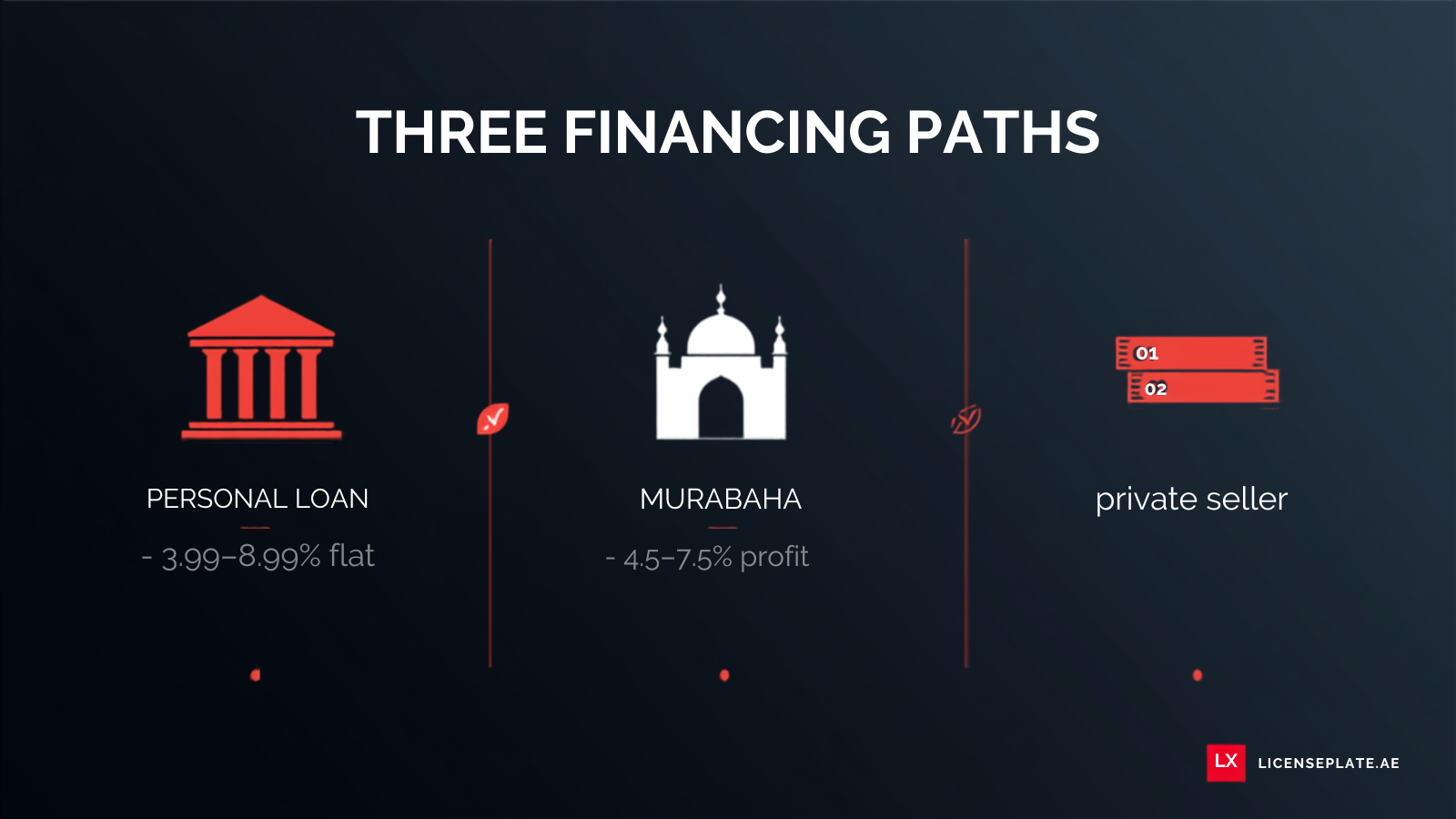
- Three real paths: (1) personal finance from a UAE bank (conventional or Sharia-compliant Murabaha), (2) private-seller post-dated cheque schemes on the secondary market, (3) credit-card payment against a paid-in-full RTA settlement.
- What banks look at: your salary, DBR (debt-burden ratio), UAE residency status, and credit history — not the plate itself. The plate is not collateral in a conventional finance structure.
- Typical rates 2026: conventional personal loans from 3.99% to 8.99% flat, Murabaha profit rates from 4.5% to 7.5%.
- The single biggest trap: confusing "flat rate" with "reducing rate." A 4.99% flat rate is roughly a 9.5% reducing rate — read our full breakdown below.
- Sharia-compliant alternative: Murabaha structures the transaction as a sale + resale, avoiding riba (interest). Dubai Islamic Bank, Emirates Islamic, ADIB, Ajman Bank all offer it — but Murabaha for a plate specifically is under-marketed; you frame it as a personal-purchase Murabaha, not an auto Murabaha.
What This Guide Covers
- What "plate financing" actually means in the UAE
- Why no UAE bank offers a dedicated plate loan
- Path 1: Personal finance (conventional or Sharia)
- Path 2: Private-seller installment via post-dated cheques
- Path 3: Credit card payment with cashback / points play
- The AED math — flat rate vs reducing rate, worked example
- Sharia-compliant financing: how Murabaha applies to a plate purchase
- The 10-working-day RTA settlement window — the constraint that shapes everything
- Plate as collateral — the B2B lending market
- Credit-card strategies for plate purchases
- Which path fits which buyer
- Six financing mistakes that cost buyers real money
- FAQ — everything a first-time financed buyer asks
What "Plate Financing" Actually Means in the UAE
UAE plate financing is any arrangement that lets a buyer spread the cost of a number plate purchase over time rather than paying the full amount up front — typically via a personal loan from a UAE bank, a post-dated cheque installment schedule with a private seller, or credit-card financing against a paid RTA settlement. There is no product marketed by any UAE bank as a "number plate loan" specifically. The financing is real; the label is not.
That distinction matters because it determines what happens when you walk into a bank and ask. If you say "I want to finance a plate," the relationship manager reaches for the auto-finance form — which is the wrong product, because auto-finance is secured by the vehicle registration, not by a plate. What you actually want is a personal finance product priced for your salary and DBR, disbursed as cash to your account, which you then use to settle the plate at RTA.
Why No UAE Bank Offers a Dedicated Plate Loan
1. The plate is not registrable as collateral in a bank's system
Auto finance works because a UAE bank can place a lien on the car's registration (mortgage the vehicle) until the loan is paid. The RTA (Dubai) and the emirate-equivalent authorities recognise vehicle mortgages and record them against the chassis. There is no equivalent recording mechanism for a number plate — the plate is a right, not a titled asset in the way a car is.
2. Plate valuations are illiquid and highly variable
Banks lend against assets they can value and, if needed, dispose of quickly. A plate's market value moves with auction cycles, cultural events, and the taste of a very small pool of high-net-worth buyers. That volatility is what makes plates a compelling asset — and exactly what makes them unappealing as loan collateral for a mainstream bank.
3. Regulatory pigeonholes
UAE Central Bank regulations classify consumer finance products into a defined set of categories: personal, auto, home, credit card, education. A "plate loan" doesn't map to any of them. The product would need a category, disclosures, and a risk model — and no bank has bothered because the demand is served (imperfectly) by existing personal finance.
Path 1: Personal Finance (Conventional or Sharia-Compliant)
What it is
A general-purpose personal finance from a UAE bank. Cash disbursed to your account. You use it however you like — including to settle a winning RTA plate auction, or to complete a private plate purchase. The plate itself is not held by the bank.
Who qualifies
- Salaried residents: minimum monthly salary typically AED 5,000 – 10,000 (varies by bank). Salary transferred to the lending bank usually gets better rates.
- Self-employed / business owners: most banks require a trade licence + 6–12 months of business bank statements. Higher rates, tighter DBR (debt-burden ratio) limits.
- DBR ceiling: Total monthly debt (all loans + credit card minimums) cannot exceed 50% of gross monthly income. This is a UAE Central Bank rule, not a per-bank rule.
- Maximum loan size: typically 20x your monthly salary, capped at AED 5 million.
What it costs
| Loan structure | Typical 2026 rate | Notes |
|---|---|---|
| Conventional personal loan (flat rate) | 3.99% – 8.99% p.a. | Flat rate — misleadingly low; see math section |
| Conventional personal loan (reducing rate) | 7.5% – 17.5% p.a. | Actual effective cost — comparable to a credit card in some tiers |
| Islamic personal finance (Murabaha profit) | 4.5% – 7.5% p.a. | Sharia-compliant; no interest, structured as sale + resale |
| Salary-transfer preferential rate | –1.0% to –2.5% off standard | Requires transferring your salary to the lending bank |
| Loan tenure | 12 – 48 months | Max 48 for personal loans; some banks stretch to 60 |
| Processing fee | 1% of loan amount (max AED 2,500) | One-time, at disbursement |
| Early settlement fee | 1% of outstanding balance (max AED 10,000) | Applied if you repay early |
| Late payment fee | AED 200 – 500 per missed instalment | Plus credit-bureau impact |
The end-to-end sequence for a plate buy
- Estimate your total plate cost including 5% VAT and RTA fees. See our RTA auction walkthrough for the full cost breakdown.
- Approach 2–3 banks with quotes on the same principal and same tenure. Get every rate quoted on reducing balance, not flat. Any RM who won't quote reducing is either being lazy or hoping you won't compare properly.
- Get pre-approval before you bid. Personal loan pre-approvals typically take 24–72 hours if your salary transfers, longer for self-employed.
- Bid or negotiate. When you win / agree the plate, request disbursement of the loan to your account.
- Settle at RTA within the 10-working-day window (auction path) or transfer to the seller (private path).
Path 2: Private-Seller Installments via Post-Dated Cheques
What it is
A direct arrangement between you and the seller where you pay in monthly installments backed by post-dated cheques. The seller retains legal ownership of the plate (registered to their name) until the final cheque clears. Common for larger private-market transactions where the seller is willing to trade time for a higher effective price.
How the structure works
- Buyer and seller agree total price, deposit, installment count, and installment amount.
- Buyer pays deposit (typically 20–40%) upfront in cleared funds.
- Buyer writes post-dated cheques for the remaining balance, one per month.
- Seller holds all the cheques and typically retains the plate registration until the last cheque clears.
- Once the final cheque clears, the seller transfers the plate to the buyer at RTA / TAMM / MOI.
Where this goes wrong
- Bounced cheques. UAE law has softened on cheque bouncing (since 2022 it is no longer automatic criminal action), but it remains a civil liability. A single bounced cheque typically voids the entire deal and forfeits the deposit.
- Seller default. If the seller cannot or will not transfer at the end, you have paid in full for a plate registered to someone else. Recovery requires civil court.
- No formal escrow. The seller holds the plate; the buyer holds nothing but a promise. Every professional plate broker will tell you this is the highest-risk path in the entire UAE plate market.
How to make it safer
- Insist on a notarised bilateral agreement. The RTA / TAMM does not enforce this, but a Dubai Courts notarisation gives you clean recourse.
- Escrow through a marketplace or broker. If you can push the transaction through a marketplace like LicensePlate.ae, the middleman provides the trust layer that a private cheque schedule lacks.
- Never use post-dated cheques with a first-time seller you haven't verified. See our due-diligence checklist and plate fraud playbook.
Path 3: Credit Card Payment with Cashback / Points Play
What it is
You settle the full RTA plate purchase amount with a credit card, then either pay it off in full at month-end (no interest) or use the card's installment-plan feature (interest applies). The catch: RTA accepts credit cards for plate settlements, so this is legitimately usable, but the per-transaction and monthly card limits create a natural ceiling.
When it actually makes sense
- Plate cost is within your monthly credit limit and you have the cash to settle at month-end.
- Your card earns 1.5%+ cashback or 2+ points per AED — you're effectively getting paid to route a large purchase through the card.
- Your card offers 0% installment plan on large purchases (typical UAE offer: 3, 6, or 12 months at zero profit rate, sometimes with a small processing fee).
The trap
If the plate is above your credit limit — which for most premium plates it will be — you cannot make the purchase in one hit even if you have the funds. Credit-card-based financing is a play for plates in the AED 30,000 – 200,000 tier, not the AED 500,000+ tier. Above that, you're on Path 1 or Path 2.
Path 4: The RTA's Own Instalment Scheme (Dubai)
There is a fourth route that most financing coverage — including the three paths above — leaves out entirely, because it is not a bank product at all. Dubai's RTA operates its own official instalment facility for eligible plates under Administrative Resolution No. 917 of 2021.
- 25% down payment, with the balance spread over a maximum of 24 months.
- Zero interest charged by the RTA — it is a payment convenience, not a lending product.
- Minimum plate value of AED 10,000 for individuals, AED 100,000 for companies and licensed traders.
- The catch: a lien is placed on your Traffic File, so the plate cannot be sold, gifted or transferred until the final instalment clears.
For long-term holders this is usually the cheapest legitimate money available — a 24-month interest-free float on 75% of the price. For flippers it is the wrong instrument, because the lien closes the resale door for exactly as long as you are paying. Full mechanics, eligibility and the default consequences are in our dedicated guide to the Dubai number plate instalment plan under RTA Resolution 917.
The AED Math — Flat Rate vs Reducing Rate (Worked Example)
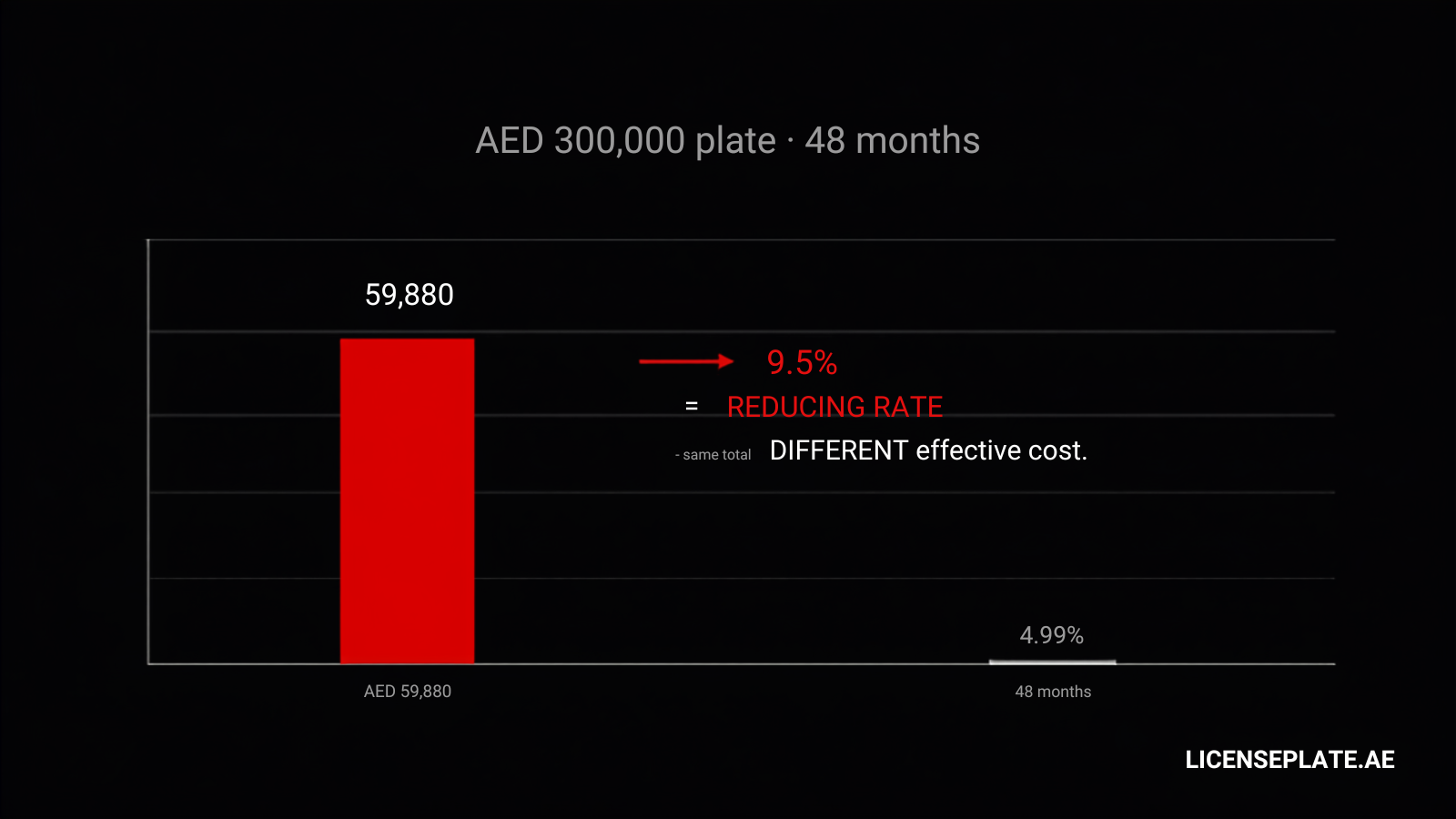
Take a real scenario: you're financing an AED 300,000 plate over 48 months.
Scenario A: "4.99% flat rate" (as marketed)
- Total interest = AED 300,000 × 4.99% × 4 years = AED 59,880
- Total repayable = AED 359,880
- Monthly installment = AED 7,497
Scenario B: "9.5% reducing rate" (the actual cost)
- Same monthly installment: AED 7,497 (banks calibrate this so both scenarios collect the same total)
- Same total interest: AED 59,880
- But the effective annual cost of your borrowing = 9.5%, roughly double the flat rate.
Why this matters
Banks and brokers advertise the flat rate because it looks lower. When comparing offers from two banks — one at "5.99% flat" and another at "10% reducing" — the second is often the cheaper loan. Always ask for the Annual Percentage Rate (APR) or the reducing rate equivalent for a proper comparison.
Quick conversion rule of thumb
For a 48-month personal loan: reducing rate ≈ flat rate × 1.9. So 4.99% flat ≈ 9.5% reducing; 6% flat ≈ 11.4% reducing; and so on. Not exact, but close enough for a first-pass comparison.
Sharia-Compliant Financing: Murabaha for a Plate Purchase
What Murabaha is
An Islamic financing structure where the bank buys the asset and immediately resells it to you at an agreed profit margin, payable in installments. There is no interest — the bank's return is the profit margin on the sale, which is fixed and disclosed at the outset. This satisfies the Islamic prohibition on riba (interest).
How it applies to a plate
The bank does not literally buy a licence plate on your behalf (that would require the bank to hold the plate register, which is impractical). In practice, for a plate purchase, Islamic banks offer a commodity Murabaha or a personal-purpose Murabaha: the bank buys a Sharia-compliant commodity (typically metals through an approved broker), resells it to you at an agreed profit, and you use the resulting cash to fund your plate purchase. Structurally different from an interest loan; economically comparable.
Who offers it
- Dubai Islamic Bank — dedicated personal finance Murabaha, salary-transfer preferential rate available
- Emirates Islamic — Al Diwan personal finance with Murabaha structure
- ADIB (Abu Dhabi Islamic Bank) — Ghina personal finance, Sharia-supervised
- Ajman Bank — personal finance Murabaha with flexible tenor
- Sharjah Islamic Bank, RAKBank Islamic, FAB Islamic — comparable products
What to check before signing
- The profit rate is fixed for the full tenor. Unlike some conventional loans, Murabaha profit cannot be re-priced mid-contract.
- Early settlement rebate. If you pay off early, most Islamic banks offer a "hibah" (gift) rebate on the remaining profit. Not automatic — ask.
- Fatwa / Sharia supervisory board sign-off. Every legitimate Islamic finance product carries this. If you can't find it on the bank's website, ask the RM.
The 10-Working-Day RTA Settlement Window
This is the constraint that shapes every plate-financing decision.
When you win a plate at an RTA auction, you have 10 working days from auction close to pay the full winning amount. Miss it and your AED 5,000 deposit is forfeit and the plate is re-listed. The RTA does not offer any installment or deferred-payment option at settlement — it is a hard cash cutoff.
What this means for financing:
- Loan pre-approval before you bid. Never rely on getting a loan disbursed after you win. Bank disbursement can take 3–5 working days once documentation is complete, and documentation itself takes 2–3 days. Cutting it close on a AED 300,000 loan is the definition of avoidable stress.
- Cash-in-hand check before you bid. Confirm the loan disbursement window with your RM in writing. "Guaranteed within X working days of signing" is what you want.
- Backup line of credit. If your loan is delayed by even one working day past the RTA cutoff, you lose the deposit. A pre-arranged overdraft or credit-card cash advance is expensive insurance — but insurance nonetheless.
For the full RTA settlement process see our first-timer's RTA auction walkthrough.
Plate as Collateral — The B2B Lending Market
Consumer banks don't take plates as collateral. A small but real B2B credit market does — specialist lenders and private financiers who understand the plate market's liquidity and take premium plates as security against short-term facilities.
This is a working capital solution more than a plate-purchase solution: an existing plate owner uses their plate as security for a 6–24 month loan, freeing up cash for another investment (often another plate). It is not typically used to buy a plate — because that would require the plate to already be registered to the borrower, which chicken-and-eggs the whole idea.
Full context on plate-backed lending: The B2B credit market built on premium plate collateral.
Credit-Card Strategies for Plate Purchases
Cashback plays
A 1.5% cashback card on a AED 100,000 plate settlement returns AED 1,500. If your card is a 2% cashback tier, that's AED 2,000 — the equivalent of a 0.67% price discount on the plate. Meaningful for buyers already close to their liquidity ceiling.
Points and mileage plays
Premium cards (Emirates Skywards Signature, ADCB Etihad Guest, HSBC Advance) award 1–4 points/miles per AED. A AED 100,000 plate settlement can yield 100,000+ points — enough for a business-class ticket to Europe. Some sellers accept this as a legitimate portion of the buy motivation.
0% installment plans
Many UAE cards offer 0% installment plans on large purchases, typically 3, 6, or 12 months. Processing fee 0.5%–2% depending on card. If you can settle the full amount at month-end from cash flow, this is effectively a free short-term loan.
What breaks all three
Your credit limit. For premium plates above AED 100,000, few personal cards allow settlement in one hit — you'd need a limit increase, a corporate card, or to split across multiple cards (which the RTA doesn't allow on a single settlement).
Which Path Fits Which Buyer
| Buyer profile | Recommended path | Why |
|---|---|---|
| Salaried resident, plate AED 30k–150k, 12-month payoff plan | Credit card + 0% installment plan | Zero-cost financing if you clear at month-end. Get cashback / points on top. |
| Salaried resident, plate AED 150k–1M, 24–48 month payoff | Bank personal finance (or Murabaha) | Standard use case. Compare 3 banks on reducing-rate APR. |
| Self-employed / business owner, plate AED 100k–2M | Bank personal finance under business account, or private-seller installments | Business banks often quote higher rates than salary-based; installments avoid the DBR check. |
| Investor buying to flip within 6 months | Short-term overdraft or credit-card 3-month installment | Long-tenor bank finance costs more than 6-month cost of capital typically warrants. |
| High-net-worth, plate AED 1M+ | Private banking margin facility | Cheapest capital, no DBR ceiling, structured against investment portfolio. |
| Buyer with Sharia requirement | Murabaha from any UAE Islamic bank | Structurally equivalent economics, Sharia-supervised. |
Six Financing Mistakes That Cost Real Money
1. Comparing flat rates instead of reducing rates
Covered above. Two banks quote you "4.99% flat" and "5.5% flat" — you take the 4.99% offer. But the second bank is actually offering 9.4% reducing, while the first is quietly 9.7% reducing. Always ask for APR.
2. Not getting loan pre-approval before bidding
The RTA 10-day settlement window doesn't care that your loan is "almost approved." Pre-approval before you bid protects your deposit.
3. Financing a plate you can't afford in cash
A plate is an appreciating asset in normal market conditions. But financing it means you now have two exposures: the plate's market value, and your ability to service the loan. If your income drops, you may be forced to sell the plate into a soft market to service the loan. Rule of thumb: don't finance a plate whose loan monthly is more than 15–20% of your take-home pay.
4. Assuming Islamic finance is automatically cheaper
Murabaha profit rates are competitive with conventional loan rates, but not automatically cheaper. Compare on total AED payable, not on "profit vs interest" labels.
5. Signing up for a post-dated cheque schedule with an unverified seller
The single highest-loss financing scenario in the UAE plate market. Deposits and monthly cheques against a plate you don't yet own is a trust exercise — treat it accordingly.
6. Using a personal loan to bid speculatively on multiple plates
A personal loan is a fixed liability. Bidding on 5 plates hoping to win 1 means you might win 3 and owe the loan-plus-two-more settlements. See our 10 expensive mistakes first-time plate buyers make.
FAQ — UAE Number Plate Financing
Can you finance a UAE number plate?
Yes, through three paths: a personal loan (conventional or Sharia-compliant Murabaha) from a UAE bank, a private-seller post-dated cheque installment schedule, or credit-card payment against a paid RTA settlement. No UAE bank offers a dedicated "number plate loan" product.
Do UAE banks offer specific plate financing?
No. UAE banks offer general personal finance products, some of which can be used for plate purchases. The plate itself is not held as collateral in a conventional bank finance structure.
What is the interest rate on a personal loan for a plate in 2026?
Conventional personal loans in the UAE quote flat rates of 3.99%–8.99% p.a., which convert to reducing-balance rates of roughly 7.5%–17.5% p.a. Islamic Murabaha profit rates run 4.5%–7.5% p.a. Always compare on reducing-rate APR.
Can I pay for an RTA plate in installments directly to the RTA?
No. The RTA requires full settlement within 10 working days of a winning auction bid. There is no RTA-side installment plan. All installment plans are between the buyer and their financer or between the buyer and a private seller.
What is the maximum personal loan I can get in the UAE?
UAE Central Bank rules cap personal loans at 20x monthly salary or AED 5 million, whichever is lower. Total monthly debt payments cannot exceed 50% of gross monthly income (DBR ceiling).
Is Murabaha cheaper than a conventional personal loan?
Not automatically. Compare on total AED payable over the full tenor, not on "profit vs interest" labels. Both can be cheaper in different tiers.
Can non-residents finance a UAE number plate?
Non-residents cannot typically access UAE personal finance products. They must pay in cash or arrange financing in their home jurisdiction. Non-residents can still open a Dubai traffic file and complete the plate purchase — see our non-resident buying guide.
What happens if I miss a loan payment on my plate finance?
Late fees of AED 200–500 per missed installment, credit bureau impact, and after 90 days of non-payment the bank can accelerate the loan and pursue civil recovery. The plate itself is not repossessed (it's not collateral), but your credit and asset base can be.
Can I use a credit card to pay for a plate at the RTA?
Yes. RTA accepts credit and debit cards for plate settlements. Your card's credit limit is the practical ceiling.
Is it a good idea to finance a plate for investment?
Only if the expected annual appreciation on the plate meaningfully exceeds your loan's effective annual cost (reducing rate) — and you can service the loan even if the plate's market value stalls or drops. Never finance a plate whose monthly loan payment is more than 15–20% of your take-home income.
Can the bank take my plate if I default on a personal loan?
No — the plate is not held as collateral on a standard personal finance. The bank pursues your salary, other assets, and civil recovery like any other unsecured debt. This is different from auto finance where the car itself is registered mortgaged to the bank.
What documents do I need for a UAE personal loan for a plate?
Valid Emirates ID, passport + visa page, salary certificate (last 3 months), bank statements (last 3–6 months), proof of address (Ejari or utility bill). Self-employed applicants add: trade licence, memorandum of association, and 12 months of company bank statements.
How long does it take to get a personal loan disbursed?
Pre-approval: 24–72 hours for salaried applicants (longer for self-employed). Full documentation to disbursement: 3–7 working days typically. Plan for 2 weeks end-to-end and you won't miss any RTA settlement window.
Are there any plate-specific escrow services in the UAE?
Yes — some marketplaces (including LicensePlate.ae) provide agent-mediated communication and payment coordination that functions as a partial escrow layer. Formal legal escrow services from law firms can also be arranged for high-value transactions.
The Plate Is Financeable — Just Not the Way You Think

Every buyer we've worked with who used financing for a plate has hit the same two moments. First, the "why isn't there a plate loan" frustration — the realisation that the UAE banking system doesn't formally recognise the plate as a financeable asset the way it does a car or a house. Second, the "oh, this actually works" realisation once they figure out that a plain personal loan, plus a bit of planning around the RTA settlement window, gets them exactly where they wanted to go.
If you're eyeing a plate that stretches beyond your immediate cash: run the numbers on our free plate value calculator, then price a personal loan against your salary at three banks (compare reducing-rate APR only), then time the disbursement before you bid. The plate you win is the same plate you'd have bought with cash — the financing is what happens between the decision and the mounting.
Ready to look at plates you can now afford? Browse the full LicensePlate.ae marketplace.
The other direction: this guide covers borrowing to buy a plate. If instead you already own a valuable number and it is sitting on a car you are still financing, see number plates on a financed car in the UAE — including why the RTA does not require a bank NOC to move it.
Delete Comment?
Are you sure you want to delete this comment? This action cannot be undone.
Delete Article?
Are you sure you want to delete this article? This will also delete all comments. This action cannot be undone.