

How to Check Your UAE Number Plate Value: The Complete Pricing Framework
18 March 2026
Dubai Classic
LicensePlate.ae Team
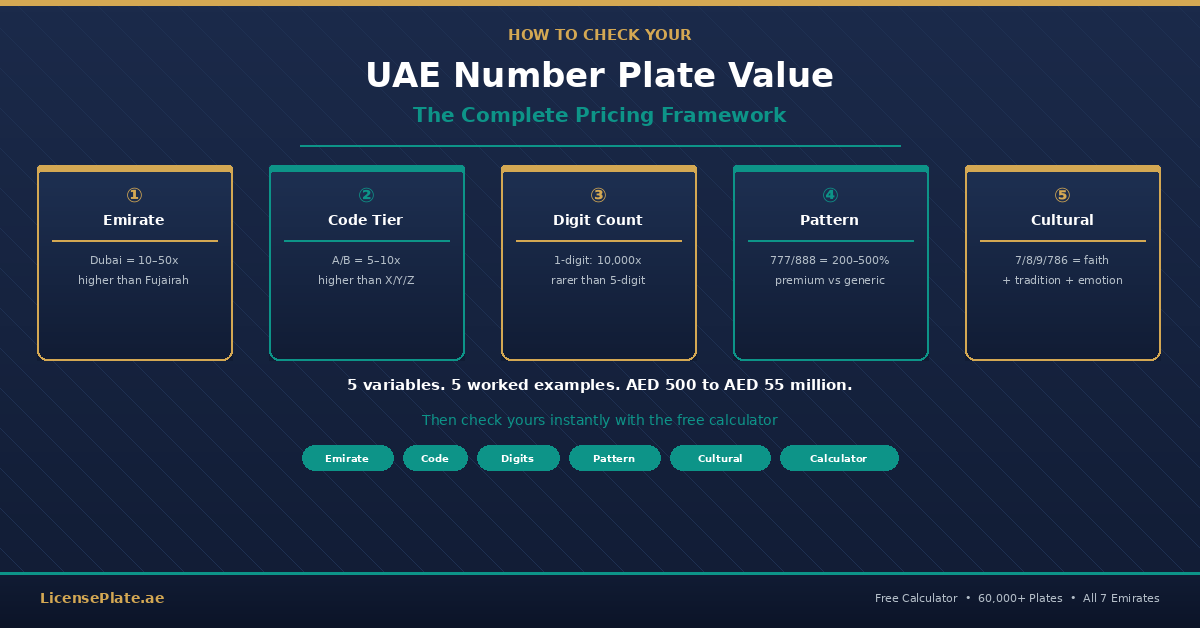
The answer is not a single number. It is a framework. Every UAE number plate’s value is determined by exactly five variables: which emirate issued it, what code letter it carries, how many digits are in the number, what pattern those digits form, and whether the number carries cultural or religious significance. Change any one of those five inputs and the price shifts, sometimes by orders of magnitude. A Dubai A 7 and a Fujairah Z 74831 are both UAE number plates. One is worth tens of millions. The other is worth a few hundred dirhams. The five-variable framework explains why.
This guide walks through each variable with real AED ranges, then applies the framework to five worked examples covering every price tier from AED 500 to AED 55 million. By the time you finish reading, you will be able to look at any plate in the country and estimate its value within a realistic range. Or you can skip the reading and check your plate’s value instantly with our calculator, which applies this same framework algorithmically using live marketplace data from 60,000+ active listings across all seven emirates.
Variable 1: The Emirate
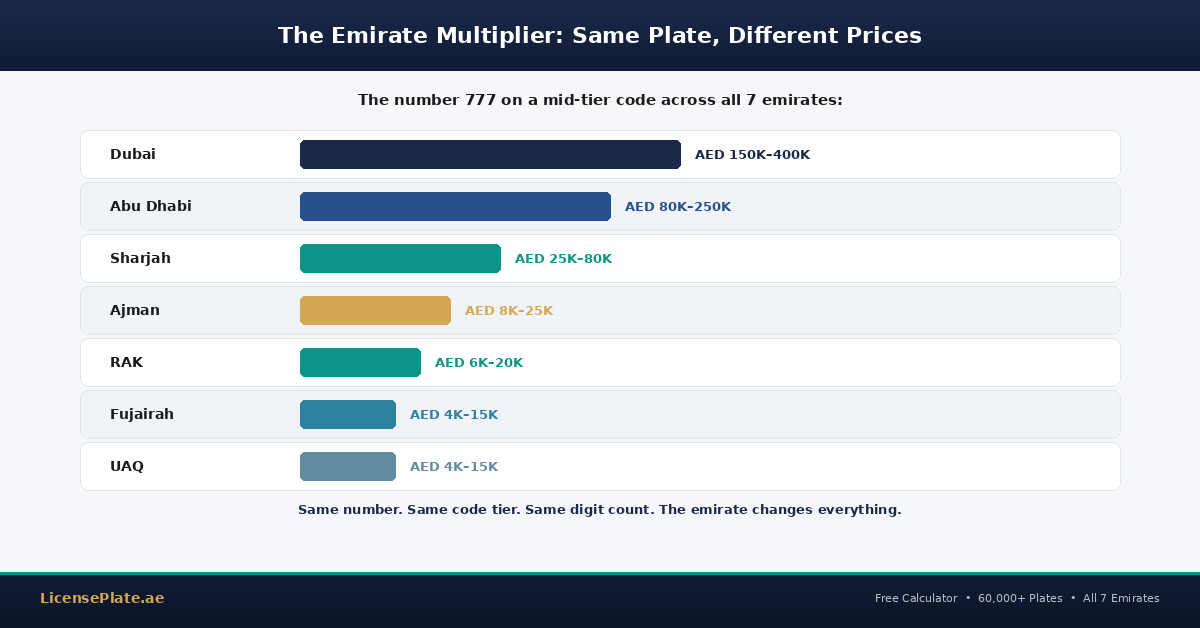
The emirate of registration is the single largest price multiplier. The same number on the same code can differ by 10 to 50 times depending on whether the plate says Dubai, Abu Dhabi, or Fujairah. This is not arbitrary. It reflects population size, wealth concentration, secondary market liquidity, and the cultural prestige each emirate carries.
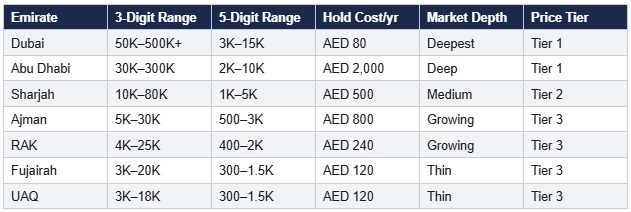
Dubai commands the highest premiums because it has the largest population (3.7 million+), the deepest secondary market, and the most international recognition. A three-digit plate that costs AED 50,000 in Dubai might cost AED 5,000 in Ajman or AED 3,000 in Fujairah. For the full pricing matrix in Dubai specifically, the Price Guide 2026 maps every code and digit count. For the full emirate-by-emirate comparison, browse Dubai, Abu Dhabi, Sharjah, Ajman, RAK, Fujairah, or UAQ listings.
Variable 2: The Code Letter
In Dubai, the code letter on a plate is the second-largest price driver after the emirate itself. The Codes A to Z guide documents how earlier-issued codes (A, B, C, D) command 5 to 10 times the price of later codes (X, Y, Z) for the exact same number. This is because early codes were issued when Dubai’s vehicle fleet was smaller, meaning they contain a higher concentration of low-digit numbers in circulation.
The double-letter codes AA, BB, CC, DD operate in their own pricing universe. They were introduced later but carry prestige because they are used exclusively for RTA open auctions and charity events. DD 6 sold for AED 37 million. BB 88 sold for AED 14 million. These prices reflect the combined effect of code prestige plus cultural number significance.
Dubai Code Tiers
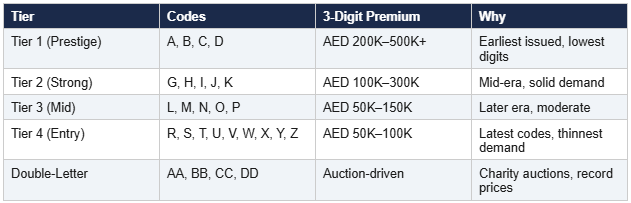
In other emirates, the code premium is softer. Sharjah uses numeric codes (1, 2, 3) instead of letters. Abu Dhabi uses categories 1 to 50. Ajman, RAK, Fujairah, and UAQ all use A through Z but with much smaller price differences between codes because the markets are thinner and less speculative.
Variable 3: The Digit Count
This is the simplest variable and the one that creates the widest price ranges. Fewer digits means fewer possible combinations, which means higher scarcity, which means higher prices. There are only 9 possible single-digit plates per code (1 through 9). There are 90 possible two-digit plates (10 through 99). There are 900 possible three-digit plates. There are 9,000 four-digit plates. And there are 90,000 possible five-digit plates. The ratio of single-digit to five-digit supply is 1 to 10,000. That scarcity ratio is the primary structural driver of UAE plate pricing.
Dubai Price Ranges by Digit Count (2026)
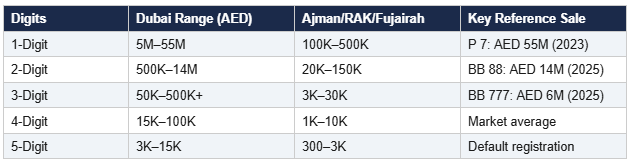
The jump between each digit tier is not linear. Going from five digits to four typically doubles the price. Going from four to three multiplies it by 3 to 5 times. Going from three to two can multiply it by 10. And single-digit plates exist in a category so rarefied that their prices are set by charity auction dynamics and personal willingness to pay rather than any conventional market logic.
Variable 4: The Number Pattern
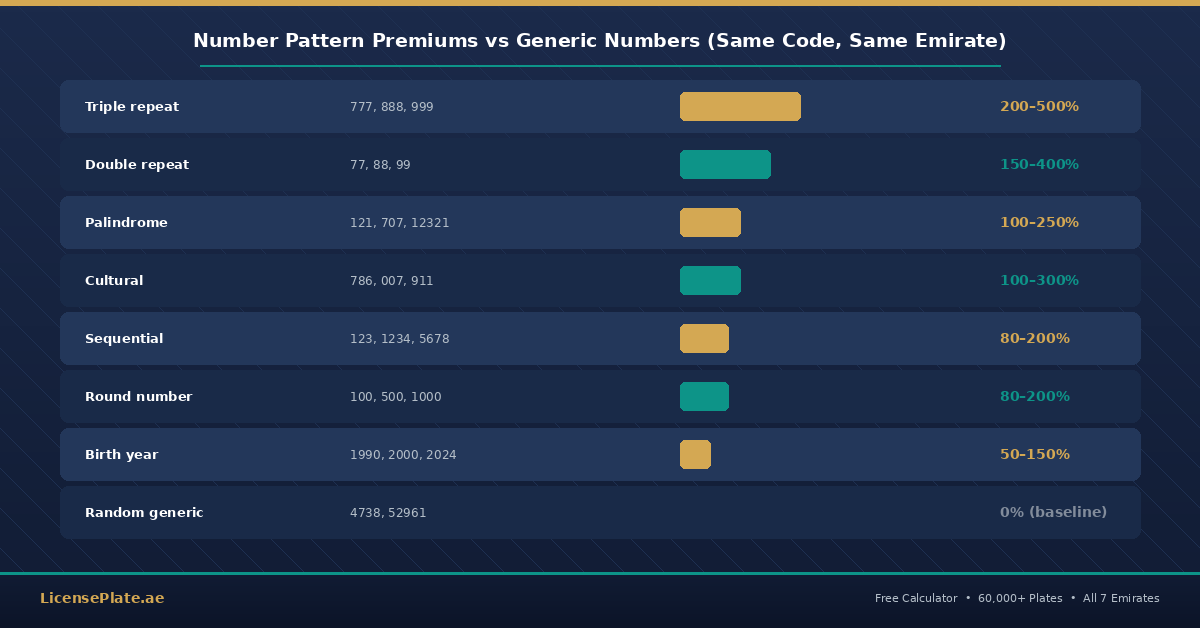
Two three-digit plates on the same code in the same emirate can differ in price by 300 to 500 percent depending on the pattern of the digits. The Numerology Guide covers the cultural layer in depth. Here is the pricing layer.
Pattern Premium Multipliers (vs Generic Numbers on Same Code/Emirate)
Pattern Premium Multipliers (vs Generic Numbers on Same Code/Emirate)
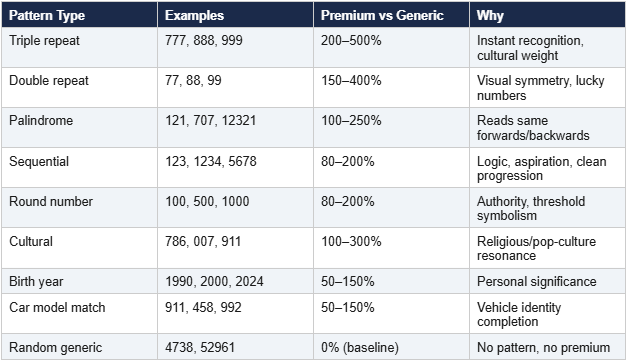
A plate like Dubai G 888 commands a premium not just because 888 is a triple repeat, but because 8 carries prosperity symbolism in Chinese culture, and the UAE’s Chinese community (200,000+ residents plus significant investment flows) actively bids on these numbers. Pattern premiums compound when the number also has cultural weight.
Variable 5: Cultural and Religious Significance
This is the variable that turns a number plate from a registration into an asset with emotional demand. The Cultural Numerology Guide covers this in full, but the pricing impact is direct:
Number 7: Seven heavens in Islam, seven emirates of the UAE, spiritual power across Hindu and Chinese traditions. P 7 sold for AED 55 million. BB 777 sold for AED 6 million.
Number 8: Prosperity in Chinese culture (bā sounds like fā, meaning wealth). BB 88 sold for AED 14 million.
Number 9: Longevity and completeness in Arabic tradition, emperor’s number in Chinese culture. AA 9 sold for AED 38 million.
786: Bismillah ir-Rahman ir-Rahim in Abjad numerals. D 786 sold for AED 527,000. Sacred to millions of Muslims across South Asia and the Gulf.
Number 4: Negative premium. Sounds like "death" in Chinese. Plates containing 4, 44, or 444 sell at 10 to 20% discounts versus equivalent patterns with other digits.
Cultural significance creates pricing floors that are unusually resistant to market dips because the demand is devotional or traditional rather than speculative.
Five Worked Examples: From AED 500 to AED 55 Million
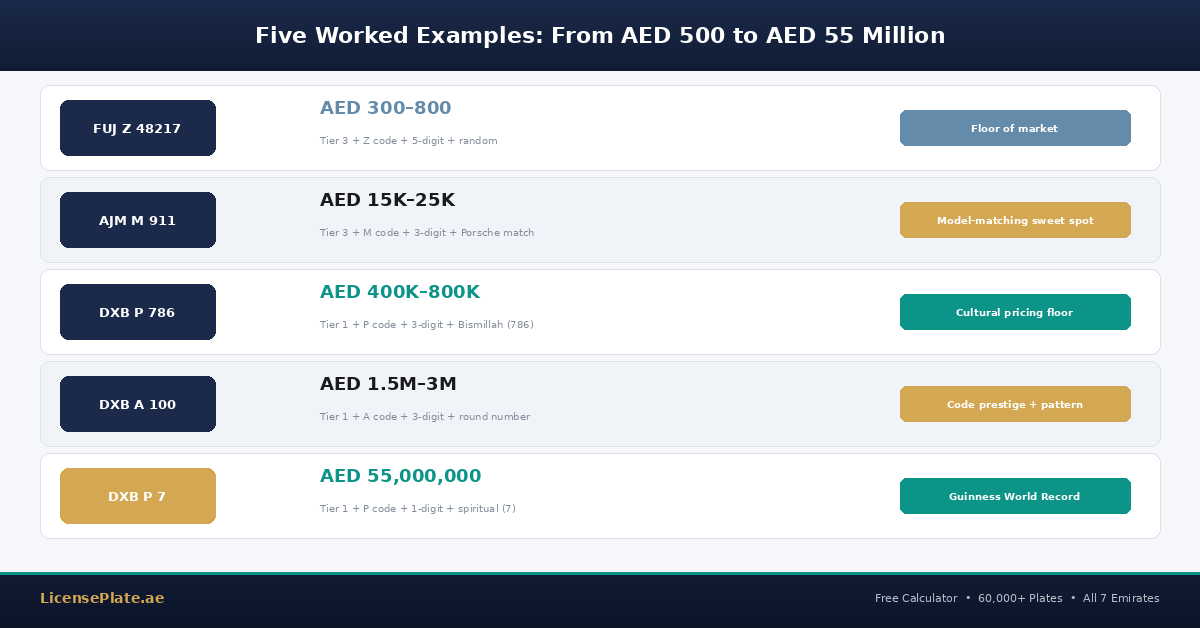
Now let us apply the framework to real plates across every price tier.
Example 1: Fujairah Z 48217 — Estimated Value: AED 300 to AED 800
Emirate: Fujairah (Tier 3, lowest multiplier)
Code: Z (latest code, minimal premium)
Digits: 5 (default registration tier)
Pattern: Random generic (no repeats, no sequence, no cultural weight)
Cultural: None
Result: every variable is at its lowest setting. This is the floor of the UAE plate market. You could buy this plate for the price of a pizza dinner and hold it for AED 120 per year.
Example 2: Ajman M 911 — Estimated Value: AED 15,000 to AED 25,000
Emirate: Ajman (Tier 3, but higher than Fujairah due to larger market)
Code: M (matches common initial, minor premium)
Digits: 3 (mid-premium tier)
Pattern: Car model match (Porsche 911) + emergency number resonance
Cultural: Moderate (Western pop-culture significance)
Result: the Ajman emirate keeps the base price low, but the three-digit count and the 911 pattern create a genuine premium. A Porsche owner in Dubai would pay significantly more for the same combination on a Dubai code. In Ajman, it remains achievable. The Ajman guide covers this model-matching strategy in detail.
Example 3: Dubai P 786 — Estimated Value: AED 400,000 to AED 800,000
Emirate: Dubai (Tier 1, highest multiplier)
Code: P (Tier 3 code, mid-range)
Digits: 3 (mid-premium tier)
Pattern: Cultural/religious (786 = Bismillah in Abjad numerals)
Cultural: Very high (sacred to millions of Muslims, devotional demand creates pricing floor)
Result: the code is mid-tier, but the 786 cultural weight pushes the value dramatically above a generic three-digit P plate (which might sell for AED 70,000 to AED 120,000). D 786 (earlier code) sold at auction for AED 527,000 in 2018. On a P code in 2026, the range is higher because overall market levels have risen 40 to 60 percent since 2018.
Example 4: Dubai A 100 — Estimated Value: AED 1,500,000 to AED 3,000,000
Emirate: Dubai (Tier 1)
Code: A (Tier 1 code, highest single-letter prestige)
Digits: 3 (mid-premium)
Pattern: Round number (100 = authority, threshold symbolism)
Cultural: Moderate (universal prestige, no specific religious weight)
Result: Dubai Tier 1 emirate multiplied by Tier 1 code puts the base high. Three digits keeps it in the mid-premium band. The round-number pattern adds 80 to 200% above a generic A three-digit plate. For reference, DD 100 (double-letter code, charity auction) sold for AED 5.1 million at the 2026 Most Noble Number. On a standard A code through the secondary market, the price settles lower but still in seven figures.
Example 5: Dubai P 7 — Verified Sale: AED 55,000,000
Emirate: Dubai (Tier 1)
Code: P (Tier 3 code, mid-range)
Digits: 1 (ultra-premium, only 9 possible per code)
Pattern: Single digit (maximum scarcity)
Cultural: Maximum (7 = seven heavens, seven emirates, spiritual power in every major tradition)
Result: the code is actually mid-tier (P), which is why this plate sold for AED 55 million rather than AED 100 million+. If the same number 7 were on an A code, the price would be stratospheric. But the single-digit scarcity (only 9 exist per code, and most are never resold) combined with the number 7’s cross-cultural spiritual weight created a Guinness World Record. The full story is in the Numerology Guide.
Check Your Plate’s Value Right Now
The framework above gives you the mental model. The LicensePlate.ae plate calculator gives you the number. It applies the same five-variable logic algorithmically, using live marketplace data from 60,000+ active listings that refresh hourly. Enter your emirate, code, and number. You get back a price range (min / average / max), a rarity analysis, a demand score, a confidence rating, and comparable plates currently listed on the marketplace.
The calculator is free. No registration required. If you own the plate and want to sell, you can list it directly from the results page via the upload tool. If you are buying and want to verify a seller’s asking price, the calculator gives you the market benchmark to negotiate from.
A few things to keep in mind when reading the result:
The estimate is a market range, not a guarantee. Final sale prices depend on buyer motivation, timing, and negotiation skill. Auction prices run higher than private sales. Urgent sellers accept discounts.
Cultural premiums are partially captured. The algorithm factors in pattern premiums and known cultural associations (7, 8, 9, 786). But the full emotional weight of a number to a specific buyer is something no algorithm can predict.
Confidence score matters. A high confidence score means the calculator has strong comparable data. A lower score means fewer data points were available, so the range is wider. For rare plates (single and double-digit), the range will always be broad because so few comparables exist.
What to Do After You Check Your Value
Once you know what your plate is worth, you have three paths:
If you want to sell: List your plate for free on LicensePlate.ae. Your listing reaches 60,000+ active buyers across all seven emirates. Agent-mediated communication keeps your identity private until you are ready to proceed. The scam prevention guide covers how to verify buyers.
If you want to buy: Browse by emirate (Dubai, Abu Dhabi, Sharjah, Ajman, RAK, Fujairah, UAQ) and use the calculator to compare asking prices against fair market value before making an offer. The verification checklist covers due diligence.
If you want to invest: The Investment Guide covers returns, risks, and portfolio strategy across all tiers. The FAQ Hub answers 50 questions on buying, selling, and holding plates as assets. For VIP mobile numbers with similar valuation mechanics, visit MobileNumber.ae.
Frequently Asked Questions
Q: How do I check my UAE number plate value?
Use the LicensePlate.ae plate calculator. Enter your emirate, code, and number. The tool returns a market price range based on live data from 60,000+ listings, plus rarity analysis and comparable plates. It is free and requires no registration.
Q: What determines a number plate’s price in Dubai?
Five variables: the emirate (Dubai commands the highest premiums), the code letter (A/B/C are most valuable), the digit count (fewer digits = exponentially higher price), the number pattern (repeating, palindrome, sequential), and cultural significance (7, 8, 9, 786 carry premiums of 100 to 500% above generic numbers).
Q: Why are some plates worth millions while others cost AED 500?
Scarcity. There are only 9 single-digit plates per code versus 90,000 five-digit plates. That 1:10,000 ratio is the structural driver. Cultural significance and code prestige then multiply the base scarcity premium.
Q: Is the calculator estimate the actual selling price?
No. The calculator provides a market range based on comparable listings and historical data. Actual sale prices depend on buyer motivation, timing, and negotiation. Auction prices typically run 10 to 30% higher than private sale prices for the same plate.
Q: Can I check plates from all seven emirates?
Yes. The calculator supports Dubai, Abu Dhabi, Sharjah, Ajman, RAK, Fujairah, and Umm Al Quwain. Price levels and market dynamics differ by emirate, and the calculator adjusts accordingly.
Q: Why does the same number cost 10 times more in Dubai than in Ajman?
Three factors: population size (Dubai has 6 times Ajman’s population), wealth concentration, and secondary market liquidity. More buyers competing for the same fixed supply of plates drives prices exponentially higher.
Q: What is the most expensive number plate ever sold?
P 7 (Dubai) sold for AED 55 million at the 2023 Most Noble Number charity auction. It is certified by the Guinness Book of World Records as the most expensive licence plate ever sold globally.
Q: How do cultural numbers like 786 affect plate value?
786 represents Bismillah in Abjad numerals and is sacred to millions of Muslims. Plates containing 786 carry 100 to 300% premiums above generic three-digit numbers on the same code. D 786 sold for AED 527,000 at auction. The cultural demand creates a pricing floor that resists market dips.
Q: Does the code letter really matter that much?
In Dubai, yes. The same three-digit number on Code A might cost 5 to 10 times more than on Code Z. In the northern emirates (Ajman, RAK, Fujairah), code premiums exist but are much softer, measured in hundreds rather than thousands of dirhams.
Q: Where can I sell my plate after checking the value?
List it for free on LicensePlate.ae. Your plate reaches buyers across all seven emirates through agent-mediated communication that protects your privacy. You can also list through the general classifieds sites or Emirates Auction’s buy-now section.
Delete Comment?
Are you sure you want to delete this comment? This action cannot be undone.
Delete Article?
Are you sure you want to delete this article? This will also delete all comments. This action cannot be undone.