

Dubai Number Plate Check: The Complete Pre-Purchase and Pre-Sale Verification Workflow
8 May 2026
Dubai
LicensePlate.ae Team
A buyer is sitting across from a seller in a Mall of the Emirates parking garage. The plate they are about to acquire is a four-digit Dubai code S configuration that the seller is offering at AED 78,000. The price feels right. The seller seems legitimate. The Plate Ownership Certificate is in a folder on the dashboard. The buyer is about to transfer the money.
And then a small voice in the back of the buyer's head asks: have I actually verified anything?
That voice is the difference between a clean transaction and an expensive lesson. Every year in Dubai, plate buyers who skip the verification workflow inherit AED 4,500-9,000 in undisclosed fines per market reporting from DubaiLivingGuide. Some pay for plates already encumbered by liens or restrictions. A small percentage transfer money for plates the seller does not actually own. None of this happens because the verification tools are missing or expensive. They are free, fast, and operated directly by RTA, Dubai Police, EVG, and the Ministry of Interior. Almost nobody runs them in the right sequence.
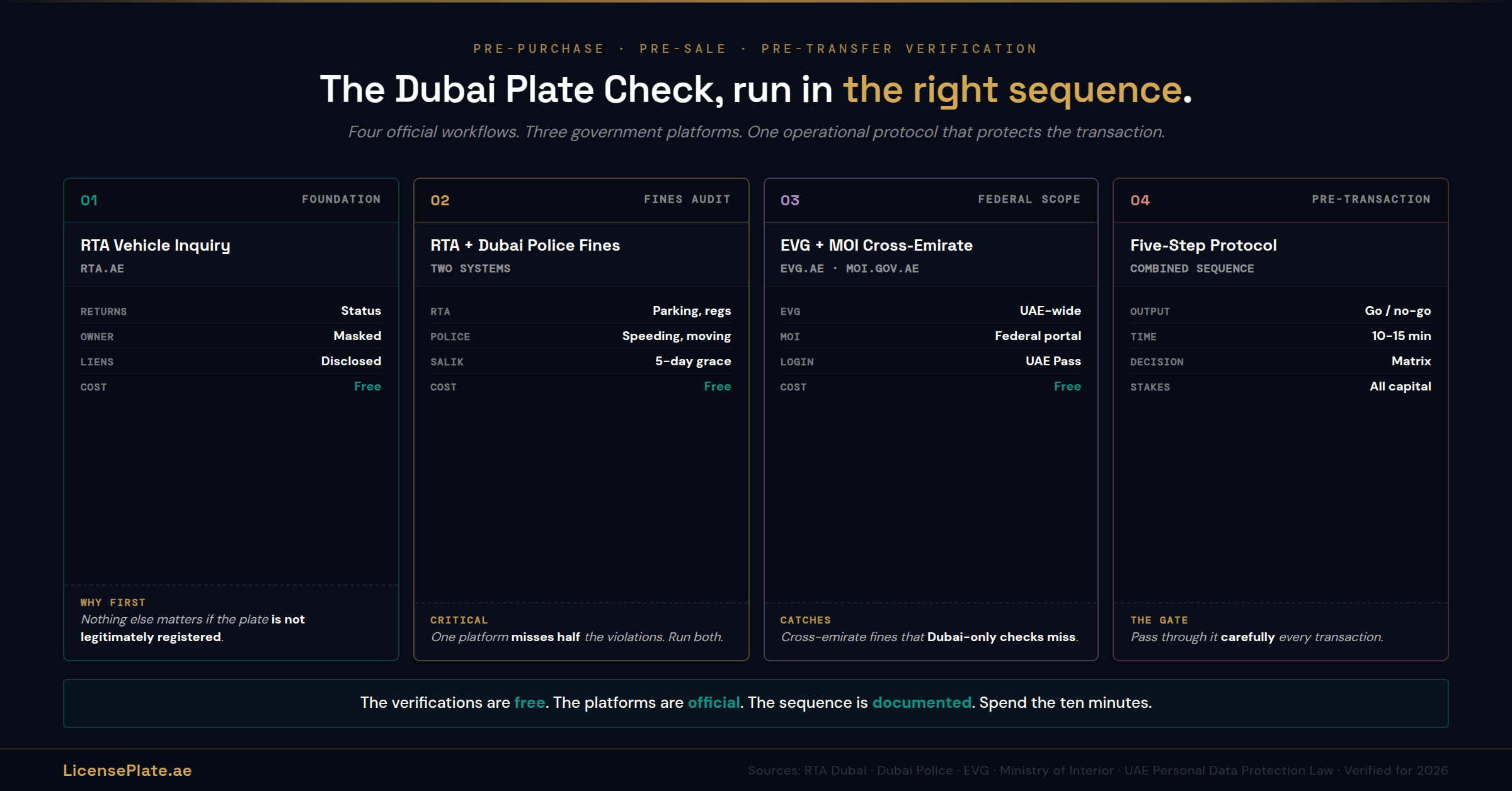
This piece publishes the complete Dubai number plate check workflow that every buyer should run before any transaction, every seller should run before any listing, and every transferor should run before any handover. Four official workflows, three government platforms, one operational sequence. The exact URLs. The exact data points. The exact order. No theory. No padding. The check protocol that protects the transaction.
First, Who Runs This Check and When
The Dubai plate check workflow has five distinct trigger points. Run the full sequence at any of them.
Trigger 1: Pre-purchase verification of a plate. You have agreed a price with a seller. Before any payment, you run the four checks to confirm the plate is registered to the seller, free of fines, free of liens or restrictions, and matches the documentation provided. Per the existing verification due diligence article and the plate fraud playbook, this is the highest-stakes verification scenario in the UAE plate market.
Trigger 2: Pre-purchase verification of a used vehicle with its plate. You are buying a used car. The plate stays with the vehicle by default per the what happens when you sell your car article, and any unpaid fines transfer with the vehicle to you as the new owner. Running the plate check before purchase reveals the actual financial obligation you are about to inherit.
Trigger 3: Pre-sale verification by the owner. You are listing a plate (or a vehicle with its plate) for sale. Running the check on your own plate before listing identifies fines you may not know about, lien or restriction status that could block transfer, and registration expiry dates that could affect transaction timing. This is the seller-side equivalent of the buyer-side workflow.
Trigger 4: Pre-transfer verification before plate management actions. You are about to perform any plate management action (transfer between vehicles, sale to another owner, change plate type, request third plate). The change plate guide covers the operational mechanics; the verification workflow ensures the action is not blocked by undisclosed obligations.
Trigger 5: Periodic owner audit. Plate owners running an annual self-audit identify accumulated fines, registration expiry approaching, and any restrictions or liens applied since the last check. The audit takes ten minutes and prevents surprise blocks at registration renewal time.
Workflow 1: RTA Vehicle Inquiry (Ownership and Registration Status)
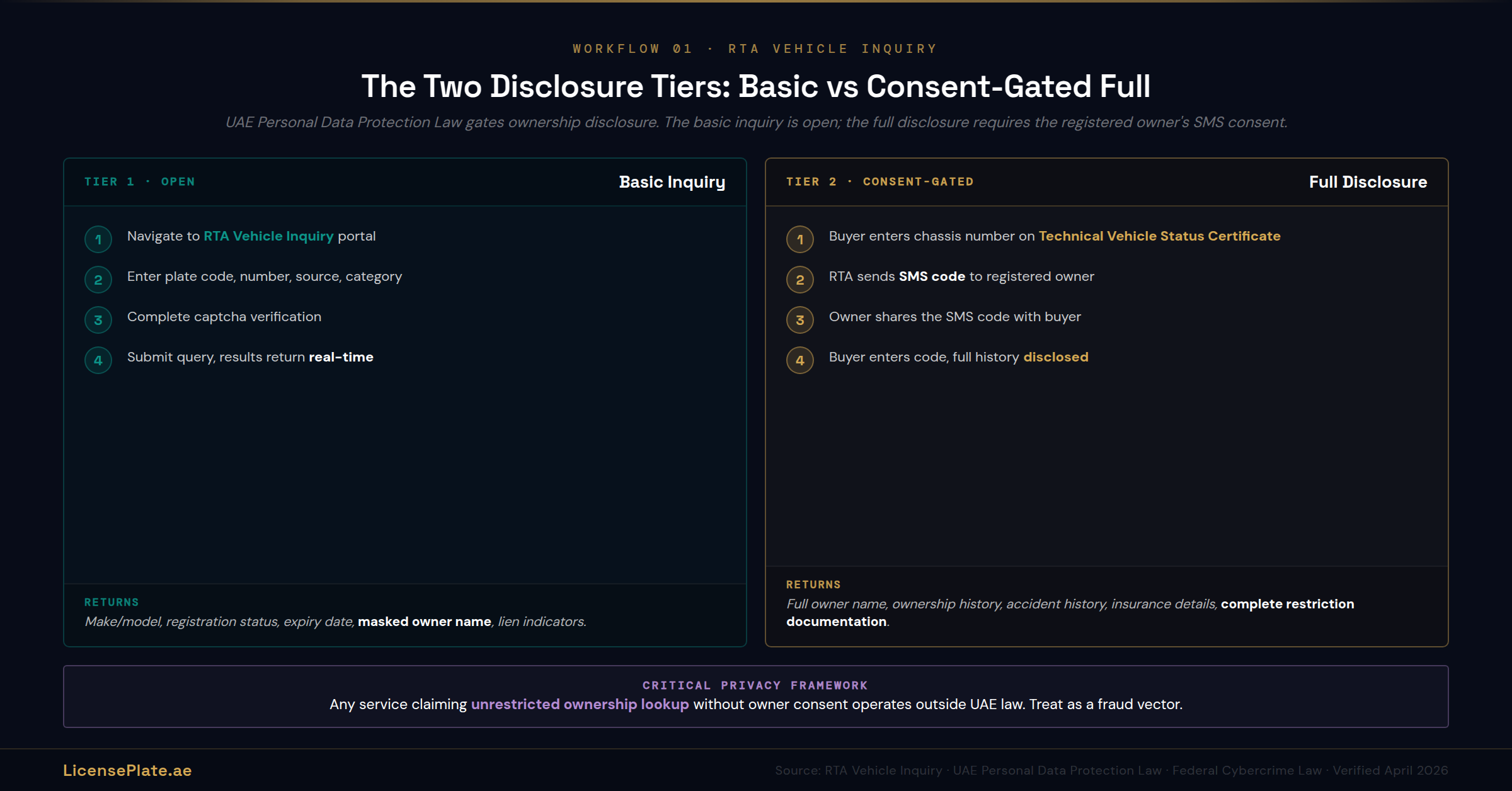
Purpose: Confirm a plate is legitimately registered, identify the registration status (active, expired, restricted, on lien), and verify basic ownership matches what the seller is claiming. This is the foundational check; nothing else matters if this one fails.
Where: RTA's official Vehicle Inquiry portal at rta.ae/vehicle-inquiry
What it returns: Per multiple verified sources including the RTA Vehicle Inquiry documentation, the system returns: vehicle make and model, plate code and number, registration expiry date, owner name (masked for privacy under UAE Personal Data Protection Law), vehicle type classification, and any active liens or restrictions on the plate.
How to run it: Navigate to the RTA Vehicle Inquiry portal. Enter the plate code, plate number, plate source (Dubai, Abu Dhabi, etc.), and plate category (private, commercial, taxi, etc.). Complete captcha. Submit query. Results appear in real time.
The full ownership disclosure workflow
Basic inquiry returns masked owner information. To access full ownership details, the buyer initiates the Technical Vehicle Status Certificate service via the RTA portal. The workflow:
1. Buyer enters the chassis number on the RTA Technical Vehicle Status Certificate service.
2. The system sends an SMS verification code to the registered owner's mobile number.
3. The owner shares the SMS code with the buyer.
4. The buyer enters the code into the portal.
5. Full vehicle and ownership history is disclosed.
This consent-gated workflow is the only official method for full ownership disclosure under UAE privacy law. Any third-party service claiming to provide unrestricted ownership lookup without owner consent should be treated as suspicious. Per the plate fraud playbook and scams safety guide, these services are commonly used as scam vectors.
Common failure modes
Wrong plate code or source: Entering the wrong plate code (e.g., 'O' instead of 'D') or wrong emirate source returns 'no record' results that the user mistakenly interprets as a plate that does not exist. Always verify the exact plate code with the seller before running the inquiry.
Recently transferred plates: Plates transferred within the last 24-48 hours may not yet appear in the inquiry system due to backend sync delays. If a plate is reported as 'just transferred,' wait 48 hours before drawing conclusions from the inquiry.
Restricted plates: Plates with active liens, court orders, or police restrictions appear as 'restricted' in the inquiry. Do not proceed with any transaction on a restricted plate; the restriction blocks transfer and the buyer cannot take legal ownership.
Workflow 2: Outstanding Fines Check (RTA + Dubai Police)
Purpose: Identify all outstanding traffic violations associated with the plate. Per the Dubai traffic system architecture, fines stay with the vehicle and plate, not the original driver. When the plate transfers to a new owner, the fines transfer with it.
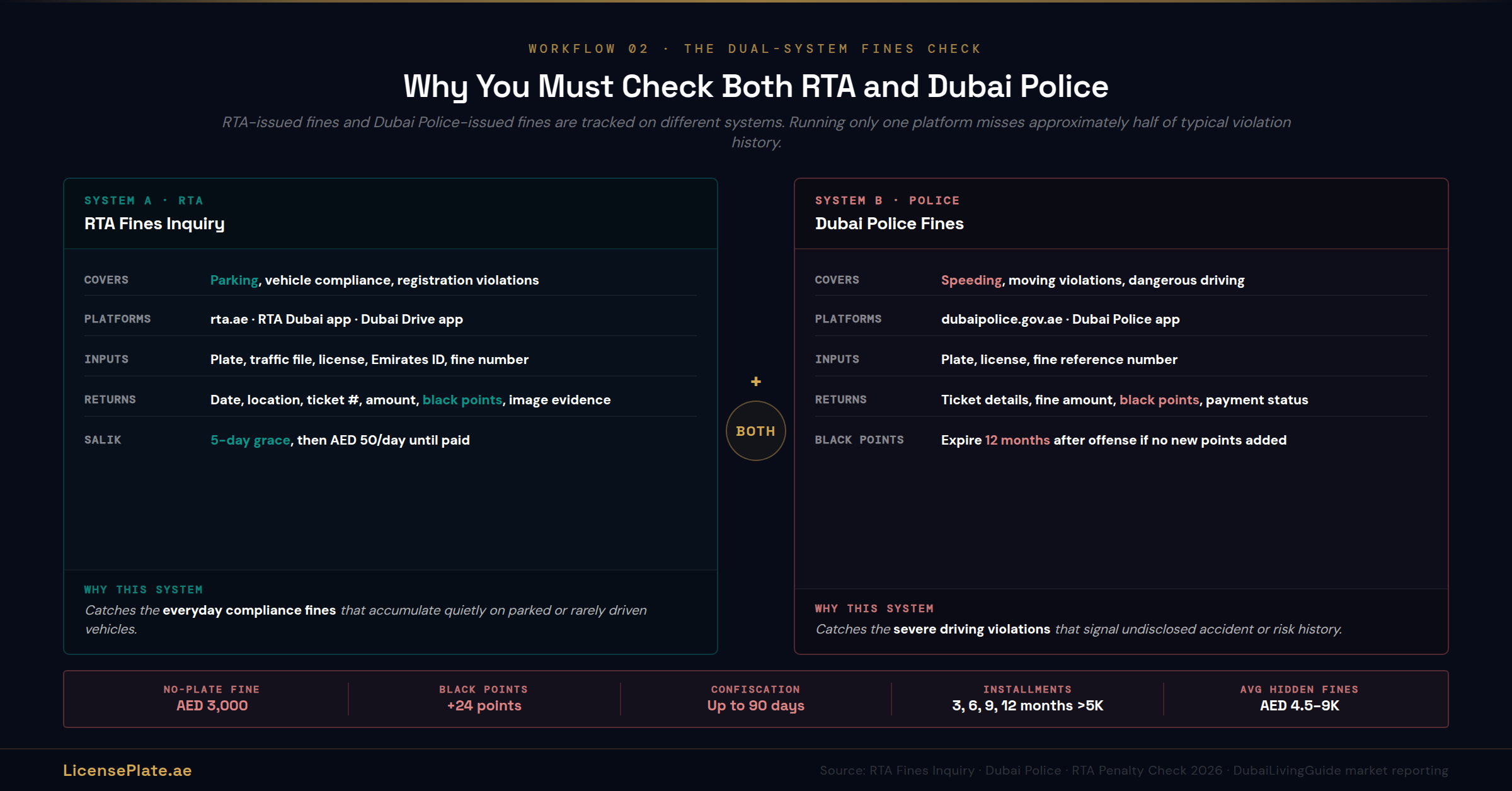
Why two platforms: RTA-issued fines (parking, vehicle compliance, registration violations) and Dubai Police-issued fines (moving violations, speeding, dangerous driving) are tracked on different systems. Running the check on only one platform misses fines from the other. Both must be checked.
Sub-workflow A: RTA Fines Inquiry
Where: RTA Fines Inquiry and Payment service at rta.ae fines inquiry, or the RTA Dubai mobile app available on iOS and Android, or the Dubai Drive app integrated platform.
Inputs accepted: Plate number + plate source + plate code + plate type combination, traffic file number, driving license number, Emirates ID number, or specific fine reference number. The plate number combination is the most common buyer use case.
What it returns: Each violation showing: violation date and time, location, ticket number, fine amount, black points (if applicable), reason for the fine, and image evidence from radar or fixed camera where available.
Sub-workflow B: Dubai Police Fines Inquiry
Where: Dubai Police website at dubaipolice.gov.ae, or the Dubai Police mobile app.
Inputs accepted: Plate number, driving license number, fine reference number. Plate number is the standard buyer use case.
What it returns: All police-issued violations linked to the plate. Output format includes ticket details, fine amount, black points, and payment status.
How to interpret the results
Total outstanding fine amount: Add the totals from both platforms. This is the financial obligation that transfers with the plate. Use this number to negotiate the purchase price downward, or require the seller to clear all fines before transfer.
Black points accumulation: Per RTA-published rules, black points expire 12 months after the offense if no additional points are added. Plates with high black point loads can affect future registration renewals; verify the count is stable, not actively accumulating.
Salik violations: Salik toll violations are tracked separately within the RTA system. They have a 5-working-day grace period; thereafter, AED 50 per day is charged until payment clears. A long-untouched plate may have substantial Salik penalty accumulation invisible to a casual check.
Note: Driving without a legible number plate carries a fine of AED 3,000, accumulation of 24 black points, and possible vehicle confiscation for up to 90 days. This is the most expensive fine in the system. If a plate check returns this violation, the plate or vehicle was driven without proper plate display, which often signals other compliance issues.
Installment plans for large outstanding amounts
If outstanding fines exceed AED 5,000 (individuals) or AED 20,000 (companies), the RTA accepts payment in 3, 6, 9, or 12-month installment plans. For sellers facing large accumulated fines, this option allows clearing the obligation without immediate full payment, which can keep a transaction moving.
Workflow 3: Cross-Emirate Verification (EVG + MOI)
Purpose: Consolidate fine and registration data across all seven emirates. A plate registered in Dubai may have accumulated fines from drives in Abu Dhabi, Sharjah, or other emirates. Federal-level checks ensure no obligation is missed.
Sub-workflow A: EVG (Emirates Vehicle Gate)
Where: EVG official portal at evg.ae, a government-operated platform offering consolidated UAE vehicle services.
What it offers: Cross-emirate fine inquiry by plate number, plate source, plate category, and plate code. Vehicle and traffic fines combined. Single login (UAE Pass) accesses all data.
How to run it: Visit evg.ae. Log in with UAE Pass or create an EVG account. Click 'Vehicle' or 'Traffic Fines.' Enter plate number and select emirate (Dubai, Abu Dhabi, etc.) and plate type (private, commercial). The portal displays all pending fines with dates, violation details, and amounts.
When EVG matters most: For cross-emirate buyers (Dubai resident purchasing an Abu Dhabi-registered vehicle, or vice versa) and for buyers checking plates that have driven across multiple emirates. The 7 emirates plate price comparison covers the cross-emirate registration eligibility framework that determines which buyers face this scenario.
Sub-workflow B: Ministry of Interior (MOI) federal portal
Where: MOI UAE official website at moi.gov.ae, which manages a federal traffic services platform covering all emirates.
What it offers: Federal-level traffic fines consolidation. Especially useful for vehicles registered outside Dubai or for owners managing fines across multiple emirates. The MOI system consolidates fine information nationwide.
How to run it: Visit moi.gov.ae. Find 'Payment of Traffic Fines' under e-services. Click 'View More,' then 'Start Service.' Log in with UAE Pass or MOI account. Enter plate details and view consolidated fines.
When MOI matters most: For cross-emirate transactions, for buyers consolidating fine data across multiple vehicles, and for any plate with usage history outside Dubai. The MOI federal scope catches obligations that single-emirate inquiries may miss.
Workflow 4: Pre-Transaction Verification Protocol
Purpose: Combine the previous three workflows into a single pre-transaction protocol that runs in correct sequence and produces a clear go/no-go decision before any payment changes hands.
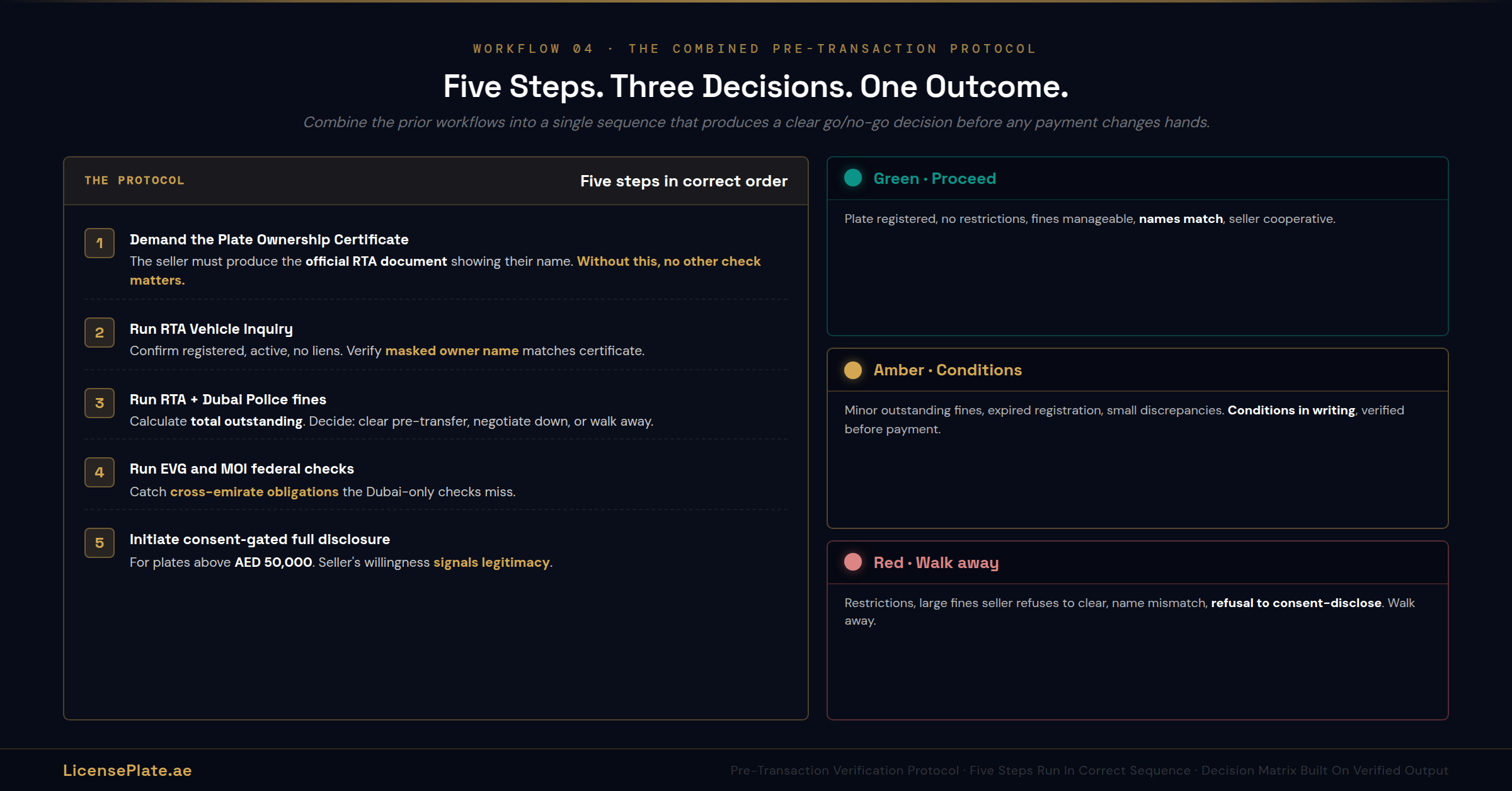
The five-step protocol
Step 1: Demand the Plate Ownership Certificate. The seller must produce the official Plate Ownership Certificate showing their name as registered owner. Without this document, no further check is meaningful.
Step 2: Run RTA Vehicle Inquiry. Confirm the plate is registered, registration is active (not expired), and there are no active liens or restrictions. Verify the masked owner name is consistent with the seller's name on the Plate Ownership Certificate.
Step 3: Run RTA Fines Inquiry and Dubai Police Fines Inquiry. Calculate total outstanding fines. Decide: require seller to clear fines pre-transfer, or negotiate the purchase price downward by the fine amount, or walk away if the fine load is excessive relative to the plate's value.
Step 4: Run EVG and MOI federal checks. Catch any cross-emirate obligations missed by the Dubai-only checks. Particularly important for plates that have traveled extensively or for sellers who have lived in multiple emirates.
Step 5: Initiate Technical Vehicle Status Certificate consent flow. If the basic checks pass and you are committing significant capital (typically AED 50,000+), request the seller initiate the consent-gated full disclosure workflow. The seller's willingness to do this signals legitimacy. Refusal is a meaningful warning sign.
Decision matrix
Green light (proceed with transaction): Plate confirmed registered, no active restrictions, fines manageable or cleared, owner name matches Plate Ownership Certificate, seller cooperative with consent-gated disclosure.
Amber light (proceed with conditions): Minor outstanding fines that seller agrees to clear pre-transfer; expired registration that seller agrees to renew; small discrepancies in masked owner name resolved with seller's documentation. Conditions must be in writing and verified before payment.
Red light (do not proceed): Plate restricted or under lien; significant outstanding fines seller refuses to clear; owner name on RTA inquiry does not match Plate Ownership Certificate seller produced; seller refuses to initiate consent-gated disclosure for high-value plates; cross-emirate fines indicate fraud or undisclosed driving record. Walk away.
Step 1 needs a check of its own. A Plate Ownership Certificate sent as a PDF can be edited. RTA's Document Validation Service checks it against RTA's record and shows RTA's copy; our guide explains how to verify an RTA certificate before paying.
The Privacy Framework: What You Can and Cannot See
Under the UAE Personal Data Protection Law, individual ownership details are protected. The plate check workflows surface what the law permits without owner consent and require consent for further disclosure. Understanding this framework prevents wasted effort on tools claiming to bypass it.
What you can see without owner consent
Plate registration status (active, expired, restricted), vehicle make and model, plate type and category, masked owner name (often first letter only or initials), traffic violations linked to the plate, registration expiry date, and active lien or restriction indicators.
What requires owner consent
Full owner name, full ownership history including previous owners, accident history with named parties, insurance policy details, and detailed restriction documentation. Access to these requires the SMS-verified consent flow described in Workflow 1.
What is never publicly accessible
Full ownership history beyond what previous auctions disclosed, legal or police records linked to a plate (unless you are an authorised party), banking or financial information of the owner, and any data that could identify the owner's address or contact details.
Per verified market reporting, any website claiming to provide full vehicle owner details by number plate in Dubai for a fee should be treated as a red flag. Access to private information is restricted to authorities or authorised users through official channels. Unauthorised access or attempted access carries penalties under UAE Federal Cybercrime Law.
Eight Mistakes Buyers Make During the Plate Check Workflow
Mistake 1: Running only one workflow. RTA fines and Dubai Police fines are separate systems. Running only one misses half the picture. Always run both at minimum, plus EVG/MOI for cross-emirate exposure.
Mistake 2: Trusting the seller's screenshot of a clean check. Sellers sometimes show outdated or selectively cropped reports. Run the check yourself, on your own device, in real time, in front of the seller if possible. Sellers who refuse this signal something.
Mistake 3: Skipping the captcha or using browser autofill incorrectly. Captcha errors and autofilled wrong plate codes are the most common source of 'no record' false negatives. Type the plate details manually and complete the captcha carefully.
Mistake 4: Confusing 'no record' with 'clean record.' If the system returns no record, the most common cause is wrong input (plate code, source, or category typo). Verify all four inputs are correct before concluding the plate is clean.
Mistake 5: Running the check on the wrong emirate. Plates from non-Dubai emirates check through different systems (TAMM for Abu Dhabi, MOI federal portal for others). Running an Abu Dhabi plate through Dubai's RTA system returns no useful result.
Mistake 6: Negotiating before checking. Per the plate negotiation playbook, running the check before negotiation gives you negotiation leverage. Running it after weakens your position. Always check first, negotiate second.
Mistake 7: Accepting outstanding fines as the buyer's problem. Outstanding fines are the seller's problem until the transaction closes. Either require fines cleared pre-transfer or reduce the purchase price by the fine amount. Never accept the fines silently.
Mistake 8: Skipping the consent-gated full disclosure for high-value plates. For plates above AED 50,000, the additional friction of the consent-gated disclosure is worth the protection. Sellers willing to initiate this workflow are signaling legitimacy. Sellers refusing are signaling something else.
Frequently Asked Questions
Q: Is checking a Dubai number plate free?
Yes for the basic checks. RTA Vehicle Inquiry, RTA Fines Inquiry, Dubai Police Fines Inquiry, EVG, and MOI federal portal are all free official services. Some third-party services charge for consolidated reports (typically AED 150-250) but these add convenience, not access to additional official data. The free official channels return everything you legally need before a transaction.
Q: Can I see who owns a Dubai plate?
Only with the owner's consent through the SMS-verified Technical Vehicle Status Certificate workflow. UAE Personal Data Protection Law restricts unrestricted ownership disclosure. The basic inquiry returns masked owner information; full disclosure requires the SMS code shared by the registered owner. Any service claiming unrestricted ownership lookup operates outside UAE law and should be treated as suspicious.
Q: What happens to outstanding fines when I buy a used car?
They transfer to you as the new owner. Fines stay with the vehicle and plate, not the original driver. This is why running the fines check before purchase is critical: undisclosed fines become your immediate financial obligation at transfer. Per market reporting, average undisclosed fines on apparently clean used cars range AED 4,500-9,000.
Q: Why do I need to check both RTA and Dubai Police?
Because they track different fines. RTA handles parking, vehicle compliance, and registration violations. Dubai Police handles moving violations, speeding camera fines, and dangerous driving offenses. Running only one platform misses approximately half of typical violation history. Always run both.
Q: What does 'plate restricted' mean on RTA inquiry?
It means the plate has an active lien (commonly from a bank loan secured against the vehicle), a court order, or a police restriction. Restricted plates cannot be transferred until the restriction is cleared. If the inquiry returns this status, do not proceed with any transaction; resolution must happen before transfer.
Q: How current is the data in RTA and Dubai Police inquiries?
Real-time for queries, with payment processing taking up to 24-48 hours to reflect in some cases. Recently issued fines may take a few hours to appear in the system. Recently transferred plates may take 24-48 hours to update across all systems. For high-stakes transactions, run the check immediately before payment to capture the most current state.
Q: Can I check a plate from another emirate using Dubai's RTA system?
No. RTA Dubai's inquiry covers Dubai-registered plates. For Abu Dhabi plates, use TAMM. For Sharjah, Ajman, RAK, Fujairah, or Umm Al Quwain plates, use the Ministry of Interior federal portal at moi.gov.ae or EVG at evg.ae. The federal portals consolidate cross-emirate data; the emirate-specific portals do not.
Q: What's the SMS to 4488 service?
A Dubai eGovernment service for quick owner detail retrieval. Send 'CAR [plate number]' as a text message to 4488 and receive a response with masked owner details and registration information. The service is convenient for quick checks but returns less data than the full RTA Vehicle Inquiry portal. Useful for initial verification, not a substitute for the full workflow.
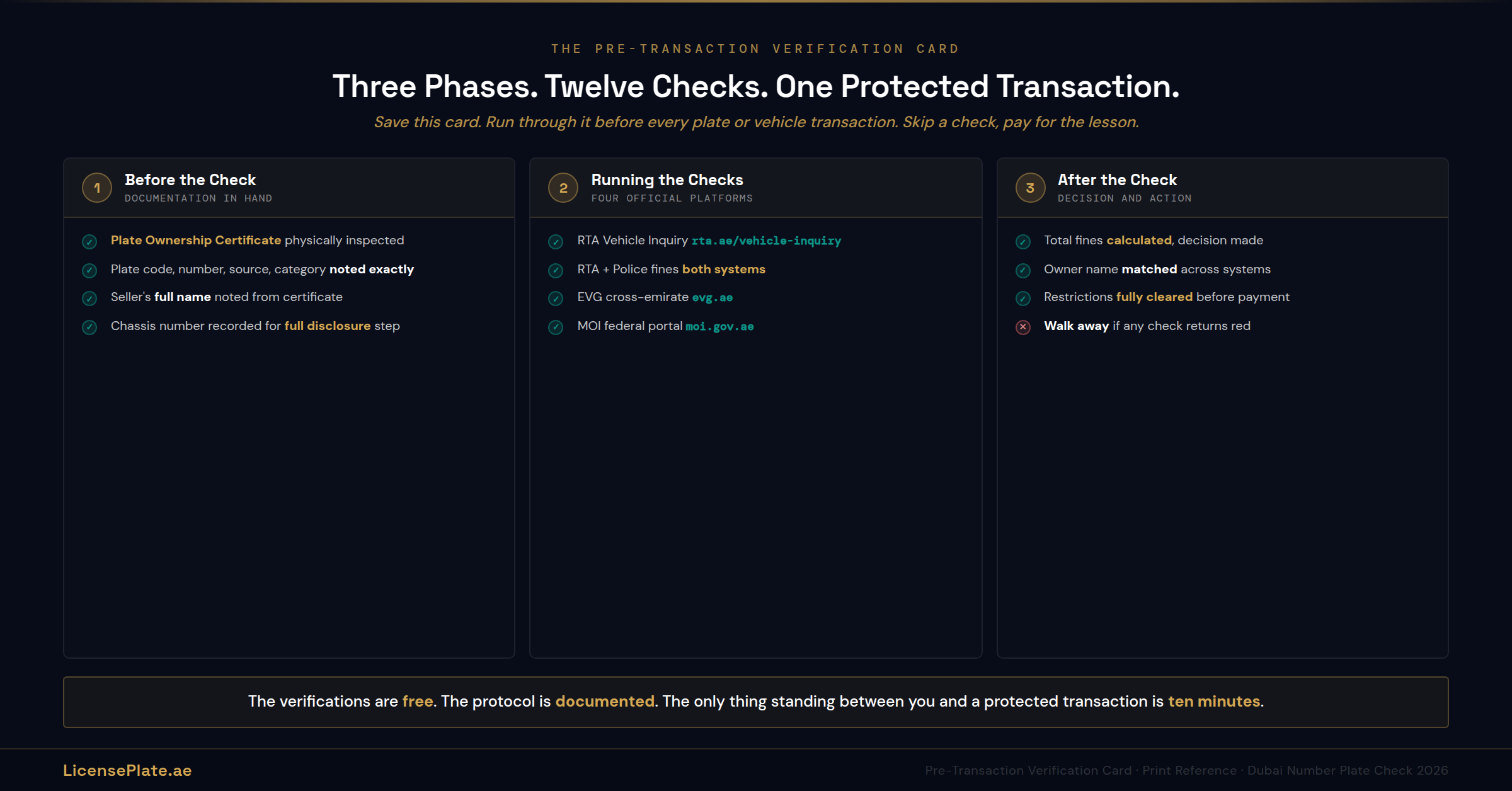
The Dubai number plate check is not glamorous. It does not photograph well. It does not get discussed in the same conversations as auction records or apex tier plates. But the four-workflow protocol above is the difference between a buyer who gets the plate they paid for at the price they agreed to, and a buyer who pays for a plate that turns out to be encumbered, restricted, or accompanied by AED 9,000 in undisclosed fines.
The verifications are free. The platforms are official. The sequence is documented. The only thing standing between most buyers and protected transactions is the willingness to spend ten minutes running the checks before payment. Spend the ten minutes. Run the checks. Use the data to negotiate, walk away, or proceed with confidence. The protocol is what separates plate transactions that close cleanly from plate transactions that become legal cases.
For procedural depth on the transaction itself, the anatomy of a plate transaction article covers the full handover sequence. For the negotiation conversation that follows the check, the plate negotiation playbook covers tactics by channel. For valuation context to interpret the price relative to comparables, the plate calculator anchors the math. Together with this verification workflow, those pieces form a complete pre-purchase decision-support stack. The check protocol is the gate. Pass through it carefully every time.
Delete Comment?
Are you sure you want to delete this comment? This action cannot be undone.
Delete Article?
Are you sure you want to delete this article? This will also delete all comments. This action cannot be undone.