

How to Renew Your Car Registration in Dubai (2026) — Plus Every Other Emirate
Renewing your Mulkiya in Dubai takes about fifteen minutes online, and most years it is genuinely that simple: clear your fines, confirm your insurance is linked, pay the fee, done. The renewal itself is not where people get stuck. They get stuck on the things attached to the renewal, and for a surprising number of people, the thing attached is the number plate. A plate mid-transfer. A plate they meant to keep off a car they are selling. A plate sitting behind a fine that freezes the whole file. A damaged plate that quietly fails inspection.
This guide does the standard renewal walkthrough properly, with the verified 2026 fees, the grace period, the inspection rule, and the three ways to renew. Then it does the part no other renewal guide bothers with: what your plate is actually doing during all this, and how to keep a valuable plate from becoming the reason your renewal stalls. If your plate is worth more than a rounding error, that second part is the one that matters.
Quick answer: To renew your Dubai car registration, clear all traffic fines and Salik dues, confirm your vehicle insurance is valid and linked to RTA, pass a technical inspection if the car is over three years old, then complete the renewal through the Dubai Drive app, rta.ae, a smart kiosk, or an authorised testing centre. Standard light-vehicle cost is roughly AED 350 to AED 420 all-in, plus around AED 150 to AED 170 for inspection. You can renew up to 150 days before expiry, and there is a 30-day grace period after expiry before fines apply. Your existing plate stays with you through the renewal.
THE SHORT VERSION
Five things to know before you renew
• Renewal is annual and the card is valid for 12 months. You can renew up to 150 days early, and there is a 30-day grace period after the expiry date.
• The UAE runs two renewal systems, not seven. Dubai renews through the RTA. Every other emirate renews through Emirates Vehicle Gate or the MOI app, with Abu Dhabi also served by TAMM.
• Three things block a renewal every time: unpaid fines or Salik, insurance that is missing or not electronically linked, and a failed or absent technical inspection.
• Inspection starts in year four. A vehicle under three years old is exempt, and the certificate is only valid for 30 days once issued.
• Your plate is the part that goes wrong. A plate mid-transfer, a plate you meant to keep off a car you are selling, or a damaged plate will each stall an otherwise routine renewal.
On this page
The Renewal Itself: What It Is and When to Do It · What You Need Before You Start · The Three Ways to Renew · What It Actually Costs · Renewing Outside Dubai: Which System You Are In · Renewal by Emirate: Authority, Portal and What Changes · The EVG Route, Step by Step · Where Your Plate Comes Into It · Why Renewals Get Blocked, and How to Unblock Them · Common Mistakes People Make at Renewal · Frequently Asked Questions
The Renewal Itself: What It Is and When to Do It
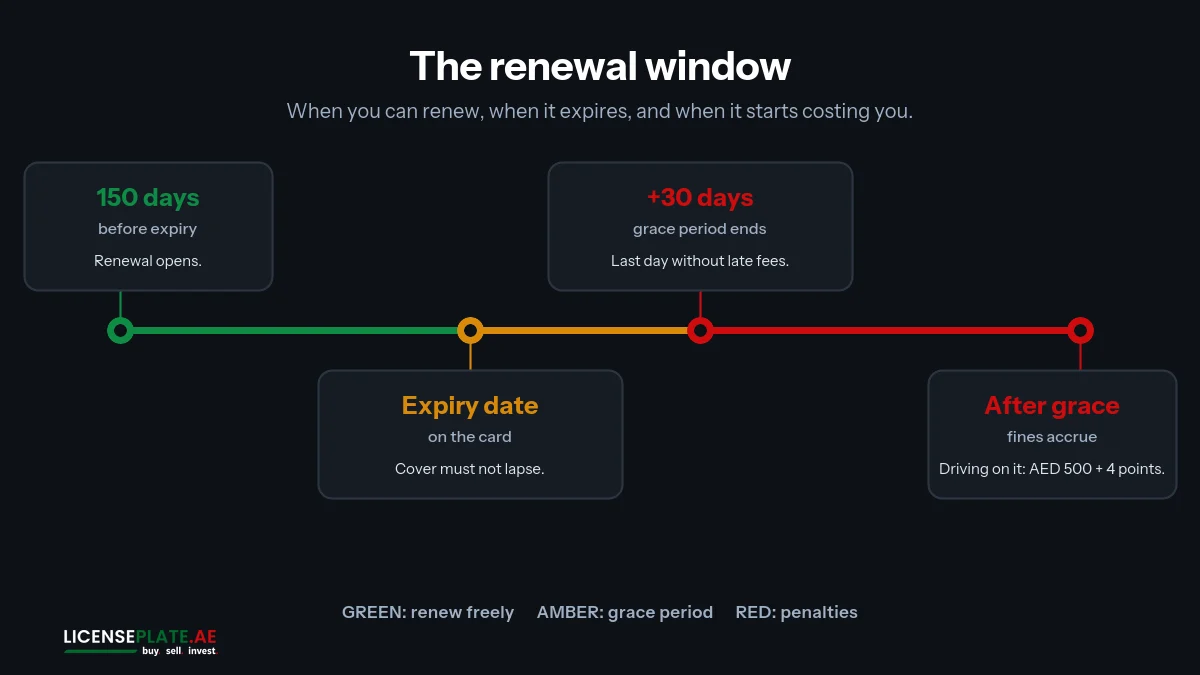
Vehicle registration in Dubai, the Mulkiya, is valid for one year and has to be renewed every twelve months. Drive on an expired Mulkiya and you are exposed to an AED 500 fine, four black points, and a possible seven-day vehicle impoundment under the federal traffic law. Your insurance also effectively lapses the moment registration expires past the grace period, which quietly shifts the entire cost of any accident onto you. That combination is why renewal is not optional and not worth leaving late.
You can renew early. RTA lets you renew up to 150 days before the expiry date. There is no penalty for renewing early and no downside, so if you are travelling or simply want it off your list, doing it ahead of time is the cleanest move.
There is a grace period, but understand what it does and does not cover. After expiry you get a 30-day grace period during which you can renew without late fees, and most insurance policies are written for 13 months specifically to cover this window. What the grace period does not do is make it legal to keep driving indefinitely. Miss the 30 days and a late fee starts accruing on the registration itself. Note that this is a different charge from the AED 500 driving fine above, and the two are frequently quoted as one figure online — check the schedule on the portal rather than trusting a number in an article. If the Mulkiya lapses for more than a year the renewal stops being a simple online job and becomes an in-person process at a main RTA centre, sometimes with the registration marked for cancellation.
What You Need Before You Start
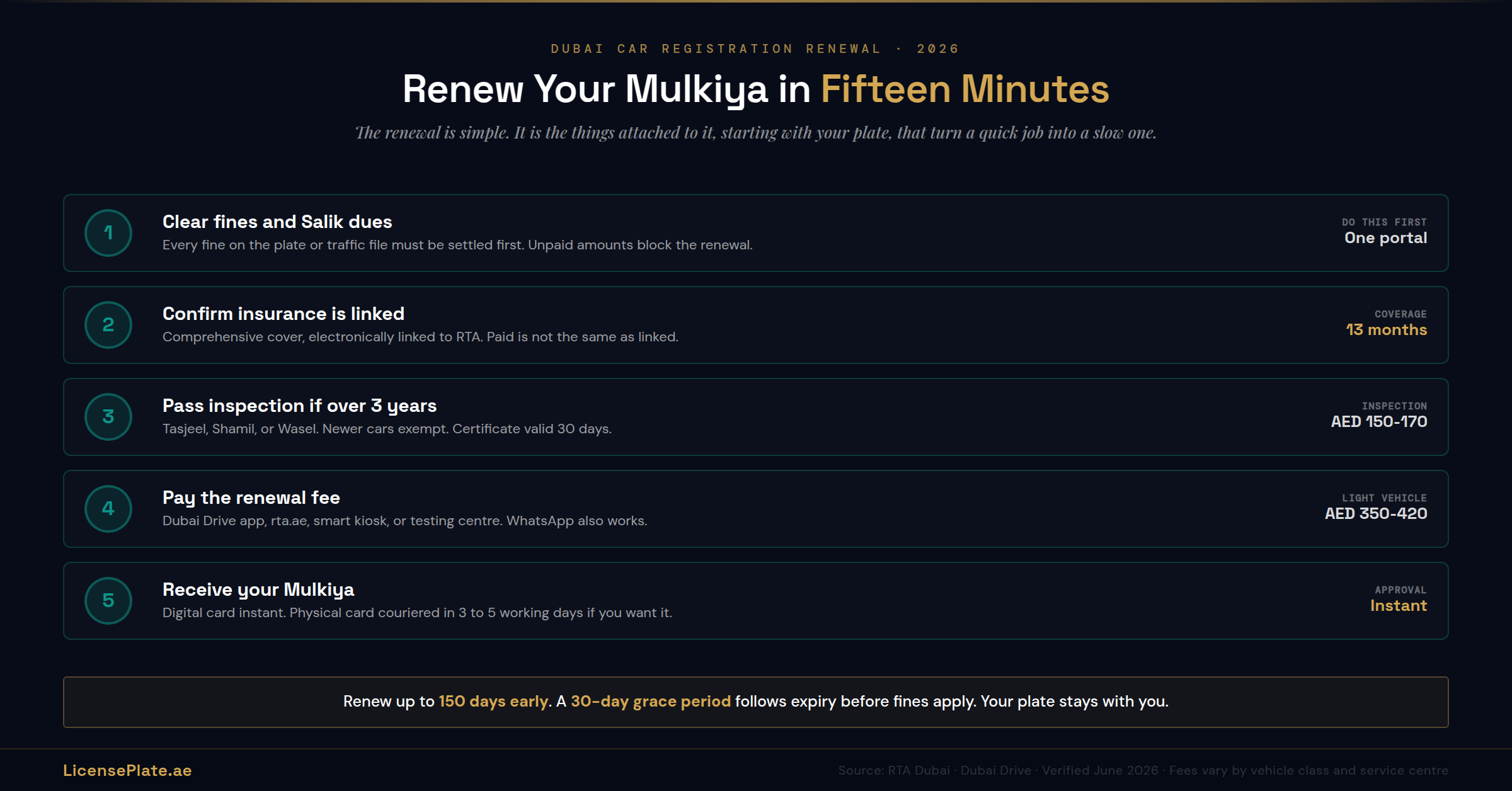
Have these ready and the renewal runs without interruption. Miss one and the system bounces you partway through.
Valid vehicle insurance, linked to RTA. This is the single most common silent blocker. RTA requires comprehensive cover, usually written for 13 months to bridge the renewal window, and it must be electronically linked to the RTA system. If your insurance renewed but the link did not update, the renewal fails with an unhelpful error. Confirm the link is live before you start, not after the system rejects you.
A passed technical inspection, if the car is over three years old. Vehicles older than three years need a roadworthiness inspection at an authorised centre such as Tasjeel, Shamil, or Wasel before renewal. Newer cars are exempt. The inspection certificate is valid for 30 days, so do not get it too far ahead of the renewal. Inspection runs roughly AED 150 to AED 170 for a light vehicle.
Cleared fines and Salik dues. Every outstanding traffic fine, Salik toll charge, and municipality parking penalty tied to your plate or traffic file has to be settled first. The system checks against the plate and the TC number, and any unpaid amount blocks the renewal outright. The UAE traffic fine check guide covers how to find and clear every fine across all seven emirates from one portal, which is the step to do before you even open the renewal page.
Emirates ID and the current Mulkiya. Standard identity and vehicle documents. If someone is renewing on your behalf while you travel, they need these plus the required authorisation.
The Three Ways to Renew
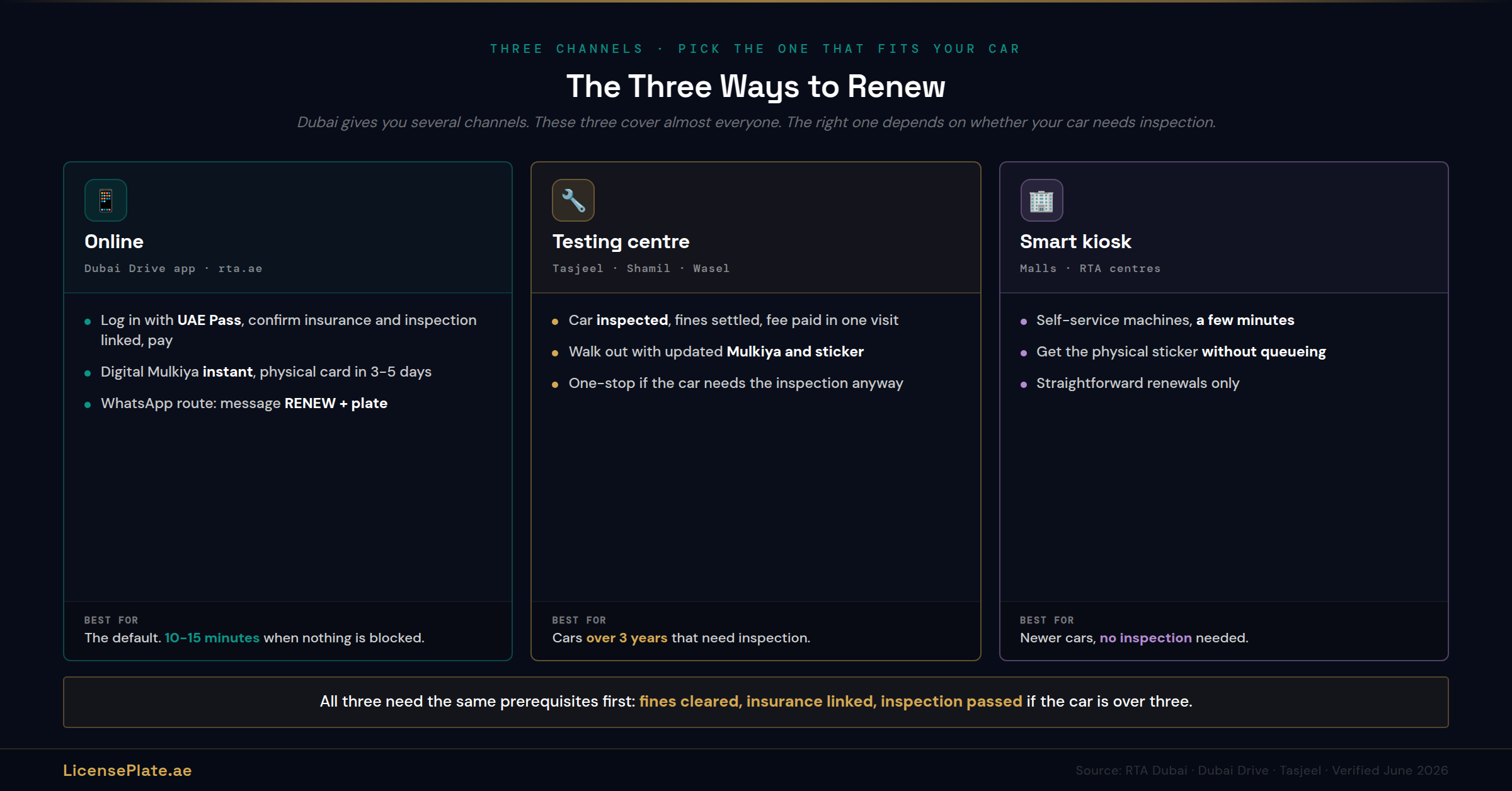
Dubai gives you several channels. Three cover almost everyone.
Online, through Dubai Drive or rta.ae
The default for most people. Log in with UAE Pass or your RTA account, open Vehicle Licensing, select registration renewal, confirm the insurance and inspection are linked, pay the fee. Approval is effectively ins tant and you get a digital Mulkiya immediately, with the physical card couriered in three to five working days if you want it. There is also a WhatsApp route: message RENEW followed by your plate number to the RTA service number, and it walks you through. Start to finish, the online renewal is a ten to fifteen minute job when nothing is blocked.
At an authorised testing centre
If your car needs inspection, this is the one-stop option. Drive to a Tasjeel, Shamil, or Wasel centre, the car gets inspected, you settle any fines or Salik dues on the spot, pay the renewal fee, and walk out with the updated Mulkiya and a new registration sticker. For a car over three years old that needs the inspection anyway, doing everything in one visit is often faster than splitting the inspection and the online renewal into two tasks.
Smart kiosk
Self-service kiosks in malls and RTA centres handle straightforward renewals in a few minutes. Best when your car does not need inspection and you just want the physical sticker without queueing at a counter.
What It Actually Costs
The headline number people remember is around AED 350, but the all-in figure depends on the vehicle and whether inspection is needed. Here is the honest breakdown for a light private vehicle in 2026.
Renewal fee: roughly AED 350 to AED 420 all-in for a light private vehicle, covering the registration fee plus the standard RTA issuance and knowledge-and-innovation charges.
Inspection: around AED 150 to AED 170 for a light vehicle over three years old. Newer cars skip this.
Heavy vehicles and motorcycles: different schedules. Heavy vehicles run higher, commonly AED 400 to AED 650 plus a larger inspection fee. Motorcycles are typically lower.
Plate replacement, if needed: a damaged or lost plate is replaced at roughly AED 35 for a short plate and AED 50 for a long plate, plus the AED 20 innovation fee. This matters at renewal because a damaged plate can hold up the process, which is the bridge into the part of this guide that actually concerns plate owners. The full official fee structure across every plate service is laid out in the Dubai number plate costs and fees guide.
Renewing Outside Dubai: Which System You Are In
Vehicle registration renewal in the UAE runs on two systems, not seven. Dubai is served by the Roads and Transport Authority and nothing else; the remaining six emirates are served by the federal Emirates Vehicle Gate, the online arm of the Ministry of Interior, with Abu Dhabi additionally reachable through TAMM. Which one applies to you is decided by a single fact: where the vehicle is registered, not where you live or where you are standing when you renew. The federal government summarises the channels on the official UAE portal.
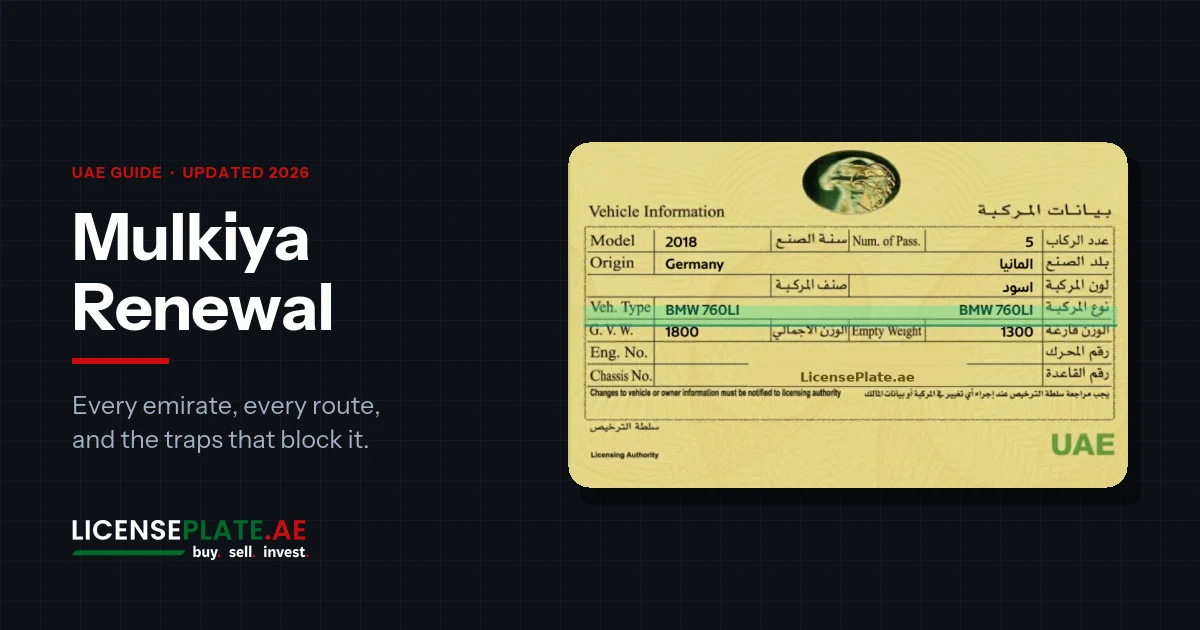
That distinction matters more than it sounds. A Dubai resident whose car carries a Sharjah plate does not renew with the RTA, cannot renew in the Dubai Drive app, and will not find the vehicle listed there at all. Every year people lose an afternoon to that discovery. The card in the glovebox tells you the answer — the place of issue printed on it is the authority you renew with. If you are not sure what you are looking at, every field on the Mulkiya is decoded here.
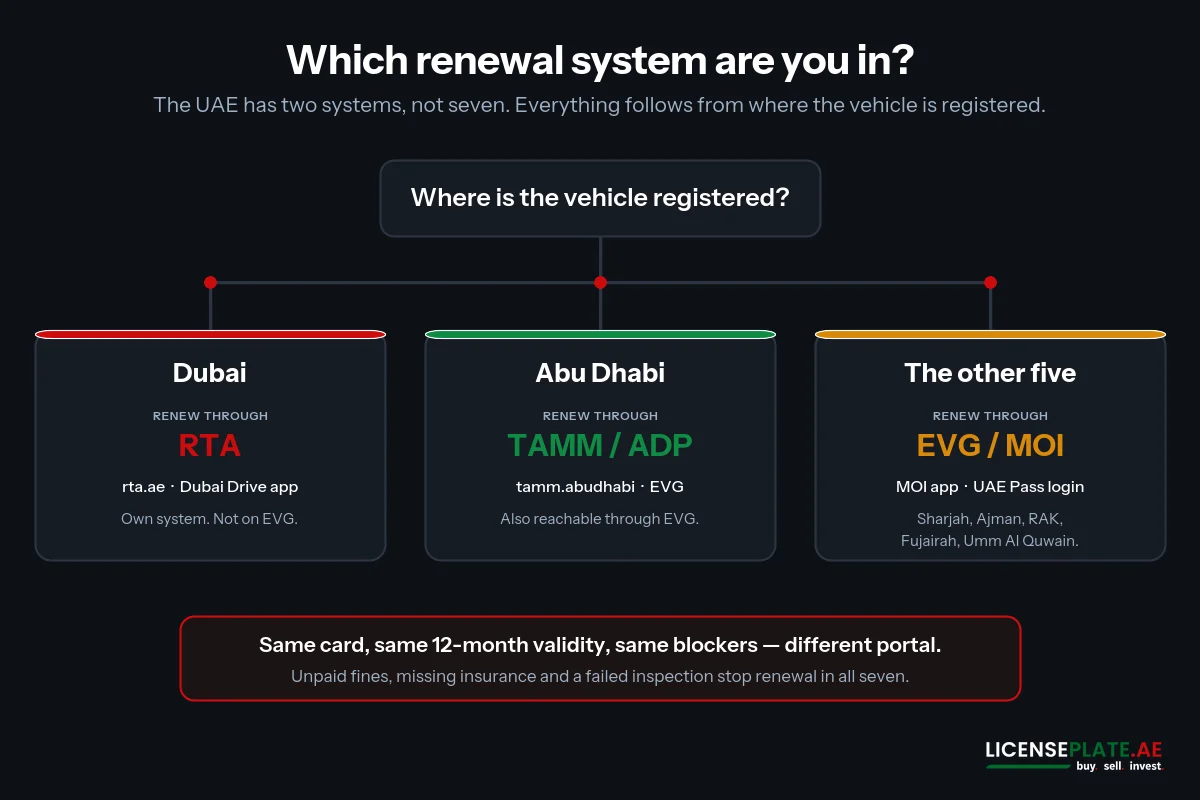
Key takeaway: the card, the 12-month validity, the inspection rule and the blockers are the same everywhere. Only the portal changes.
Nothing about your vehicle changes when you cross an emirate border. The only thing that changes is which website will admit your plate exists.
Renewal by Emirate: Authority, Portal and What Changes
Renewal by emirate is a question of routing, not of rules. The table below is the whole map: the authority that owns your file, the portal that will take your payment, and whether that emirate sits on Emirates Vehicle Gate. Dubai is the single exception in the country — it runs its own system and is not on EVG.
ROUTING MAP
Where each emirate renews
Technical inspection is required from year four in all seven.
| Emirate | Authority | Portal / app | On EVG? |
|---|---|---|---|
| Dubai | RTA | rta.ae · Dubai Drive app | No |
| Abu Dhabi | ADP via TAMM | tamm.abudhabi · EVG | Yes |
| Sharjah | MOI | EVG · MOI UAE app | Yes |
| Ajman | MOI | EVG · MOI UAE app | Yes |
| Ras Al Khaimah | MOI | EVG · MOI UAE app | Yes |
| Fujairah | MOI | EVG · MOI UAE app | Yes |
| Umm Al Quwain | MOI | EVG · MOI UAE app | Yes |
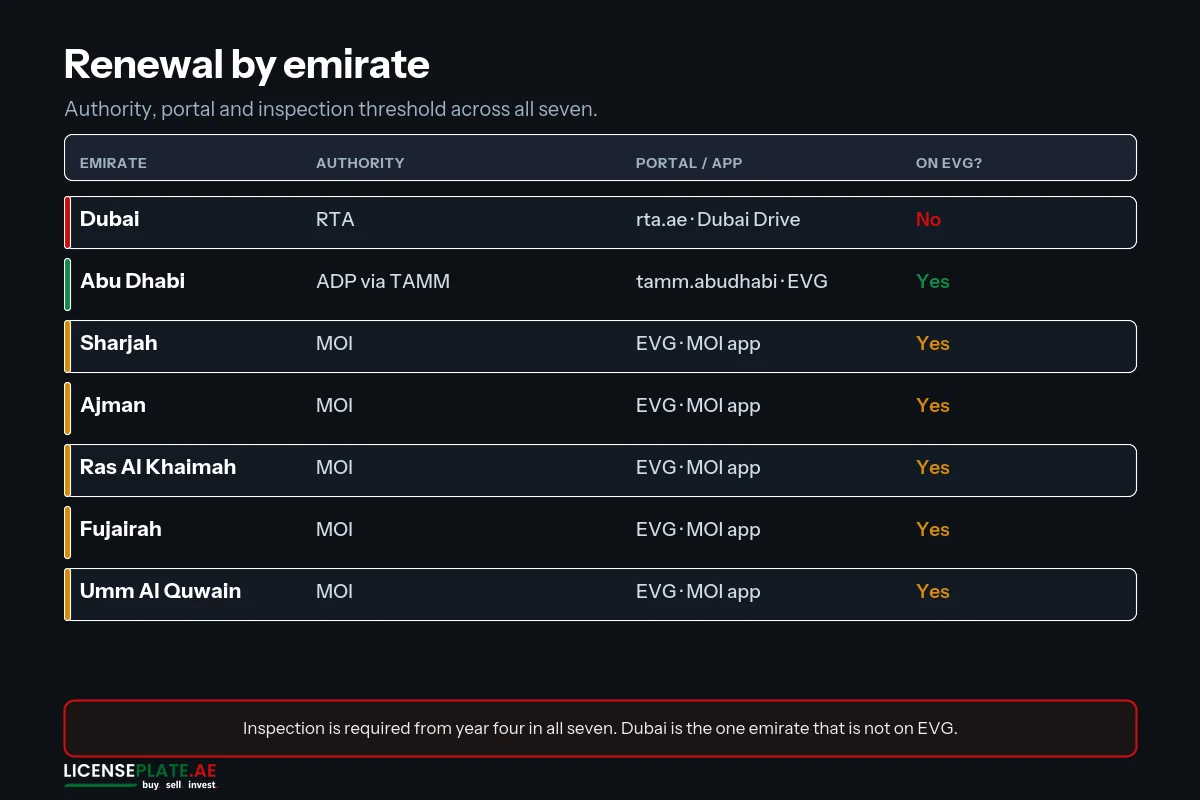
Two entries deserve a note. Abu Dhabi has two front doors: TAMM is the emirate's own platform and the one most residents use, while EVG reaches the same file federally. Either completes the renewal. If you are moving a plate rather than renewing one, the Abu Dhabi transfer rules work differently again. The northern five — Sharjah, Ajman, Ras Al Khaimah, Fujairah and Umm Al Quwain — are functionally identical to each other: same portal, same documents, same sequence.
The EVG Route, Step by Step
Emirates Vehicle Gate is the Ministry of Interior's online vehicle platform, and it is where six of the seven emirates renew. The sequence below takes about ten minutes when the paperwork is already in order, and stops dead at step two when it is not.
- Clear every fine first. Traffic fines, Salik and parking penalties tied to the plate or to your traffic file must be settled before the system will let the renewal start. This is the step that ends most attempts. A quick Salik balance check by plate shows whether unpaid toll trips are about to turn into violations.
- Renew the insurance and confirm it is linked electronically. A policy in your inbox is not a policy in the system. It must be registered against the vehicle, with at least 12 months of cover; most insurers write 13 months precisely to cover the grace period.
- Pass the technical inspection if the vehicle is in its fourth year or older. The certificate is short-lived, so book it close to the renewal rather than months ahead.
- Sign in with UAE Pass at the EVG portal or in the MOI UAE app. UAE Pass is now the primary route in, which also means the account must be verified before you start, not during.
- Select the vehicle and confirm the details shown against the card — plate number, chassis, owner. A mismatch here is a signal, not a typo, and is worth stopping for.
- Pay and download the new card. The digital Mulkiya is issued immediately and is accepted at a police stop; the printed card follows if you asked for one.
Key takeaway: the order is not optional. Fines, then insurance, then inspection, then payment — each step is gated on the one before it, and the portal will not tell you which gate you failed.
Where Your Plate Comes Into It
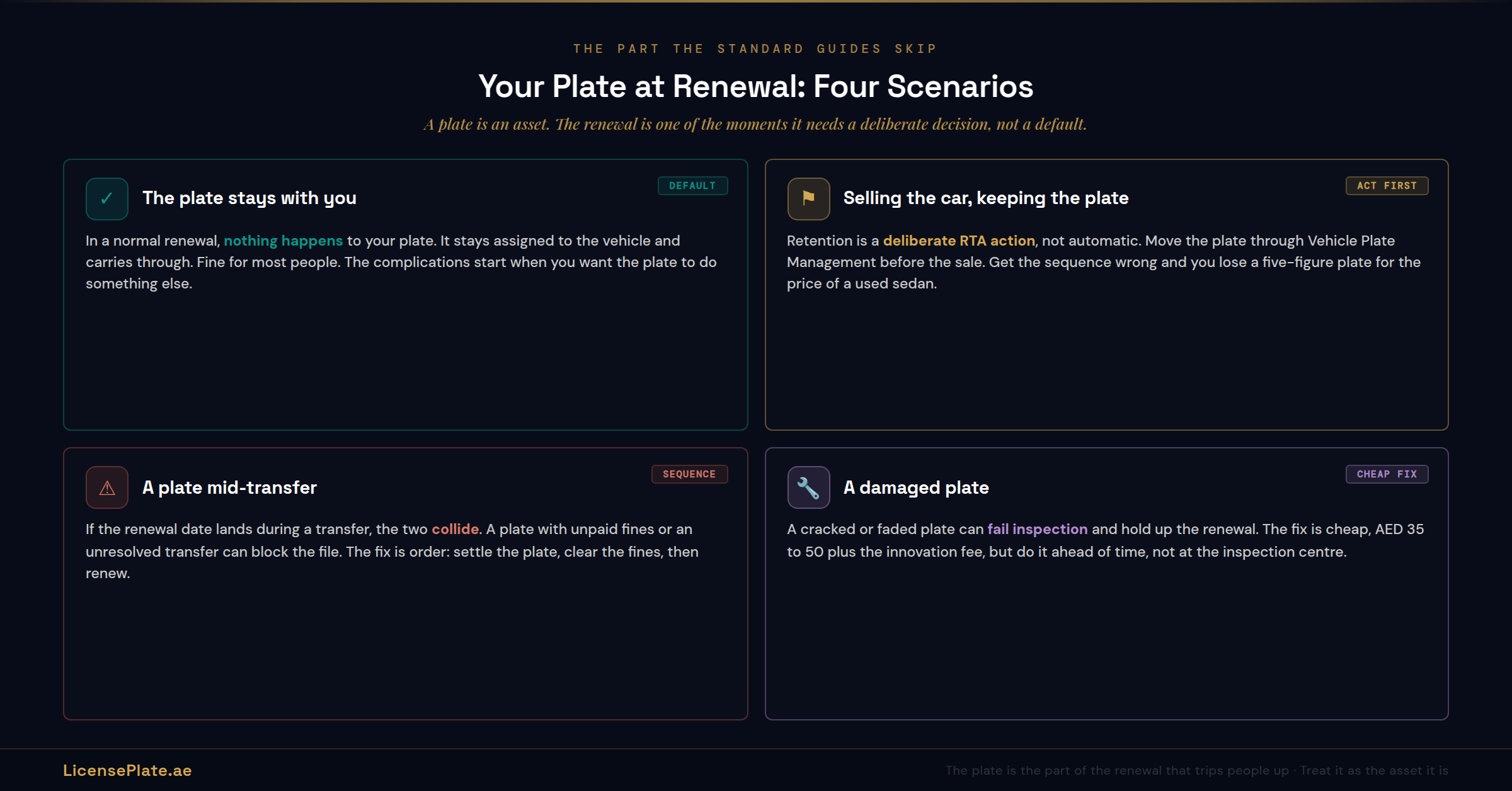
This is the part the insurance-blog renewal guides skip, because they assume your plate is a standard-issue sticker nobody thinks about. If you own a plate with real value, or you are in the middle of buying, selling, or moving one, the renewal is exactly where the plate causes problems. Four scenarios cover most of them.
Your plate stays with you, which is usually what you want
In a normal renewal, nothing happens to your plate. It stays assigned to your vehicle and carries through. That is the default and it is fine for most people. The complications start when you want the plate to do something other than stay put.
Selling the car but keeping the plate
If your plate is worth more than the car, and for a lot of premium-plate owners it is, you do not want it leaving on the vehicle when you sell. Keeping the plate is a deliberate RTA action, not an automatic one. You move the plate through RTA's Vehicle Plate Management service so it is properly retained or reassigned in the traffic system, rather than physically handed to the buyer with the car. Get the sequence wrong and you can lose a five-figure plate to a stranger for the price of a used sedan. The plate change and management guide walks through the Vehicle Plate Management workflow step by step, and the guide to selling a plate covers how to list and close on the plate once you have retained it. Do the retention before, not after, you complete the car sale.
A plate mid-transfer when renewal comes due
If you are buying or selling a plate through a transfer and the registration renewal date lands in the middle of it, the two processes collide. A plate under an active transfer, or a plate with unpaid fines attached, cannot move cleanly, and a registration tied to an unresolved ownership question can block. The fix is sequence: settle the plate transaction first, clear every fine on the plate, then renew. The pre-purchase verification checklist covers confirming a plate is clean and transferable before money moves, which is what prevents a transfer-and-renewal collision in the first place.
A damaged plate that fails the check
A physically damaged, faded, or non-compliant plate can hold up an inspection and therefore a renewal. The fix is cheap, AED 35 to AED 50 plus the innovation fee depending on whether you run a short or long plate, but it has to be done before the renewal completes. If your plate has taken a knock, replace it ahead of the renewal rather than discovering the problem at the inspection centre.
The common thread across all four: a plate is an asset, and assets need managing at exactly the moments routine admin assumes they will look after themselves. The renewal is one of those moments.
Why Renewals Get Blocked, and How to Unblock Them
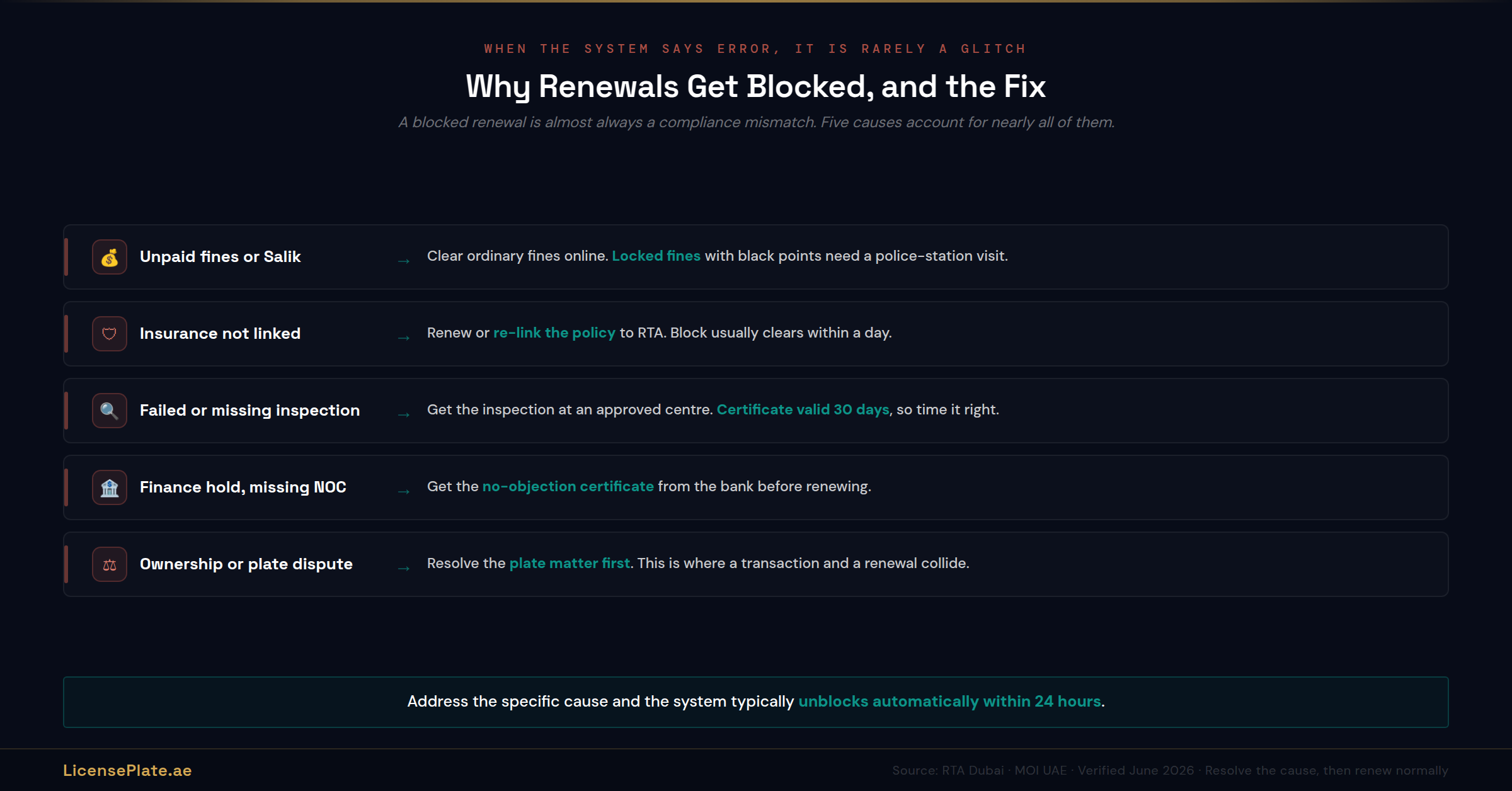
When the system shows an error or refuses to proceed, it is almost never a glitch. It is a compliance mismatch, and the reason is usually one of these:
Unpaid fines or Salik dues. The most common block. Every fine tied to the plate or traffic file must be cleared. Some serious violations carry black points and are marked as locked, which means the system shows a notice to visit a police station to resolve them before the file unblocks. Clear the ordinary fines online; handle the locked ones in person.
Insurance not linked or expired. If the policy lapsed or the electronic link to RTA did not update, the renewal fails. Renew or re-link the insurance and the block usually clears within a day.
Failed or missing inspection. A car over three years old without a valid inspection certificate cannot renew. Get the inspection, and remember the certificate is only good for 30 days.
Finance hold or missing NOC. A car still under finance may need a no-objection certificate from the bank before the registration can renew. Sort the NOC with the lender.
Ownership or plate disputes. An unresolved ownership question, including a plate under disputed transfer, can freeze the file. This is the scenario where a plate transaction and a renewal collide, and the answer is to resolve the plate matter first.
Once you have addressed the specific cause, the system typically unblocks automatically within 24 hours, and you can complete the renewal normally.
Common Mistakes People Make at Renewal
Leaving it until expiry week. You can renew 150 days early. Waiting until the last few days means any surprise block, an unlinked insurance policy, a fine you forgot, a failed inspection, turns into a scramble against the clock. Renew with margin.
Assuming insurance is linked because it is paid. Paying for insurance and having it electronically linked to RTA are two different things. Confirm the link, not just the payment.
Selling the car with the plate still on it. The single most expensive renewal-adjacent mistake for a plate owner. If the plate has value, retain it through RTA before the sale completes. Never let a valuable plate leave on a sold car by default.
Getting the inspection too early. The inspection certificate is valid for 30 days. Get it three months ahead and you will be paying for it twice.
Ignoring a damaged plate until inspection. A cracked or faded plate can fail the check. Replace it ahead of time for a few dirhams rather than losing a day to it at the centre.
Driving through the grace period as if it were free forever. The 30-day grace period is for renewing without a late fee, not a licence to keep driving on lapsed registration. Past it, fines accrue and insurance gets complicated.
Frequently Asked Questions
How much does it cost to renew car registration in Dubai in 2026?
For a light private vehicle, roughly AED 350 to AED 420 all-in, covering the registration fee plus RTA issuance and knowledge-and-innovation charges. Add around AED 150 to AED 170 for inspection if the car is over three years old. Heavy vehicles and motorcycles follow different schedules, with heavy vehicles running higher.
How early can I renew, and is there a grace period?
You can renew up to 150 days before expiry with no penalty. After expiry there is a 30-day grace period during which you can renew without late fees, and most insurance policies are written for 13 months to cover it. Past 30 days you are late, and two separate charges get confused with each other online: a late fee that accrues on the registration itself, and a flat AED 500 fine with 4 black points for actually driving a vehicle whose registration has expired, which can also mean impoundment. They are not the same charge. Confirm the current late-fee schedule on the RTA portal before budgeting for it.
Can I renew without paying my fines first?
No. Every outstanding traffic fine, Salik toll, and parking penalty tied to your plate or traffic file must be cleared before the renewal will proceed. Ordinary fines clear online; some serious violations are locked and need a police-station visit to resolve.
Do I need a vehicle inspection to renew?
Only if your car is over three years old. Newer vehicles are exempt. The inspection happens at an authorised centre such as Tasjeel, Shamil, or Wasel, and the certificate is valid for 30 days, so do not get it too far in advance.
What happens to my number plate when I renew?
In a standard renewal, nothing. The plate stays assigned to your vehicle and carries through. The plate only becomes a factor if you are keeping it off a car you are selling, transferring it, or replacing a damaged one, in which case the plate action needs handling through RTA's Vehicle Plate Management service alongside or before the renewal.
I'm selling my car but want to keep my plate. What do I do at renewal?
Retain the plate through RTA's Vehicle Plate Management service before the car sale completes, so it is properly reserved in the traffic system rather than handed over with the vehicle. Do this first. A valuable plate left on a sold car by default can be lost to the buyer.
Why is my registration renewal blocked?
Usually one of: unpaid fines or Salik dues, insurance that is expired or not electronically linked, a missing or failed inspection, a finance hold needing a bank NOC, or an ownership or plate dispute. Resolve the specific cause and the system normally unblocks within 24 hours.
Can someone renew my registration for me?
Yes. Another person can renew on your behalf if they have the required documents, including your Emirates ID, the Mulkiya, and the necessary authorisation. This applies to both online and in-person renewal and is useful when you are travelling.
What happens if my registration has been expired for over a year?
The renewal stops being a simple online job. The vehicle may be marked for cancelled registration, and you will generally need to complete the process in person at a main RTA service centre rather than online. Renew within the year to keep it simple.
My car is registered in Sharjah but I live in Dubai. Where do I renew?
You renew with Sharjah, through Emirates Vehicle Gate or the MOI UAE app. Registration follows the vehicle's emirate of issue, not your address, and a Sharjah-registered car will not appear in the Dubai Drive app at all. The place of issue printed on your Mulkiya is the authority that owns the file.
Is renewal the same in Abu Dhabi as in Dubai?
The requirements are the same — clear fines, valid linked insurance, inspection from year four — but the portal is different. Abu Dhabi renewals go through TAMM or Emirates Vehicle Gate rather than the RTA. The base fee for a private light vehicle is broadly comparable; heavy vehicles are charged at a higher rate.
What is EVG, and do I need a UAE Pass account?
Emirates Vehicle Gate is the Ministry of Interior's federal vehicle platform, covering every emirate except Dubai. UAE Pass is now the primary sign-in route, so the practical answer is yes — set the account up before you start, not halfway through a renewal.
Does renewing in another emirate change my plate number?
No. Renewal never reassigns a plate in any emirate. The plate stays with the vehicle unless you deliberately retain, transfer or replace it through the relevant authority. If you are holding a plate with real resale value, the annual cost of holding it is worth knowing before renewal season.
The seller says the Mulkiya is "with the bank" or being renewed. Should I worry?
Treat it as a stop sign until you see the card. A seller who cannot produce a Mulkiya matching the plate, the chassis and their own name is the most consistent pattern in plate fraud we see on this marketplace. Across the fraud cases we removed this year, one reported listing was described by a buyer in exactly those terms — a certificate that did not survive contact with the registry. The plate fraud playbook sets out how the other patterns work.
A Dubai registration renewal is a fifteen-minute job wrapped around a few things that can quietly turn it into a multi-day one. Keep your insurance linked, clear your fines before you start, get the inspection if the car is over three, and renew with margin instead of in expiry week. Do that and the renewal is exactly as simple as it should be.
The one piece the standard guides leave out is the plate, and for anyone who owns a plate worth real money, it is the piece that deserves the most attention. A plate you are keeping, transferring, or replacing does not look after itself during a renewal. It is an asset, and the renewal is one of the recurring moments where that asset needs a deliberate decision rather than a default. If your plate has value, treat the renewal as a checkpoint: confirm the plate is where you want it, in the state you want it, before you click through. The plate value calculator tells you what that plate is worth, the plate management guide covers retaining or moving it, and the verification checklist covers keeping a transfer clean.
For the wider picture on owning, buying, and selling plates in Dubai, the complete Dubai plate guide covers the full landscape from both sides of a deal. Renew the car on time, and keep the plate, the part that actually appreciates, exactly where you want it.
ABOUT THIS GUIDE
Written and maintained by the LicensePlate.ae editorial desk
We run the UAE's number plate marketplace, which means we see registration problems from the transaction side: renewals blocked by a plate mid-transfer, sellers who cannot produce a matching card, buyers who discover a hold only at the counter. This guide is maintained against the RTA, TAMM and Emirates Vehicle Gate portals and updated when the process or the fees move.