

The Complete Dubai Plate Types Guide: Short, Long, Classic, Luxury, Expo Explained
12 May 2026
Dubai
LicensePlate.ae Team
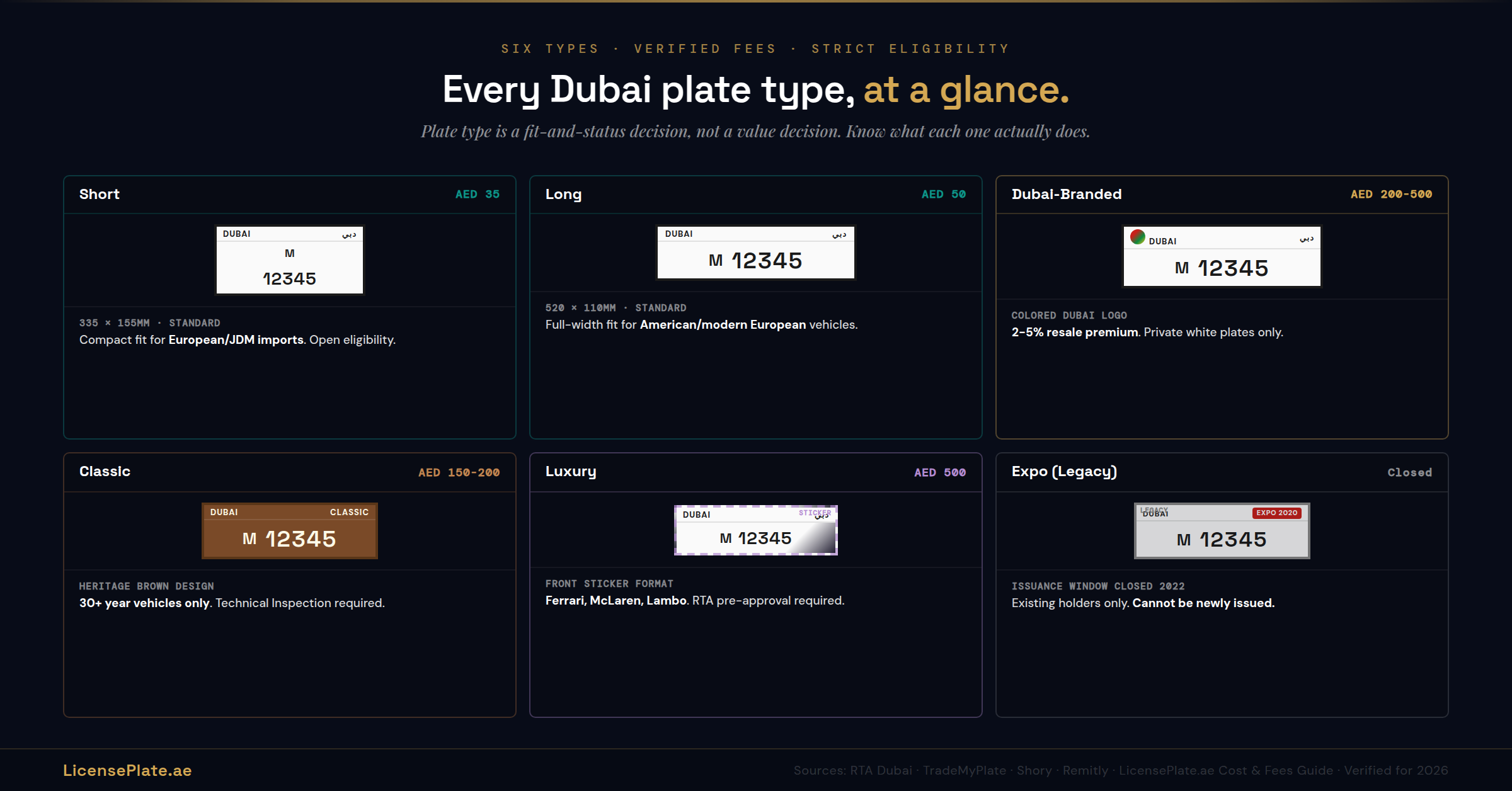
You're standing at an RTA Customer Happiness Centre. The agent behind the counter has just asked you a question that nobody warned you about: short or long? You hesitate. You look at the price difference (AED 35 versus AED 50). You wonder if it matters. You wonder if you should be paying for one of the other options the brochure mentions: Dubai-branded, Classic, Luxury. The agent waits. You pick whichever feels right and walk out fifteen minutes later with plates that may or may not suit your vehicle, your intent, or your budget.
That conversation happens hundreds of times every week at RTA centres across Dubai, and almost nobody coming through the door has a clear framework for the decision. Plate types are widely misunderstood as a value tier: the assumption that a Luxury plate is somehow worth more than a short standard plate, that a Dubai-branded plate carries more prestige than a regular white plate, that paying AED 500 buys you something fundamentally different. The reality is more interesting and less expensive than the assumption.
This piece publishes the complete Dubai plate type framework. Every type the RTA currently issues, every type they've retired, every fee with verification, every eligibility constraint, every strategic implication. The decision is not which type is most prestigious. The decision is which type fits your vehicle, your intent, and your budget. By the end, you'll know exactly what to say when the agent asks. By the end, you'll know what each type actually does, and what it doesn't.
First, the Framework: What Plate Types Actually Determine
Before the types themselves, the underlying truth. Plate type determines four things and does not determine four other things. Get this distinction right and the rest of the piece becomes straightforward.
What plate type determines:
(1) The manufacturing fee paid to RTA (ranges AED 25-500).
(2) The physical dimensions and visual appearance of the metal plate on your vehicle.
(3) Eligibility (some types require vehicle qualification, age, or pre-approval).
(4) A small resale value impact (2-5% premium for Dubai-branded colored logo plates per market reporting).
What plate type does not determine:
(1) The market value of your plate number.
(2) The prestige of your plate combination.
(3) Insurance premium rates.
(4) RTA service priority or queue position. Per the existing Dubai Plate Codes A to Z guide, Plate Decoder article, and Plate Price Check article, plate value comes from the number-letter combination, not the physical plate type that displays it. A short plate with AA 7 is worth millions; a luxury plate with V 78421 is worth a few thousand.
Hold that distinction throughout the piece. Plate type is a fit-and-status decision, not a value decision.
The Two Standard Types: Short and Long
These are the workhorses of the Dubai plate system. Almost every vehicle on the road carries one of these two. The decision between them is purely about vehicle fit.
Short Plate
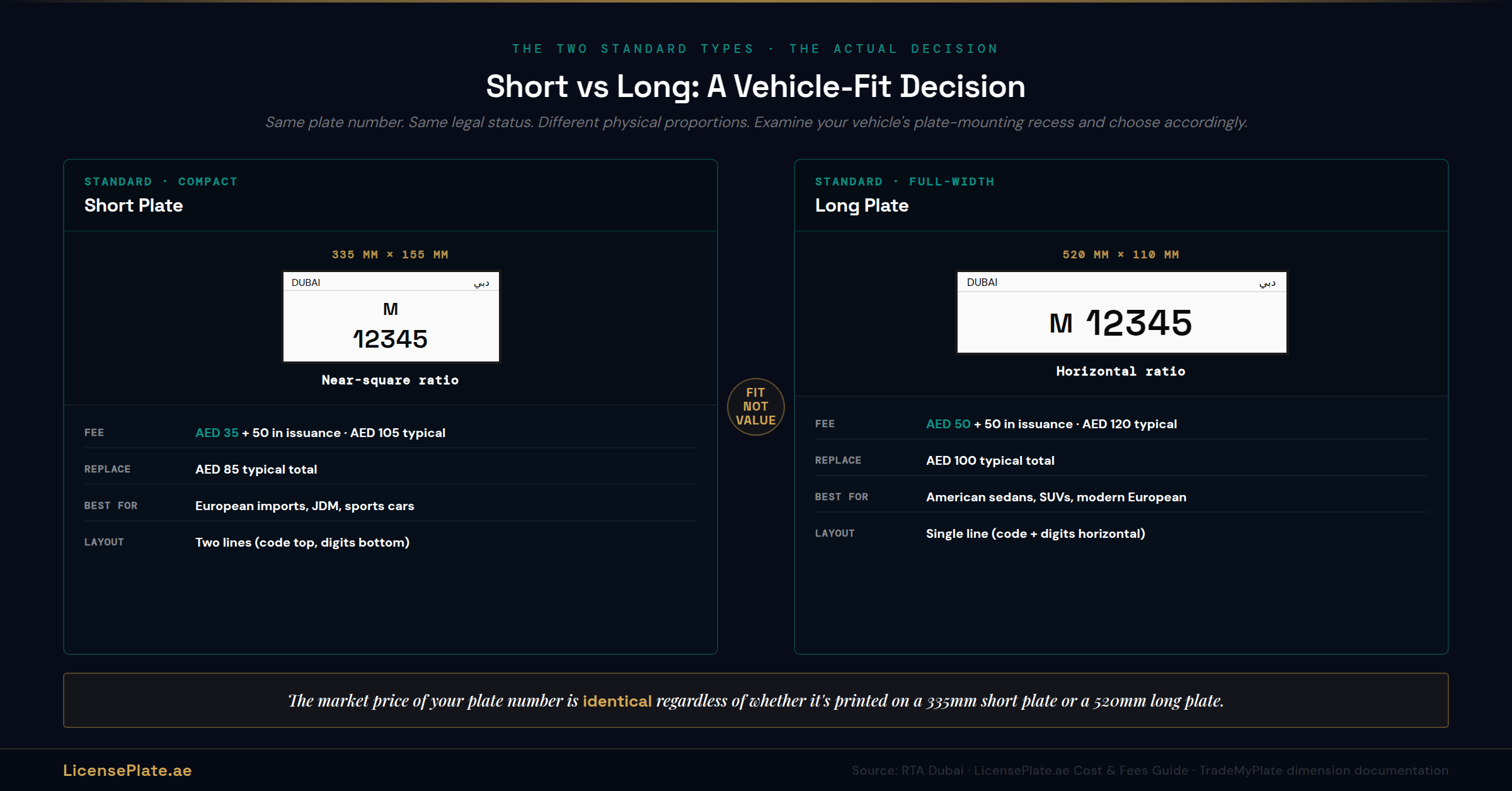
Manufacturing fee: AED 35. Plus AED 20 Knowledge & Innovation fee on any service over AED 50, plus AED 10 expiry sticker, plus AED 100 Plate Ownership Certificate. Typical total when issued as part of a new plate purchase: AED 105 per the Dubai Costs and Fees guide.
Dimensions: 335mm × 155mm. Compact, near-square ratio. Designed for vehicles with smaller plate-mounting recesses or for buyers who prefer the more European visual proportion.
Eligibility: Open to any privately registered vehicle. No vehicle-type restriction.
Visual identity: Black characters on white background, standard Dubai logo (which can be upgraded to colored logo for an additional fee, see Dubai-branded section below). Two-line layout common on shorter plates: top line carries the letter code, bottom line carries the digits.
Replacement cost if lost or damaged: AED 85 typical total (manufacturing AED 35 + AED 50 in associated fees) per the Cost & Fees article.
When to choose Short: Your vehicle has a smaller plate-mounting recess (common on European and Japanese imports), or you prefer the compact visual. Some classic and sports car owners deliberately choose short plates for the European-style proportion they create on the bumper.
Long Plate
Manufacturing fee: AED 50. Same additional fees apply (Knowledge & Innovation AED 20, expiry sticker AED 10, Plate Ownership Certificate AED 100). Typical total when issued: AED 120.
Dimensions: 520mm × 110mm. Long horizontal ratio. Designed for vehicles with full-width plate-mounting recesses, which describes most American and many European sedans, SUVs, and trucks.
Eligibility: Open to any privately registered vehicle. No vehicle-type restriction.
Visual identity: Black characters on white background, single-line layout (letter code and digits on the same horizontal line). Standard Dubai logo, upgradeable to colored logo.
Replacement cost: AED 100 typical total per the Cost & Fees article.
When to choose Long: Your vehicle has a full-width plate-mounting recess (most American and modern European vehicles). The long format also creates a cleaner readability for plates with five-digit numbers, since all characters fit on one line.
Note: Short versus long is a vehicle-fit decision, not a status or value decision. The market price of your plate number is identical regardless of which physical format you choose. Some long-time plate owners switch between short and long when they change vehicles; this is allowed and costs the standard manufacturing fee per the Change Plate workflow.
The Premium-Fee Types: Dubai-Branded, Classic, Luxury, Expo
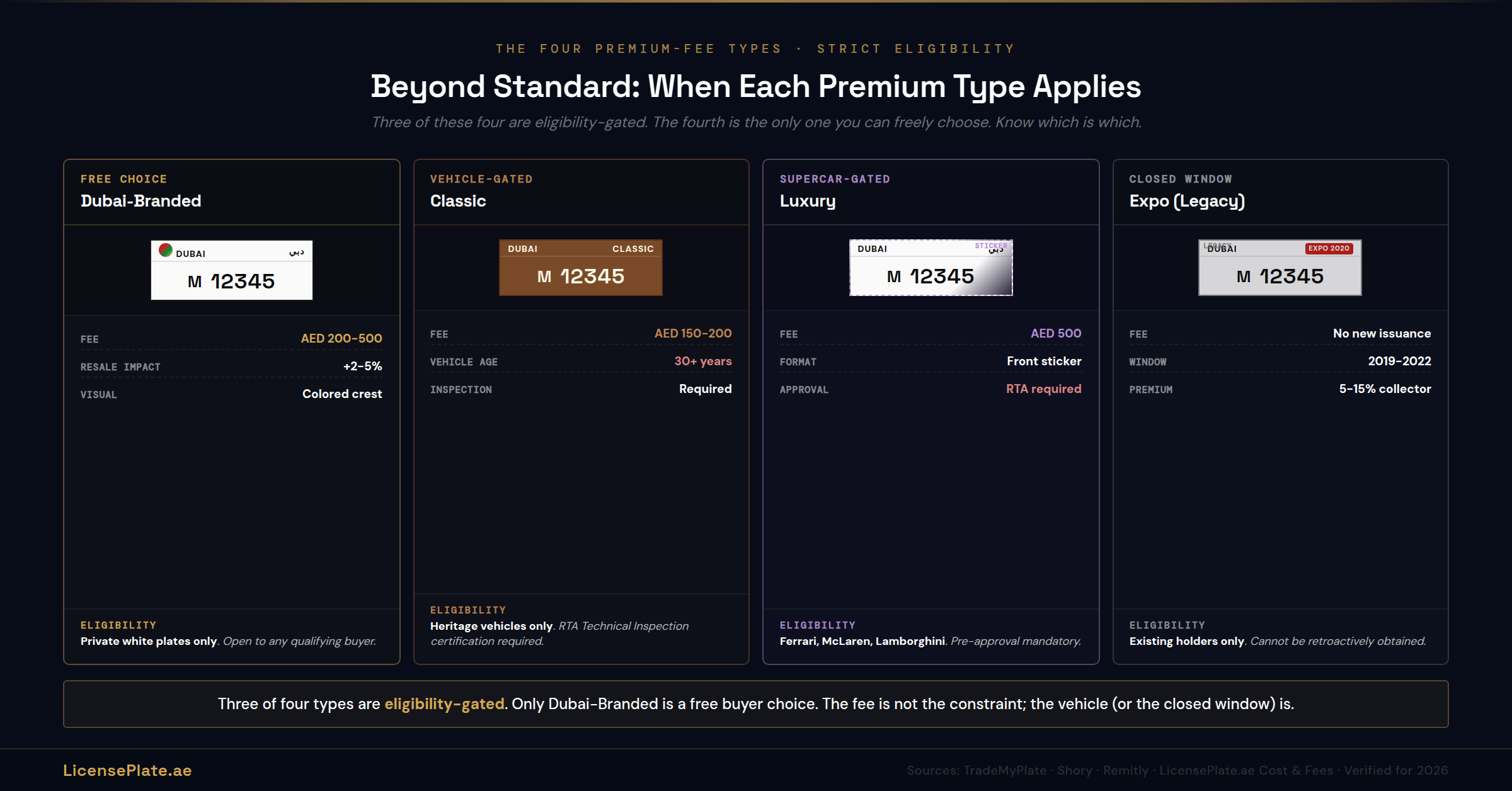
These four types carry higher manufacturing fees and varying eligibility constraints. They are not necessarily more valuable as plate numbers (the number-letter combination still drives plate value), but they carry distinct visual identities and, for the right buyer, distinct strategic implications.
Dubai-Branded Plate (Colored Dubai Logo)
Manufacturing fee: AED 200 per Shory's RTA fee guide. Some service centres list AED 400-500 for the colored logo upgrade applied to an existing standard plate per industry documentation. Verify current pricing at your specific RTA centre.
Visual identity: Standard short or long format, but the Dubai government emblem on the plate is rendered in full color (vibrant red, green, and yellow Dubai crest) rather than the standard monochrome black emblem. Available exclusively for private white plates.
Eligibility: Available only on private white plates. Commercial plates, classic plates, and luxury plates use their own visual systems. The colored Dubai logo upgrade is permanent; reverting to standard black-and-white requires a full plate replacement at standard fees.
Strategic implication: Per market reporting, colored Dubai logo plates command a 2-5% resale premium over equivalent standard plates with monochrome logos. The premium is small but consistent. For plate investors building portfolios with photography-driven listings, the colored logo photographs better for online marketplaces. For consumption-intent buyers, the visual upgrade is purely aesthetic.
When to choose Dubai-branded: You want a visible premium identifier without spending serious money. The AED 200-500 upgrade is the cheapest way to differentiate a standard plate visually. Particularly popular among luxury vehicle owners who want their plate to match the vehicle's premium positioning without paying for an actual premium plate number.
Classic Plate (Heritage Brown Design)
Manufacturing fee: AED 150-200 per Remitly's plate guide, with variations by service centre.
Visual identity: Distinct brown and white color scheme replacing the standard black-on-white. The brown coloration is a heritage design choice referencing Dubai's pre-modern plate aesthetics. Highly recognisable on the road.
Eligibility (strict): Available exclusively for vehicles 30 years or older that have passed RTA's technical inspection for classic vehicle status. A 2026 vehicle does not qualify under any circumstances. Eligibility verification is done by the RTA's Technical Inspection Department, which examines the vehicle's age documentation, physical condition, and originality of components.
Strategic implication: Classic plates are not a status upgrade for modern vehicles. They are a registration requirement for genuine classic vehicles. The brown design signals to other road users that the vehicle is a recognised classic, often connected to premium insurance treatment, modified parking rules in some areas, and access to classic vehicle events.
When to choose Classic: You own a vehicle 30 years or older and are registering it as a classic. The application requires technical inspection certification. The brown plate is part of the broader classic vehicle registration framework, not a discretionary choice.
Luxury Plate (Front Sticker Format)
Manufacturing fee: AED 500 per Shory's fee guide. Replacement up to AED 570 per the LicensePlate.ae Costs and Fees article.
Visual identity: Available exclusively as a front-sticker format. The rear plate uses a standard physical metal plate. The front sticker is applied directly to the vehicle's bodywork in a specific position approved by RTA.
Eligibility (very strict): Available exclusively for specific supercar models where mounting a physical front plate would compromise aerodynamics or damage the vehicle's design integrity. Approved models include Ferrari, McLaren, Lamborghini, and similar high-performance vehicles per industry documentation. Prior RTA approval is mandatory; the approval process verifies the specific vehicle model and the technical justification for the front-sticker exemption.
Strategic implication: Luxury plates are not a status upgrade you can choose to buy. They are a technical accommodation for vehicles whose design makes a front-mounted metal plate impractical or damaging. The AED 500 fee reflects the regulatory and approval overhead, not premium status. The status signal comes from the underlying vehicle qualifying for the exemption.
When to choose Luxury: You own a qualifying supercar (typically AED 1M+ vehicles with manufacturer design constraints that make front plate mounting impractical) and need the front-sticker accommodation. The eligibility check happens during vehicle registration; the agent will identify the requirement.
Expo-Branded Plate (Legacy Status)
Manufacturing fee (historical): AED 100. No new issuance.
Visual identity: Standard plate format with the Expo 2020 Dubai emblem replacing the standard Dubai logo. Issued during the Expo 2020 commemorative window (2019-2022).
Eligibility (closed): Per verified industry documentation, Expo 2020 plates are now classified as Legacy plates and cannot be newly issued. Existing holders may retain them indefinitely, but new registrations must use standard plate designs. The Expo plate window closed after the Expo 2020 commemorative period ended.
Strategic implication: Legacy Expo plates carry a small commemorative premium for collectors. They are not retroactively issuable; if you didn't get one during the 2019-2022 window, you cannot now obtain one. The Change Plate workflow allows existing Expo plate holders to switch to a standard plate if they choose, but the reverse is not possible.
When you might encounter Expo: You inherited a vehicle with an Expo plate, you're considering buying a vehicle that has one, or you're a collector specifically interested in commemorative plate variants. Otherwise, Expo plates are functionally a closed category.
The Special Categories: Motorcycle, Commercial, Government
These types are not optional choices for private buyers. They are mandatory categorisations based on vehicle type and ownership. Brief coverage for completeness, since readers occasionally encounter them in mixed-vehicle households or fleets.
Motorcycle Plate
Manufacturing fee: AED 25 per Shory's fee documentation, the lowest plate manufacturing fee in the system.
Visual identity: Smaller dimensions than passenger vehicle short plates, fitted to the motorcycle's rear plate-mounting bracket. Black characters on white background.
Eligibility: Mandatory for motorcycle registration; not optional.
Replacement cost: AED 75 typical total per the Cost & Fees article.
Commercial Plate (Yellow Background)
Visual identity: Yellow background with black characters, distinguishing commercial vehicles (delivery trucks, taxis with their specific T-prefix system, company-owned vans, certain rental fleets).
Strategic implication: Commercial plates carry different insurance premium structures and are subject to commercial vehicle inspection schedules. Yellow plates cannot be transferred to private ownership when commercial use ends; the plate is retired and a new private plate must be issued.
Government, Diplomatic, and Police Plates
Visual identity: Blue, red, or specialised color schemes for government vehicles, police vehicles, and diplomatic missions. Not available for private purchase under any circumstances.
The Complete Fee Reference: Every Type, Every Service
For operational reference, here is every Dubai plate type's fee structure across the four most common services (new issuance, replacement, third plate, transfer). All figures verified against multiple authoritative sources for 2026.
Short plate: New issuance AED 35 manufacturing + AED 20 Knowledge & Innovation + AED 50 in standard issuance fees = AED 105 typical total. Replacement AED 85 typical total. Third plate AED 35 starting cost (must match existing style).
Long plate: New issuance AED 50 manufacturing + AED 20 Knowledge & Innovation + AED 50 in standard issuance fees = AED 120 typical total. Replacement AED 100 typical total. Third plate AED 50 starting cost (must match existing style).
Motorcycle plate: New issuance AED 25 manufacturing + standard issuance fees = AED 75 typical total. Replacement AED 75 typical total.
Dubai-branded plate: New issuance AED 200 manufacturing + standard issuance fees. Colored logo upgrade to existing standard plate AED 400-500 per service centre. Replacement maintains the same design at standard pricing.
Classic plate: New issuance AED 150-200 manufacturing + standard issuance fees + Technical Inspection Department certification fee. Eligibility verification required before issuance.
Luxury plate (front sticker): New issuance AED 500 manufacturing + standard issuance fees + RTA approval process. Replacement up to AED 570 typical total.
Expo plate (legacy): No new issuance. Existing holders pay standard transfer/retention fees when conducting plate management actions. Replacement maintains the original Expo design.
Universal additions to any plate service: AED 20 Knowledge & Innovation fee (any service over AED 50), AED 10 expiry sticker, AED 100 Plate Ownership Certificate, 5% VAT on certain plate purchase categories (notably auctions).
For the complete fee architecture across all plate management actions (transfers, retentions, sales, third plates, plate-to-vehicle assignments), see the Dubai Number Plate Costs and Fees article.
The Three Common Decisions Buyers Actually Face
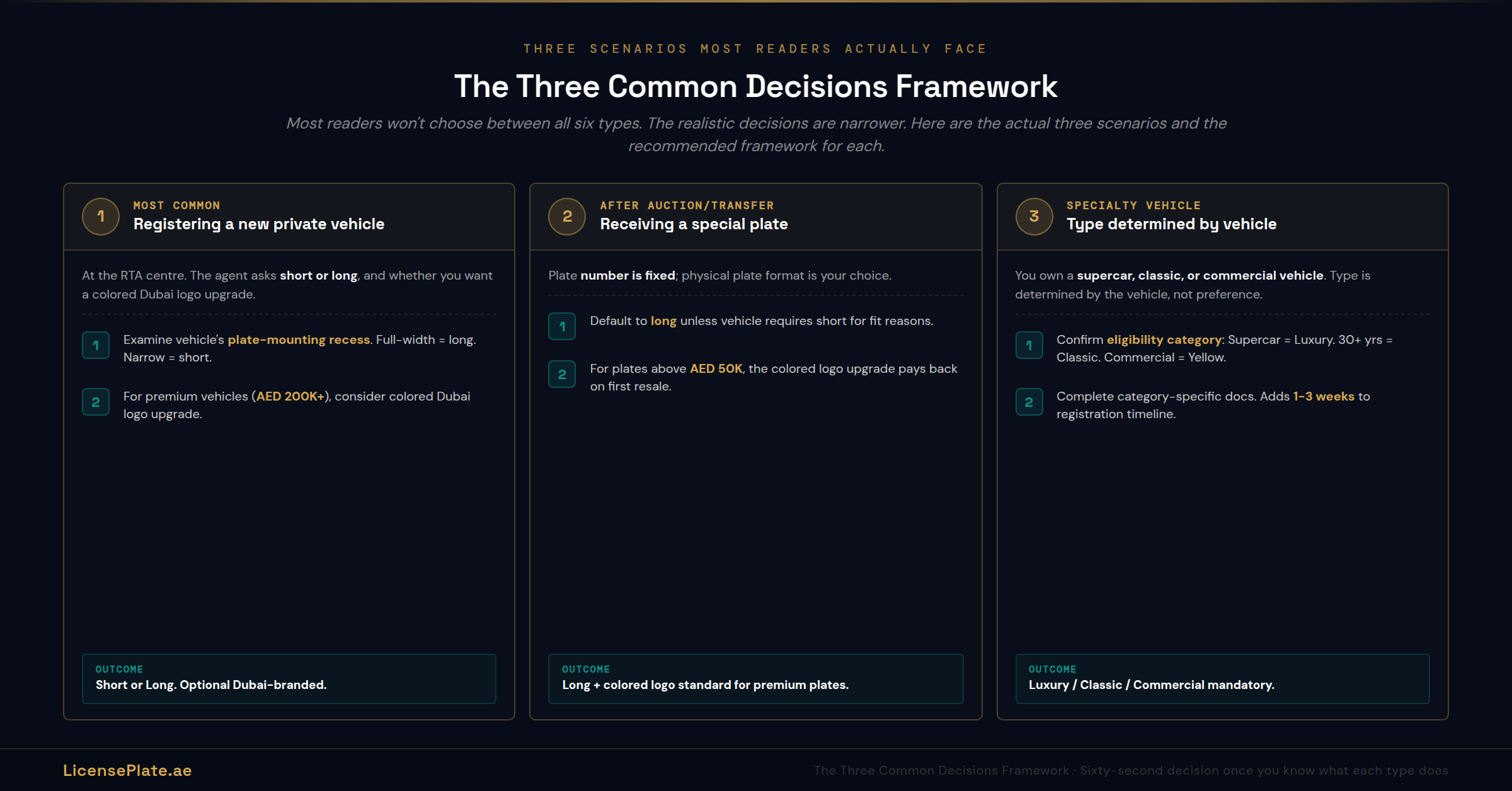
Most readers won't choose between all six types in the same transaction. The realistic decisions are narrower. Here are the three actual choice scenarios and the recommended framework for each.
Decision 1: Registering a New Private Vehicle
You're at the RTA centre registering a new car. The agent asks short or long, and whether you want a colored Dubai logo upgrade.
Step 1: Examine your vehicle's plate-mounting recess (front and rear). If both can accommodate a 520mm × 110mm long plate, choose long. If either has a narrower recess (common on European imports, sports cars, and some Japanese vehicles), choose short.
Step 2: Decide on the colored Dubai logo. The AED 200-500 upgrade is a small premium on top of a vehicle purchase that likely cost six figures. For premium vehicles (AED 200,000+), the colored logo aesthetically complements the vehicle and adds 2-5% to eventual resale. For budget vehicles, the upgrade is purely cosmetic and may not pay back.
Decision 2: Receiving a Special Plate at Auction or Transfer
You've just won an RTA auction (per the RTA Plate Auction Calendar 2026) or completed a private plate transfer. The plate number is fixed; the physical plate format is your choice.
Step 1: Default to long unless your vehicle requires short for fit reasons. Long plates are more common on premium vehicles and signal the size class typical of higher-end registrations.
Step 2: For plates above approximately AED 50,000 in market value, consider the colored Dubai logo upgrade. The 2-5% resale premium pays back the AED 200-500 upgrade fee on the first resale event. For plates above AED 500,000, the colored logo is essentially standard buyer expectation in the secondary market. Per the Investment Guide, small visual upgrades on investment-grade plates compound across the holding period.
Decision 3: Owning a Qualifying Specialty Vehicle
You own a supercar, a classic vehicle, or a commercial vehicle and the plate type is determined by the vehicle, not by preference.
Step 1: Confirm the eligibility category your vehicle falls into. Supercar with front-plate mounting issues = Luxury front-sticker. Vehicle 30+ years old with classic certification = Classic brown plate. Commercial vehicle = Yellow commercial plate.
Step 2: Complete the additional documentation the specific category requires: RTA approval letter for Luxury, Technical Inspection certification for Classic, commercial license verification for Commercial. These steps add 1-3 weeks to the registration timeline; plan accordingly.
Seven Mistakes Buyers Make When Choosing Plate Types
Mistake 1: Assuming Luxury plate means premium plate. The AED 500 Luxury plate is a regulatory accommodation for supercars, not a status tier. A short plate displaying AA 7 is a vastly more premium plate than any Luxury front-sticker displaying a 5-digit late-code number.
Mistake 2: Buying Dubai-branded for budget vehicles. The AED 200-500 colored logo upgrade is appropriate for vehicles where the aesthetic complements the existing premium positioning. On a AED 60,000 vehicle, the upgrade is cosmetic spending that does not affect resale meaningfully.
Mistake 3: Choosing Short or Long without examining vehicle fit. The most common operational mistake at RTA centres. Always verify the plate-mounting recess dimensions on your vehicle before choosing. A long plate fitted to a vehicle with short recesses creates installation issues and aesthetic mismatches.
Mistake 4: Attempting to register a non-qualifying vehicle as Classic. The 30-year age threshold is strict. Vehicles 25-29 years old are not Classics. Modified vehicles that don't pass the originality inspection are not Classics. Per the plate myths article, Classic plates are not a status upgrade for modern vehicles.
Mistake 5: Expecting to obtain an Expo plate retroactively. Expo 2020 plates are Legacy status. The issuance window closed. If you didn't get one during the 2019-2022 window, you cannot now obtain one. Buyers occasionally seek Expo plates as commemorative collector items; the only source is existing owners willing to sell.
Mistake 6: Confusing plate type fees with plate value. The AED 500 Luxury plate manufacturing fee is the cost of the physical plate. The plate's market value comes from the number combination, which can range from a few thousand AED to tens of millions of AED regardless of the physical type displaying it.
Mistake 7: Modifying or customising plates outside RTA standards. Per the Plate Frames and Mounting article, modifying plates through painting, tinting, applying coatings, or using oversized decorative frames triggers AED 3,000 fines, 24 black points, and possible vehicle impoundment for up to 90 days. The plate type framework provides all the visual variation that's legally available; stay inside it.
Frequently Asked Questions
Q: Can I switch between short and long plates after registration?
Yes. Per the Change Plate workflow at RTA, switching between short and long is a standard plate management action. You pay the appropriate manufacturing fee for the new plate type (AED 35 short, AED 50 long), plus the standard issuance fees. The plate number stays the same; only the physical format changes. The process takes about thirty minutes at a Customer Happiness Centre.
Q: Does the plate type affect my insurance premium?
No. Per Remitly's insurance documentation, plate type does not affect insurance premiums in any meaningful way. Insurance pricing is determined by vehicle make and model, vehicle age, driver record, and coverage level. Commercial plates (yellow) carry different premium structures because of the commercial use, but within private plate types (short, long, Dubai-branded, Classic, Luxury, Expo), the type does not affect your premium.
Q: Why is the Luxury plate AED 500 if it's just a sticker?
The AED 500 fee covers the regulatory approval process, the specialised manufacturing for the sticker format that meets RTA visibility standards, and the technical certification that the vehicle qualifies for the front-sticker exemption. Most of the fee is regulatory overhead, not the physical sticker itself. The fee is also a deterrent: RTA does not want every buyer requesting the front-sticker exemption when their vehicle would mount a standard plate without issue.
Q: Can I get a Dubai-branded plate on a non-private vehicle?
No. The colored Dubai logo upgrade is exclusively available for private white plates. Commercial plates, taxi plates, motorcycle plates, classic plates, and luxury plates use their own visual systems and cannot be upgraded to the colored Dubai logo design. The exclusivity is what makes the Dubai-branded designation function as a premium visual identifier.
Q: What's the cheapest legal plate type I can get?
Motorcycle plates at AED 25 manufacturing fee are the lowest cost option, but only available for registered motorcycles. For passenger vehicles, the short plate at AED 35 is the minimum, with a typical total of AED 105 including standard issuance fees. There is no further cost reduction available for standard registrations.
Q: Are Expo plates worth more than standard plates?
Slightly, in collector contexts. Expo plates carry a small commemorative premium because the issuance window has closed and they cannot be retroactively obtained. The premium is typically 5-15% over equivalent standard plates with the same number combination. The premium is meaningful for collectors specifically interested in commemorative variants but small relative to the underlying plate number's market value.
Q: Do I need a Luxury plate for my Ferrari or McLaren?
Possibly. The Luxury front-sticker is required only for vehicles where mounting a physical front plate would compromise aerodynamics or damage the vehicle's design integrity. Some Ferrari and McLaren models qualify automatically; others can mount a standard front plate without issue. The eligibility check happens during vehicle registration. If your vehicle qualifies, the Luxury plate is required, not optional. If it doesn't qualify, you cannot opt into the Luxury format.
Q: Can I display a custom plate cover or frame on my Dubai plate?
With strict limitations. Per the Plate Frames and Mounting article, simple transparent or thin metal frames that don't obscure the plate's text or emblems are generally acceptable. Decorative frames that cover plate edges, change the visible color, or add unauthorised text are not. The AED 3,000 fine for plate modification violations is one of the most enforced traffic penalties in the UAE; stay inside the legal frame guidelines or skip frames entirely.
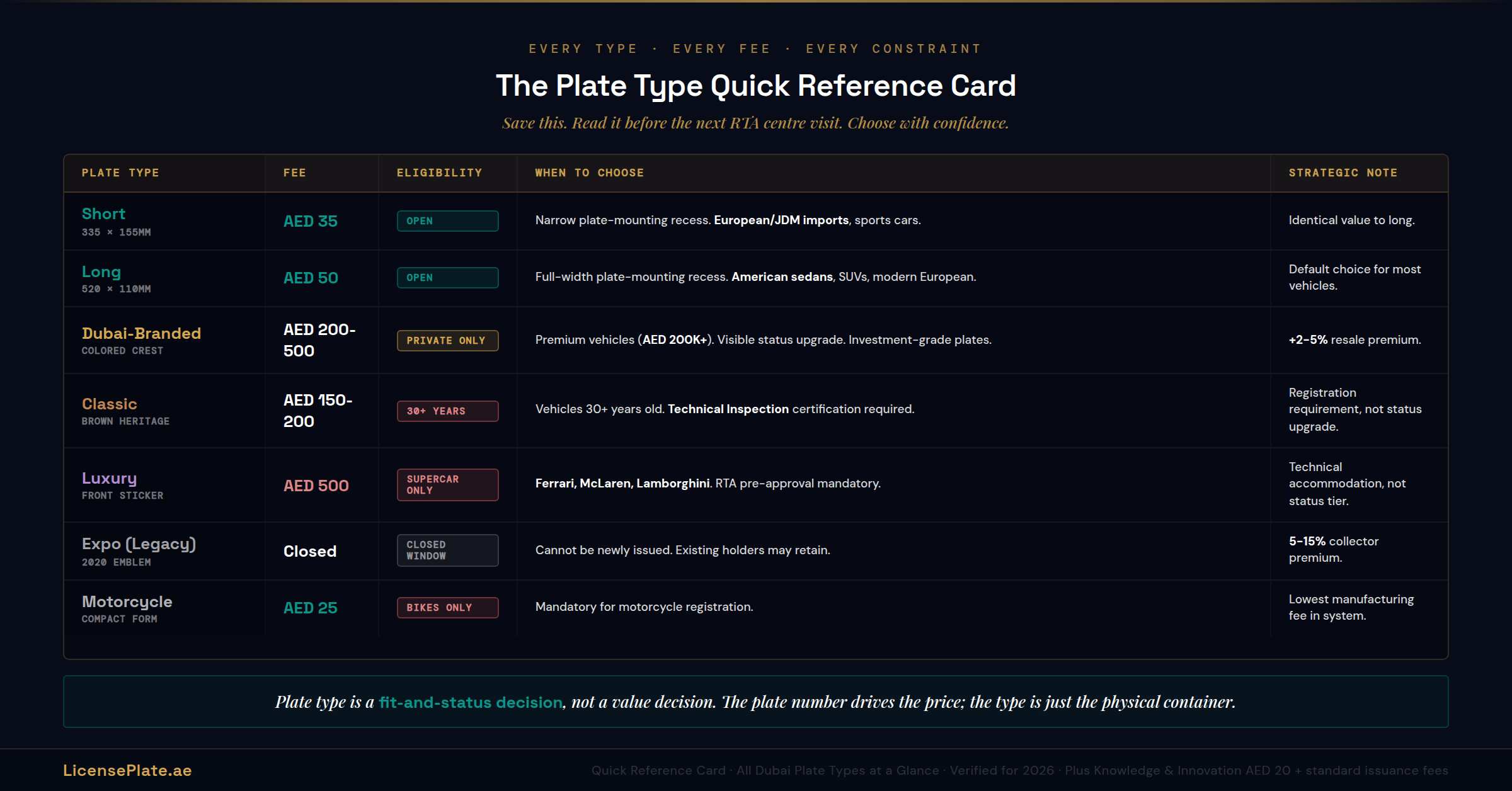
The Dubai plate types framework collapses to two operational truths. First: plate type is a fit-and-status decision, not a value decision. The market price of your plate number is determined by the letter-digit combination, not by whether it's printed on a 335mm short plate or a 520mm long plate. Second: the eligibility constraints are strict. Classic requires a 30+ year vehicle, Luxury requires supercar pre-approval, Expo is closed for new issuance, Commercial is mandatory for commercial vehicles. The types you can actually choose between for a typical private vehicle registration are short, long, and the colored Dubai logo upgrade.
With those two truths in mind, the RTA centre conversation becomes simple. Examine your vehicle's plate-mounting recess. Decide on short or long based on fit. Decide on the colored Dubai logo upgrade based on vehicle value (worthwhile for premium vehicles, cosmetic for budget vehicles). For special vehicles (classics, supercars, commercial), the type is determined by the vehicle, not by preference. The conversation that confused you fifteen minutes ago becomes a sixty-second decision once you understand what each type actually does.
For deeper context on the underlying plate-buying decision (which plate number to target, which channel to buy through, how to verify before transferring money), see the Dubai Plate Codes A to Z guide for letter-tier value, the Plate Price Check article for number-by-number pricing benchmarks, the Plate Calculator for instant valuation on any specific plate, the UAE Plate Glossary for terminology reference, and the Plate Check verification workflow for the pre-transaction protocol that protects every purchase. Together with this type framework, those pieces cover the full operational stack from initial plate selection through completed registration. The plate type decision is the simplest of the four; getting it right is the foundation that makes the rest of the journey smooth.
Delete Comment?
Are you sure you want to delete this comment? This action cannot be undone.
Delete Article?
Are you sure you want to delete this article? This will also delete all comments. This action cannot be undone.