

UAE Number Plate Colors Explained: What Blue, Green, Red, and the Rest Actually Mean (2026)
17 June 2026
Abu Dhabi
LicensePlate.ae Team
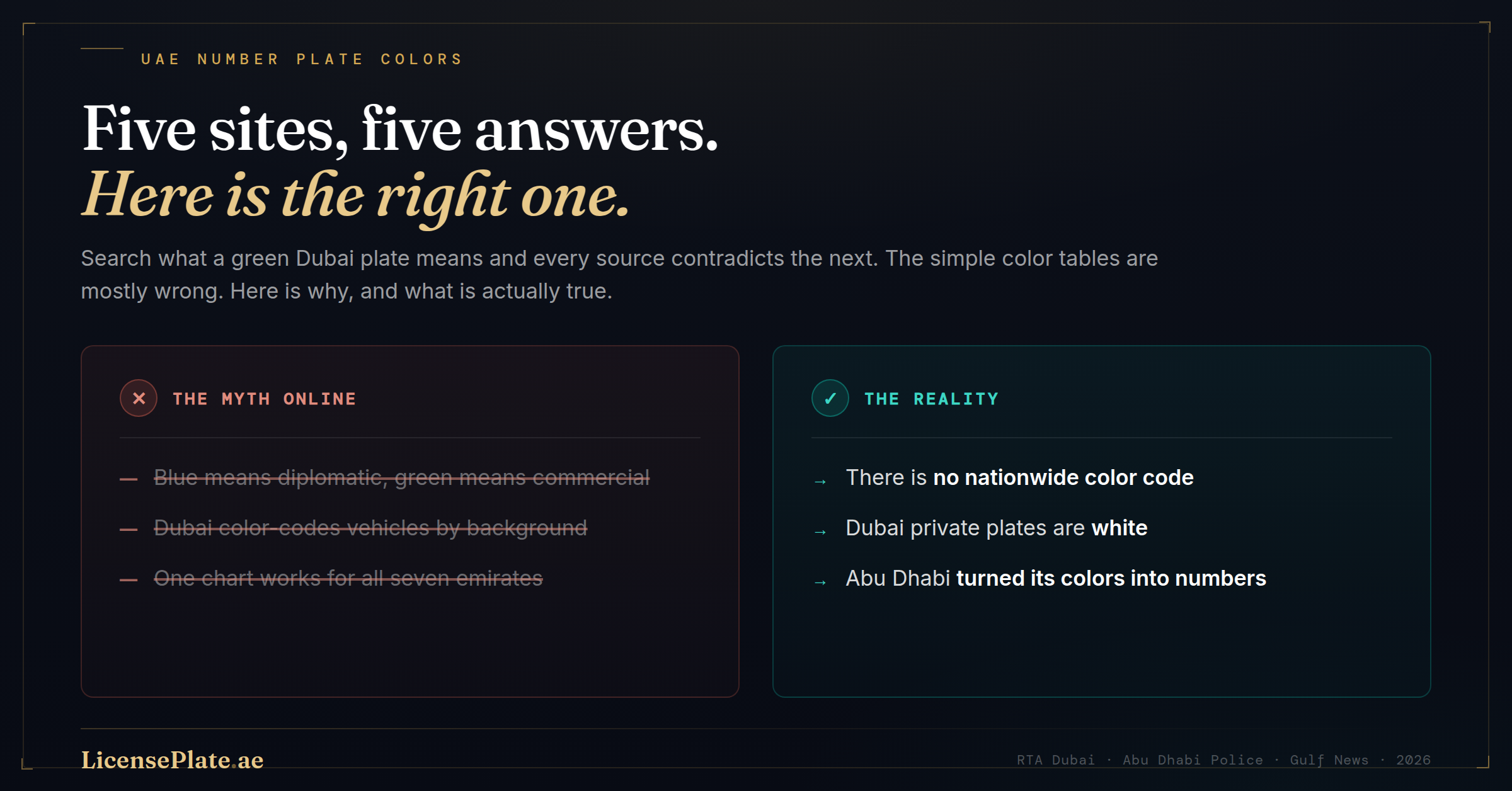
Search what a green number plate means in Dubai and you will get five different answers. One site says green is commercial, another says green is taxis, a third says green was a category Abu Dhabi retired years ago. They cannot all be right, and most of them are not. The reason the answers conflict is that nearly everyone writing about UAE plate colors is copying an old, oversimplified table and applying it to a system that has changed and that works differently in each emirate.
Here is the version that is actually correct. The short, honest answer is that the UAE does not run one tidy color code where blue means one thing and green means another across the country. Dubai and Abu Dhabi handle vehicle categories differently, Abu Dhabi specifically replaced its old colored plates with numbers, and for private cars in Dubai the background is simply white. The colors people remember are partly outdated, partly from other countries, and partly real but narrower than the tables suggest. This guide separates what is true from what is repeated, emirate by emirate, and explains why the color matters the moment you buy a used car.
Quick answer: In the UAE, a plate's category, private, commercial, taxi, government, diplomatic, classic, or temporary, is what the design signals, but it is not a simple nationwide color code. In Dubai, private plates have a white background, and category is shown by format and markings rather than background color. Abu Dhabi replaced its old colored plates (red, blue, grey, green) with numbered categories in the 2010s. So the common 'blue means X, green means Y' tables online are largely outdated. The color or format mainly tells you a vehicle's use, which affects what you can legally do with it, its insurance class, and its resale value.
Why the Color Tables Online Are Mostly Wrong
Before the categories, it helps to understand why the misinformation is so consistent. Three things got tangled together, and almost every guide repeats the tangle.
Tangle one: old systems described as current. The UAE plate system has been modernized repeatedly. The clearest example is Abu Dhabi, which used to run colored plates and then phased them out, a fact we will get to in detail because it is the key to the whole confusion. Guides that learned the old colors never updated.
Tangle two: other countries' systems borrowed wholesale. A lot of the 'blue is diplomatic, green is commercial, black is private with white text' logic is lifted straight from Indian, European, or generic international plate conventions and pasted onto the UAE, where it does not cleanly apply. If a UAE color guide reads like it could be about any country, that is usually because it is.
Tangle three: the code letter, the logo design, and the background color treated as one thing. A Dubai plate has a code letter, an optional colored 'Dubai' logo design, and a background. These are three separate features, and writers blur them into a single imagined 'plate color' that signals category. It does not work that way. The Dubai plate codes A to Z guide covers what the letter actually means, which is a different question from what the background color means.
Untangle those three and the real picture is much simpler than the contradictory tables suggest. Here it is, emirate by emirate.
Dubai: The Background Is White, the Category Is in the Format
Start with the single most common plate in the country, because getting this one right corrects most of the confusion immediately.
The myth: Dubai uses different background colors to mark private, commercial, and government cars, like a rainbow code you can read at a glance.
The reality: the standard Dubai private plate has a white background with black characters, and that covers the overwhelming majority of cars on the road, roughly nine in ten vehicles nationwide. Private cars, family SUVs, luxury vehicles, and sports cars all carry the same white background. The category is not signaled by a colored background. It is signaled by the plate format, the code letter and digits, and specific markings for non-private vehicles.
What Dubai does offer is a design choice on that white plate. You can have the plain white plate, or the newer version with the colored 'Dubai' logo printed on the left. This is purely aesthetic. It does not change the category, the rules, or the resale value of the number, a point worth remembering because some sellers imply the logo design adds value. It does not. Buyers care about the rarity of the number, not the background art. The plate types guide covers the short, long, classic, and other format variations in full.
The genuine Dubai variations worth knowing
Classic and heritage plates. Dubai reintroduced a black-and-white heritage style for classic and vintage vehicles. These are restricted to genuinely old cars, typically 30 years or older, that pass the relevant inspection. You cannot put a heritage plate on a new car for the look. The Dubai plate costs and fees guide covers the official fee structure for plate services across categories.
Taxis and commercial vehicles. Licensed taxis and commercial vehicles use distinct formats and markings that set them apart from private white plates, which is how enforcement tells a revenue vehicle from a private one at a glance. The important rule for buyers: these categories carry usage restrictions, and a vehicle registered in a commercial or taxi category cannot simply be driven as a private car without the registration being changed.
Government, police, and diplomatic. Government and security vehicles, and diplomatic vehicles tied to embassies and consulates, use their own distinct plates and are not part of the civilian market at all. Diplomatic plates in particular are tied to specific status and are not transferable to ordinary owners.
Abu Dhabi: The Colors Literally Became Numbers
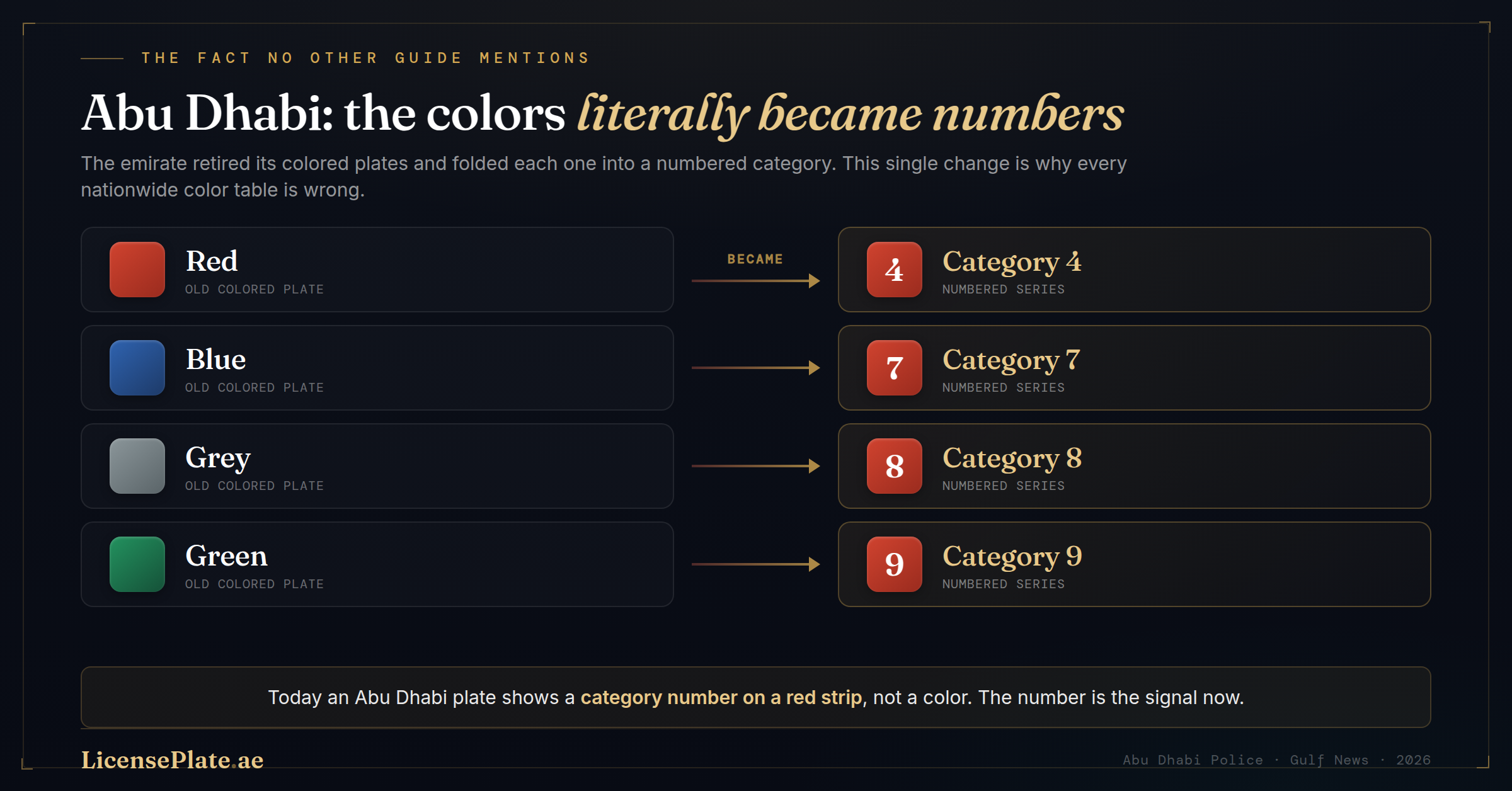
This is the fact that explains the entire mess, and almost no other guide mentions it. Abu Dhabi used to run a colored plate system. Then it replaced the colors with a numbered category system, and the old colors were folded directly into specific numbers.
The verified replacement: when Abu Dhabi moved to its numbered category system, categories 4 through 9 directly replaced the old colored plates. Category 4 replaced red. Category 7 replaced blue. Category 8 replaced grey. Category 9 replaced green. The colors people still picture when they think of Abu Dhabi plates did not disappear into meaninglessness, they became numbers on a red category strip.
So when someone tells you a green Abu Dhabi plate means a certain thing, they are describing a system the emirate retired. Today an Abu Dhabi plate shows a category number, printed on a red band along the edge, running from 1 up through the low twenties plus the commemorative category 50 issued for the UAE's Golden Jubilee. The number is the signal now, not the color. The full breakdown of what each Abu Dhabi category means and what it is worth is in the Abu Dhabi categories guide, and the broader market picture is in the Abu Dhabi plates guide.
This single change is why a nationwide color table can never be correct. One of the two largest plate-issuing emirates deliberately removed colors as the category signal. Any guide that still presents Abu Dhabi colors as current is years out of date.
The Plate Categories That Genuinely Exist (and What They Signal)
Stripping out the myths, here are the vehicle categories that are real across the UAE, regardless of how each emirate visually marks them. These are the distinctions that actually affect ownership, use, and value.
Private. The standard category, white background in Dubai, the bulk of the market. Unrestricted personal use. This is the only category that trades freely on the secondary market, which is why almost every plate on a marketplace is a private plate. When you buy a premium number to put on your own car, this is the category you are in.
Commercial. Company-owned and business-use vehicles, delivery fleets, logistics, trucks. Distinct format and markings, and crucially, usage restrictions. A commercial-registered vehicle is not freely usable as a private car without changing the registration category, which can carry cost and conditions.
Taxi and public transport. Licensed taxis and transport vehicles, marked distinctly so they are instantly identifiable. Tightly regulated. Taxi registrations generally cannot be converted to private ownership when the vehicle leaves service.
Government and police. State and security vehicles. Not part of the civilian market.
Diplomatic. Embassy, consulate, and international-organization vehicles, often associated with the letters CD for Corps Diplomatique. Tied to diplomatic status, with specific privileges, and not transferable to ordinary owners.
Classic and heritage. For genuinely old vehicles, typically 30 years and up, that pass inspection. Both Dubai and Abu Dhabi have introduced heritage-style plates for these cars. A status and enthusiast category, not something you can request for a modern vehicle.
Temporary, export, and test. Short-validity plates for vehicles in transition, newly imported, being exported, between owners, or undergoing dealer and manufacturer testing. Valid for a limited window, often one to three months, and never a permanent registration. If a used car you are viewing is on a temporary plate, that is a signal to ask why.

Why Plate Category Matters When You Buy
This is where the topic stops being trivia and starts being money. Plate category is not just a label, it changes what a vehicle is, legally and financially.
Legal use. A vehicle's registered category controls what you are allowed to do with it. Buy a car that is registered commercial or as an ex-taxi and try to run it as a private vehicle, and you are not automatically compliant, the registration category has to match the use. This is the kind of thing that surfaces at renewal or in an accident claim, at the worst possible time.
Insurance class. Insurers price by category. Commercial, rental, and former-revenue vehicles sit in different risk classes than private cars, and the premium follows the category, not just the car. A cheap used car with the wrong registration category can cost more to insure than a pricier private one.
Resale value and history. A former taxi or commercial vehicle has usually lived a harder life, more hours, more mileage, heavier wear, even if it looks clean. The plate category is a clue to the history before you read a single service record. And on the plate-as-asset side, only private plates trade freely, so if you are buying a number for its value rather than the car, category is the first thing to confirm.
None of this is visible from a photo of a shiny car. It is visible from the registration category. Before you buy any used vehicle or plate, confirm the category and confirm it matches what you intend to do. The pre-purchase verification checklist covers the full due-diligence process, and the plate value calculator prices private plates against real market data once you have confirmed the category is clean.
Common Mistakes People Make About Plate Colors
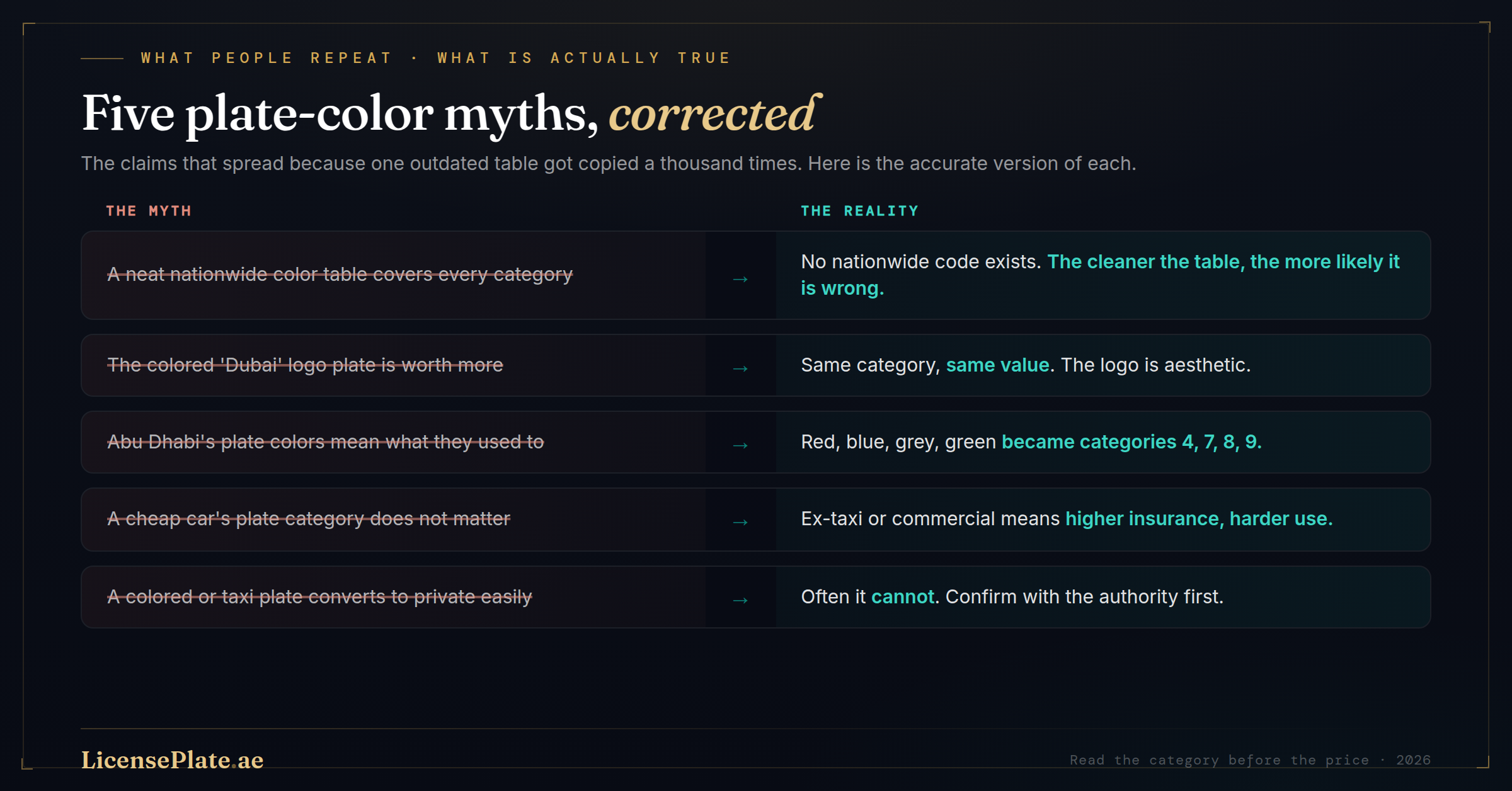
Trusting a single color table. If a guide gives you a neat nationwide list, blue means this, green means that, treat it with suspicion. The UAE does not work that way, and the cleaner the table looks, the more likely it is wrong.
Assuming the Dubai logo design changes value. The plain white plate and the colored 'Dubai' logo plate are the same category and the same value. The design is aesthetic. Buyers pay for the number, not the background.
Reading Abu Dhabi colors as current. The old red, blue, grey, and green became categories 4, 7, 8, and 9. If a source still describes Abu Dhabi by color, it is out of date.
Ignoring category when buying a cheap used car. A bargain price on a car with a commercial or ex-taxi registration is often not the bargain it looks like, once insurance and the registration-category question are factored in.
Thinking a colored plate can be made private easily. Taxi and many commercial registrations do not simply convert to private ownership. Assuming they do is how people end up with a vehicle they cannot use the way they planned.
Frequently Asked Questions
Q: What does a green number plate mean in Dubai?
There is no current standard green private-category plate in Dubai. Most claims about green plates online are either describing other countries' systems, an outdated Abu Dhabi color (Abu Dhabi's old green became category 9), or conflating the colored 'Dubai' logo design with a category code. Dubai private plates have white backgrounds; category is signaled by format and markings, not a green background.
Q: What is the most common number plate color in the UAE?
White. The standard private plate across the UAE has a white background with black characters, covering roughly 90% of vehicles on the road. Private cars, SUVs, luxury vehicles, and sports cars all use the same white background. Category is not signaled by a different background color for private vehicles.
Q: Did Abu Dhabi used to have colored plates?
Yes, and this is the key to the whole topic. Abu Dhabi previously ran colored plates and then replaced them with a numbered category system. Category 4 replaced red, 7 replaced blue, 8 replaced grey, and 9 replaced green. Today an Abu Dhabi plate shows a category number on a red strip, not a category color. This is why nationwide color tables are inaccurate.
Q: What does the colored 'Dubai' logo on a plate mean?
It is a design option, not a category signal. Dubai offers a plain white plate and a version with a colored 'Dubai' logo printed on the left. The choice is purely aesthetic. It does not change the plate's category, rules, or resale value. Buyers pay for the rarity of the number, not the logo design.
Q: Do plate colors mean the same thing in every emirate?
No. There is no unified nationwide color code. Each emirate runs its own system, and Dubai and Abu Dhabi in particular handle category differently, Dubai by format on a white background, Abu Dhabi by numbered category. This is the core reason the simple color tables circulating online are misleading.
Q: What is a red number plate in the UAE?
Red is most consistently associated with temporary, export, and test registrations, short-validity plates for vehicles in transition, being imported, exported, transferred, or tested by dealers and manufacturers. These are not permanent registrations and usually expire within one to three months. In Abu Dhabi's old system, red specifically became category 4.
Q: Why does plate category matter when buying a used car?
Because category controls legal use, insurance class, and resale value. A commercial or ex-taxi vehicle cannot simply be run as a private car without changing the registration, it sits in a different insurance risk class, and it has usually had harder use. Confirming the registration category before buying protects you from a vehicle you cannot use as intended or insure cheaply.
Q: Can I change a commercial or taxi plate to a private one?
Not automatically. Taxi registrations generally cannot convert to private ownership when the vehicle leaves service, and commercial registrations require a formal category change with its own conditions and cost. Never assume a colored or commercial-category vehicle can be casually re-registered as private, confirm it with the relevant authority before buying.
Q: What are classic or heritage plates?
Special plates for genuinely old vehicles, typically 30 years or older, that pass a technical inspection for classic status. Both Dubai and Abu Dhabi have introduced heritage-style plates for these cars. They cannot be applied to modern vehicles, and they exist for enthusiasts and collectors rather than as a category you can request for a new car.
The honest summary of UAE plate colors is shorter than the misinformation it replaces. There is no single nationwide color code. Dubai private plates are white, and category shows in the format. Abu Dhabi turned its old colors into numbers. The genuine categories, private, commercial, taxi, government, diplomatic, classic, temporary, are real and they matter, but they are not a rainbow you can read across all seven emirates from one chart.
What is worth carrying away is not the trivia but the practical edge: a plate's category tells you what a vehicle legally is, before you read its history or its price. That makes it a buying signal, not just a curiosity. A white private plate and an ex-taxi plate can sit on cars that look identical and be worth very different amounts once insurance and legal use are accounted for. If you are buying a car or a plate, read the category first. The full plate decoder and types guide covers how to read the rest of the plate, the foundational plate guide covers the whole system end to end, the complete Dubai plate guide covers buying and selling from both sides, and the verification checklist turns all of this into a pre-purchase routine that protects your money.
Delete Comment?
Are you sure you want to delete this comment? This action cannot be undone.
Delete Article?
Are you sure you want to delete this article? This will also delete all comments. This action cannot be undone.