

Abu Dhabi Number Plate Categories 1 to 50 Explained: Codes, Colours, Pricing and History
23 February 2026
Abu Dhabi
LicensePlate.ae Team
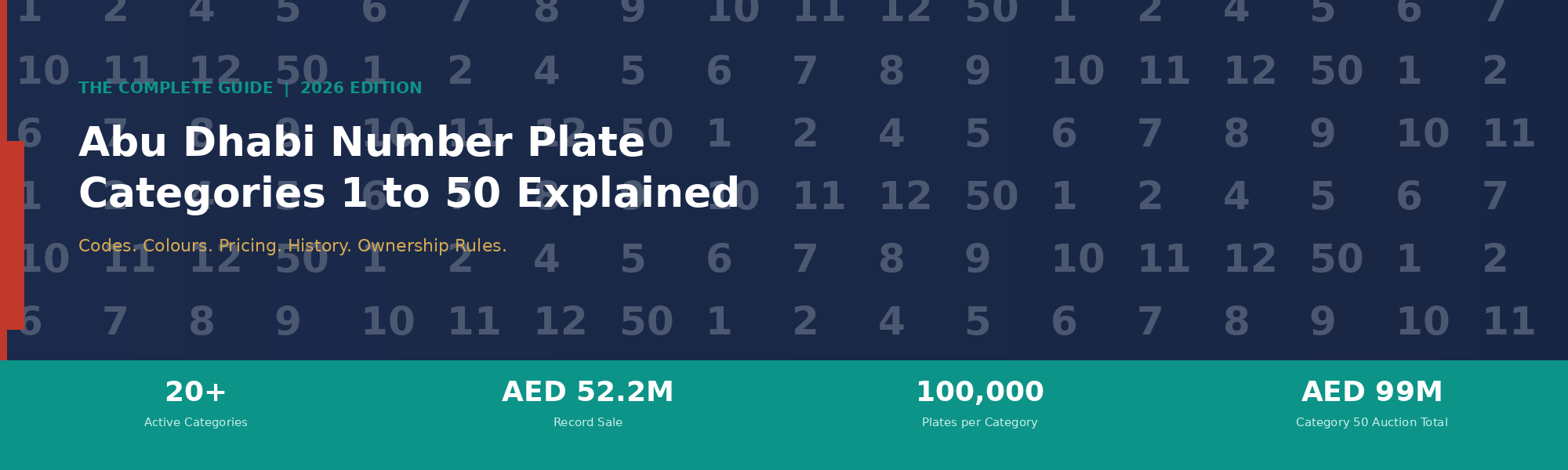
Abu Dhabi’s number plate system is unlike anything else in the UAE. While Dubai uses letter codes from A through Z and beyond, Abu Dhabi runs on a numbered category system where a single digit printed in red on the plate itself tells you exactly which series the plate belongs to. That number, displayed on a red band along the left or top edge, can range from 1 all the way through 22 and includes the commemorative category 50 released for the UAE’s Golden Jubilee. Understanding what each category means, when it was introduced, and how it affects the value of a plate is fundamental knowledge for anyone buying, selling, or investing in Abu Dhabi plates.
Yet despite the scale of this market, which has produced the single most expensive number plate ever sold on earth (plate number 1, sold for AED 52.2 million in 2008), there is no consolidated guide that explains the full category system. General classifieds sites offer fragments. Insurance blogs mention a few codes. Forum posts from 2011 discuss category 11 in isolation. Nobody has mapped the entire picture in one place. This article does exactly that. It covers every active category, traces the history from Abu Dhabi’s original colour-coded plates to today’s unified numbered format, breaks down pricing by category and digit count, and explains the September 2025 administrative decision from the Department of Municipalities and Transport that fundamentally changed how distinguished plates are owned and traded.
If you are browsing Abu Dhabi plates on LicensePlate.ae and want to understand why a category 2 plate commands a premium over category 17, or why category 50 carries collector appeal despite being one of the newest series, this is the guide. For a broader overview of how plates work across all seven emirates, see our license plate guide.
How the Abu Dhabi Category System Works
Every Abu Dhabi number plate follows a consistent format. The plate displays the words “United Arab Emirates” and “Abu Dhabi” in both Arabic and English. A red band, positioned on the left side or across the top depending on the plate shape (rectangular or square), carries a number. That number is the category code. It is followed by the plate’s registration number, which can range from one to five digits. A plate reading “2 – 789” means category 2, plate number 789. A plate reading “17 – 45321” means category 17, plate number 45321. You can visualise this format using the custom plate generator on our site.
The category code serves an administrative function, originally tied to sub-regions and licensing branches within the emirate. Abu Dhabi Police manages the issuance, while the Integrated Transport Centre (now branded as Abu Dhabi Mobility or AD Mobility) under the Department of Municipalities and Transport (DMT) oversees regulatory decisions including ownership, transfer, and auction operations. Most digital services, from plate reservation to ownership transfer, are processed through the TAMM platform.
Each category has a capacity of 100,000 plate numbers (00001 through 99999, plus single digits through four digits reserved for auction). When a category runs out of regular numbers, Abu Dhabi Police introduces a new category rather than expanding the existing one. This is why the system has grown from a handful of early categories to over twenty active codes today. Reserved auction plates are sold through Emirates Auction, the region’s designated auction partner.
The Physical Plate Design
A significant design update occurred in 2016, when Abu Dhabi introduced an intertwined Arabic and English font for the city name, creating a more modern and internationally recognisable look. In 2018, Abu Dhabi Police launched an updated plate design for light vehicles with separate front and rear bumper formats. The front plate carries the Abu Dhabi logo, while the rear plate features a red ribbon shape. Replacement with the new design is optional when renewing registration, but mandatory for newly registered vehicles. All plates are manufactured by a German company and include advanced holograms to prevent tampering, duplication, and fraud. For guidance on how to verify plate authenticity before any transaction, see our guide to avoiding number plate scams in the UAE.
From Colours to Categories: The History of Abu Dhabi Plates
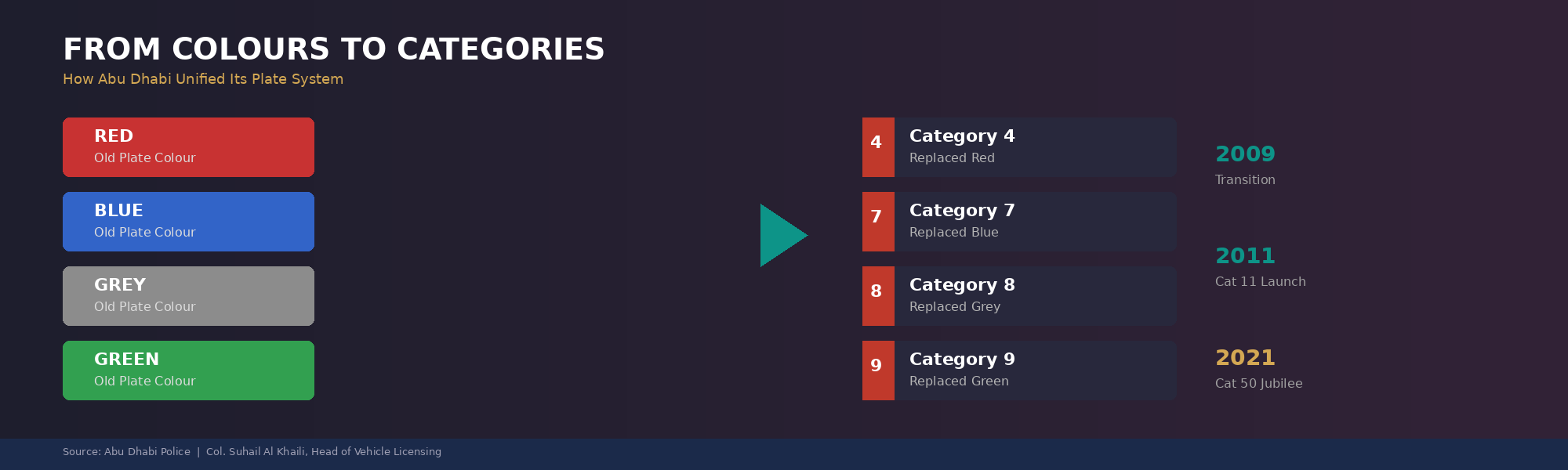
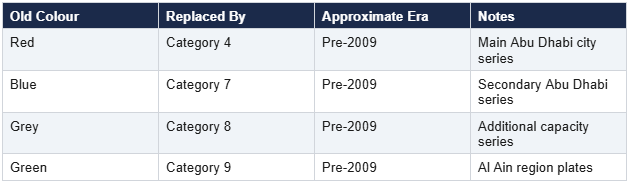
Before the numbered category system existed, Abu Dhabi plates were identified by colour. The original system, announced by Abu Dhabi Police in 2009 for replacement, used four colour bands to distinguish plate series:
The transition was not overnight. In a 2011 interview reported by The National, Colonel Suhail Al Khaili, then Head of the Vehicle Licensing Section at Abu Dhabi’s Drivers and Vehicle Licensing Department, confirmed that 95% of replacements were expected within one year, with the remaining 5% covering private vehicles on two-year registration cycles. The motivation was threefold: unifying the visual appearance of all Abu Dhabi plates under a single red-band format, improving security through clearer, electronically readable numbers, and expanding capacity as existing categories ran out of available registrations.
As Colonel Al Khaili explained at the time, “We have so many designs and colours, like a rainbow. We need to unify it all.” The new designs were described as more practical because they would not run out of numbers as quickly and were better for security because the numbers were clearer to read. By unifying all plates under red category bands, Abu Dhabi eliminated confusion between colour series and established the scalable, numbered system that remains in use today. Gulf News and The National both covered the transition extensively.
The Early Numbered Categories (1, 4 through 10)
Category 1 holds a unique position in Abu Dhabi’s plate hierarchy. It is the original and most prestigious numbered series, with the lowest number in the system. Plates in category 1 with single-digit or double-digit registration numbers are among the most coveted assets in the UAE plate market. Category 2 was introduced in 2017, notably timed to coincide with the UAE’s National Day and Commemoration Day on December 2nd, giving the number symbolic significance. Categories 4 through 9 directly replaced the old colour-coded plates, with 4 replacing red, 7 replacing blue, 8 replacing grey, and 9 replacing green. Categories 5, 6, and 10 were existing early numbered series that predated the transition. By 2011, categories 5, 6, and 10 had exhausted their available registrations, which triggered the creation of category 11.
Category 11: The Pivotal Expansion (2011)
Abu Dhabi Police officially introduced category 11 in February 2011, making it the second binary-digit category in the system. The timing was deliberate: the number 11, a repetition of the digit 1, coincided with the year 2011. Abu Dhabi Police announced that issuance would proceed in two phases. The first phase distributed ordinary five-digit registrations through standard channels. The second phase involved public and electronic auctions through Emirates Auction for special one-digit, two-digit, and three-digit plates within category 11. Proceeds from these auctions were allocated to a fund supporting victims of traffic accidents and people with special needs.
Category 11 marked a clear signal that Abu Dhabi’s plate market was no longer just an administrative function but a structured asset class with designated auction infrastructure. The pattern of releasing new categories alongside special auctions has continued ever since. For a detailed look at how auctions compare to other buying channels, see our RTA Auction vs Private Sale vs Marketplace breakdown.
Categories 12 through 22: Sequential Expansion
Following the category 11 launch, Abu Dhabi Police continued introducing new categories as demand required. Categories 12 through 17 were released progressively through the 2010s, with each new category absorbing the growing number of vehicle registrations across Abu Dhabi, Al Ain, and the Western Region (Al Dhafra). Categories 18 through 22 followed in the late 2010s and early 2020s, maintaining the same format and registration structure. Each category accommodates up to 100,000 plates, with 75,000 allocated for standard distribution and approximately 25,000 reserved for auction. Licensing services are managed through the DMT and its subsidiary entities.
Higher-numbered categories are generally associated with more recent issuance periods. This means plates in categories 12 through 17 tend to have more five-digit registrations available, while lower categories (1 through 10) are increasingly composed of plates that have already been assigned or traded on the secondary market. The practical result is that lower categories carry higher perceived prestige, because they represent older, more established series with limited remaining inventory. You can compare availability across all active categories by browsing Abu Dhabi plates by code on LicensePlate.ae.
Category 50: The Golden Jubilee Edition (2021)
In November 2021, Abu Dhabi Police launched category 50 to commemorate the UAE’s Golden Jubilee, marking 50 years since the nation’s founding in 1971. Major General Ahmed Saif bin Zaitoon Al Muhairi, Director of the Central Operations Sector, stated that the new category would give the 50th anniversary celebration another dimension. The plates became available from November 24, 2021, at all service centres of the Drivers and Vehicle Licensing Directorate.
Abu Dhabi Police subsequently offered 222 distinguished category 50 plates through Emirates Auction in a 10-day online auction that ran through early December 2021. The collection included plate number 1971 (representing the year of the UAE’s formation), plate number 2021 (the jubilee year), 55 two-digit plates, and 555 three-digit plates. The auction for category 50 plate number 1 generated intense competition, ultimately selling for AED 31 million. Plate number 50 within the same category sold for AED 6.8 million. Plate number 11 fetched AED 6.15 million. In total, the auction raised AED 99 million.
Category 50 plates carry collector significance beyond their registration value. They are the only Abu Dhabi plates tied to a specific national event, making them commemorative editions with a built-in narrative that other categories do not share. Their limited issuance window (they were available only during the Golden Jubilee period) means the supply is fixed, which tends to support long-term price appreciation in the collector market. This same supply-constraint dynamic drives value in other emirates as well; our RAK number plate investment guide explores how fixed-supply plates behave across different markets.
Every Abu Dhabi Plate Category Mapped: What the Numbers Mean
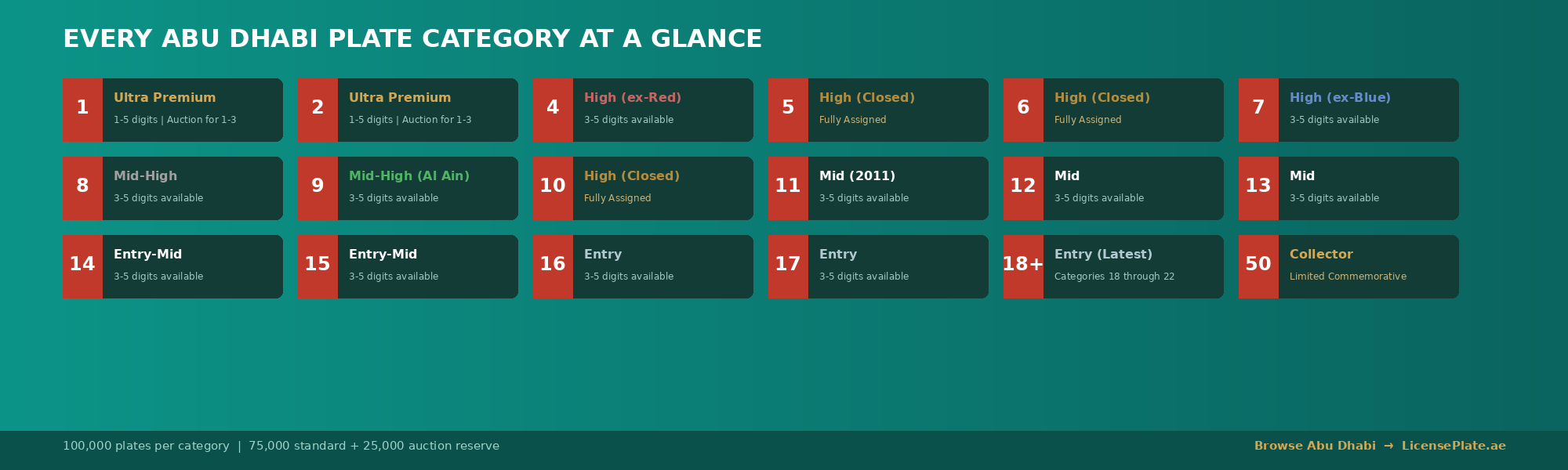
The following table consolidates every known active category in the Abu Dhabi plate system. Categories are listed in numerical order. Note that categories 3 is not in active civilian circulation, and some early categories carry unique historical weight.
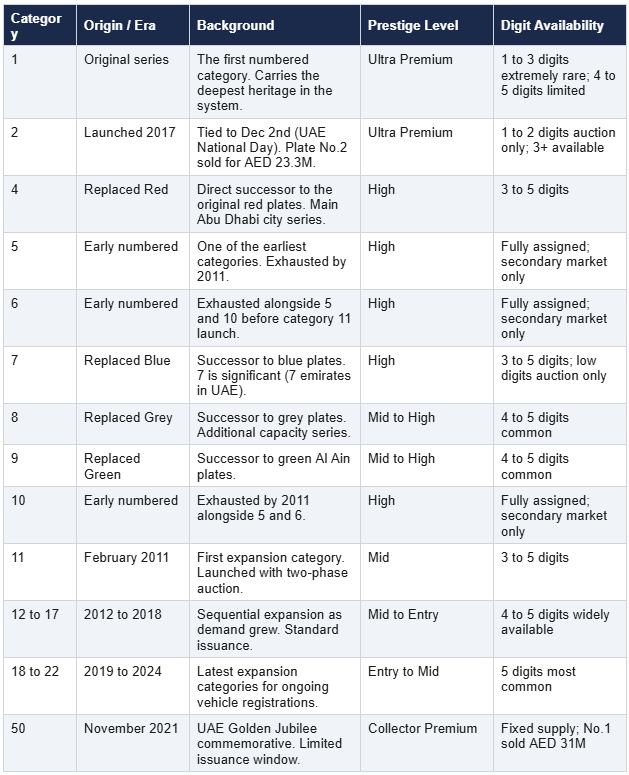
Note: Category 3 is not listed as an active civilian plate category. Categories are not strictly sequential; gaps exist where numbers were reserved for non-civilian or administrative use. For the equivalent breakdown of Dubai’s letter code system, see our Dubai Plate Codes A to Z guide. For plates in other northern emirates, browse Fujairah, Ras Al Khaimah, and Umm Al Quwain listings on LicensePlate.ae.
What Abu Dhabi Plates Cost: Pricing by Category and Digit Count
Abu Dhabi plate pricing follows two primary drivers: the category number and the digit count. Lower categories carry heritage premiums, while fewer digits exponentially increase value. The interaction between these two factors creates a pricing landscape with a wider range than most buyers initially expect. Use the Plate Calculator to estimate value for any specific combination.
Single Digit Plates (1 through 9)
Single-digit Abu Dhabi plates are the most expensive registration assets in the world. The record belongs to plate number 1 in a pre-category-system series, sold by Emirati businessman Saeed Abdul Ghaffar Khouri for AED 52.2 million at a 2008 auction organised by Emirates Auction at the Emirates Palace Hotel. That sale entered the Guinness Book of World Records and the proceeds were used to build the UAE’s first national rehabilitation centre for road traffic accident victims.
Other notable single-digit sales include plate number 5 (AED 25.2 million in 2007, purchased by Talal Ali Mohammed Khouri), plate number 7 (sold multiple times across different categories, reaching AED 16.8 million in 2010 and AED 13.4 million in 2016), plate number 9 (AED 15.4 million in 2008 and AED 10 million in 2010), and plate number 2 in category 2 (AED 23.3 million). At the November 2025 Emirates Palace auction, category 2 plate number 3 was among the headline lots offered to collectors and investors.
The price variation between single digits reflects cultural and personal significance. Numbers 1, 5, and 7 consistently command the highest premiums. Number 7 resonates because it represents the seven emirates of the UAE. Number 1 carries universal prestige. Number 5 has attracted multiple record bids from the Khouri family across different auction events. For the full history of record-breaking sales across both Abu Dhabi and Dubai, see our most expensive plates ever sold article.
Double Digit Plates (10 through 99)
Two-digit plates in Abu Dhabi typically trade between AED 1 million and AED 10 million depending on the category and the specific number combination. Repeating digits (11, 22, 33, 55, 77, 99) command significantly higher premiums than non-repeating pairs. At the December 2021 category 50 auction, plate number 11 sold for AED 6.15 million and plate number 50 sold for AED 6.8 million. Plate number 12 in a separate auction reached AED 1.6 million. The November 2025 auction at Emirates Palace featured 33 distinguished plates including two-digit lots in various categories.
Three Digit Plates (100 through 999)
Three-digit Abu Dhabi plates occupy the sweet spot between accessibility and prestige. Prices typically range from AED 100,000 to AED 3 million, with triple repeating digits (111, 222, 333, 555, 777, 999) sitting at the upper end and standard combinations starting from the low six figures. Car model numbers (such as 911 for Porsche, 599 for Ferrari, or 600 for Lexus LX600) carry premiums among automotive enthusiasts. In categories 1 and 2, even ordinary three-digit combinations can command prices well above AED 500,000 due to the category’s heritage weight. Browse three-digit Abu Dhabi plates currently listed to compare asking prices across categories.
Four Digit and Five Digit Plates
Four-digit plates range from approximately AED 10,000 to AED 200,000 depending on the category, pattern, and repetition. Plates with repeating sequences (such as 1111, 7777, or 5050) sit at the top of this range. Standard four-digit combinations in newer categories (14, 15, 16, 17) start from AED 10,000 to AED 25,000. Five-digit plates are the most affordable tier, starting from around AED 3,000 to AED 8,000 for common numbers in higher categories. However, five-digit plates with strong patterns (such as 12345, 11111, or numbers ending in 000) can trade well above AED 50,000. Before purchasing any plate, ensure all traffic fines are cleared on the vehicle, as outstanding fines block transfers.
Pricing Summary by Digit Count
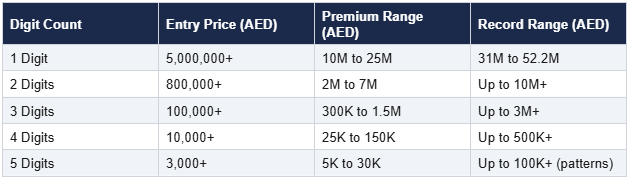
Prices are indicative based on 2024 and 2025 auction results and secondary market listings. Actual prices vary by category, specific number, market conditions, and buyer demand. For real-time pricing, browse Abu Dhabi plates on LicensePlate.ae or use the Plate Calculator for estimated valuations. Auction results sourced from Emirates Auction and Abu Dhabi Police public records.
The September 2025 DMT Decision: New Ownership Rules for Distinguished Plates
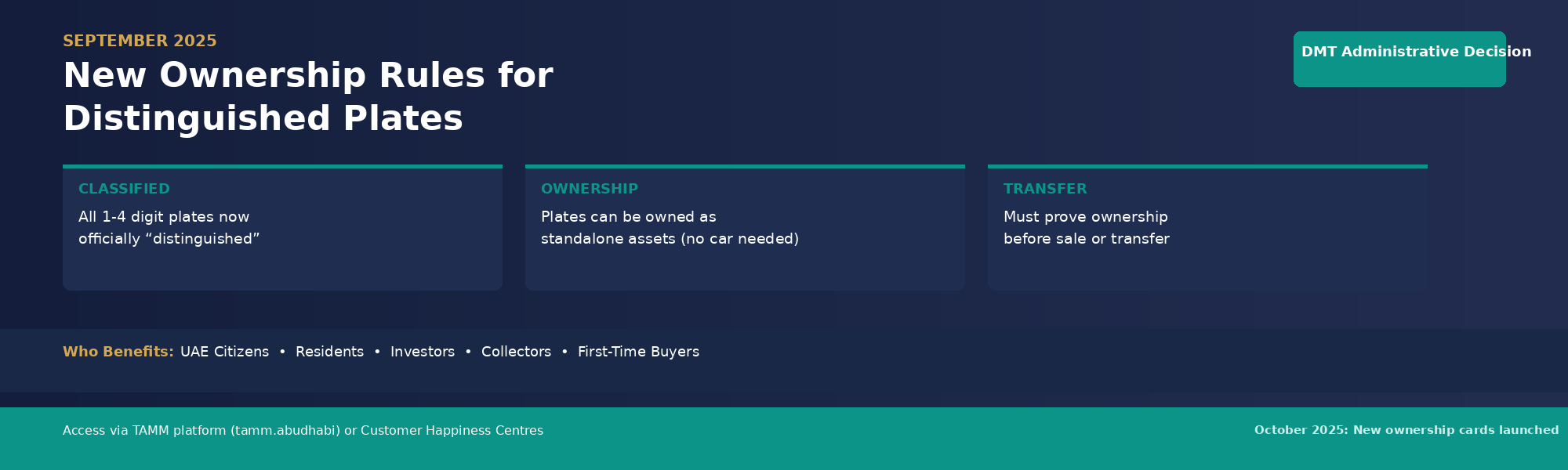
On September 13, 2025, the Department of Municipalities and Transport (DMT) issued an Administrative Decision that fundamentally changed how distinguished number plates are owned and traded in Abu Dhabi. The decision, implemented through the Integrated Transport Centre (Abu Dhabi Mobility), introduced a transparent mechanism enabling both citizens and residents to formally own distinctive plate numbers as standalone assets, independent of any vehicle assignment.
What Changed
Before September 2025, many distinguished plates in Abu Dhabi existed in a grey area. They were registered to vehicles but without clear proof of standalone ownership. A plate could be linked to a car, but the plate itself was not treated as an independently owned asset with its own title. This created friction in the secondary market. Sellers could not easily prove they owned the plate separate from the vehicle. Buyers had limited legal certainty. Transfers required navigating ambiguous procedures. Our Abu Dhabi plate transfer guide (TAMM) explains the previous transfer process in detail.
The DMT decision addressed this by formally classifying all Abu Dhabi plates into two categories: “distinguished numbers” and “non-distinguished numbers.” Under the new framework, all single-digit, double-digit, triple-digit, and quadruple-digit plates are automatically considered distinguished, along with certain five-digit plates that meet specific conditions. Distinguished plates can now be owned like property, with an official ownership certificate issued through the Integrated Transport Centre.
What This Means for Buyers and Sellers
The decision states that previously issued distinguished plates registered without official ownership documentation may not be transferred or sold unless ownership is proven. This is a critical requirement. If you are holding a distinguished plate that was registered informally to your vehicle, you must formalise ownership before any sale or transfer can proceed. An exception exists for transfers to first-degree relatives, including parents, siblings, spouses, and children, which can be processed under procedures approved by the Integrated Transport Centre.
Abu Dhabi Mobility confirmed that plate holders affected by this rule will receive a text message detailing the specifics and the value associated with formalising their ownership. During the initial phase, the service is accessible through in-person visits to customer service centres. Digital access through the TAMM platform is planned for a later phase. For guidance on verifying plate ownership before any transaction, see our safety guide on avoiding plate scams in the UAE.
In October 2025, Abu Dhabi Mobility followed up by launching new identity cards for distinguished plate owners. These cards feature a modern design with advanced security technologies and serve as physical proof of plate ownership. Owners of cars and motorcycles with special plates can apply for these cards at Customer Happiness Centres across the emirate.
Why This Decision Matters for the Market
The September 2025 rules represent the most significant regulatory change in Abu Dhabi’s plate market in years. By formalising plate ownership as a standalone asset, DMT has effectively created a clearer, more liquid secondary market. Buyers now have a legal framework that confirms ownership. Sellers have documentation that proves title. The entire transaction process becomes more transparent, which tends to attract more participants and increase market activity. This transparency also reduces the risk of fraud; for a detailed look at how scams operate and how to protect yourself, read our guide to avoiding number plate scams in the UAE. For investors, this is a positive signal. It means Abu Dhabi plates are moving closer to being treated as regulated alternative assets, similar to real estate titles or vehicle ownership certificates, rather than informal possessions tied to a vehicle registration.
How to Buy an Abu Dhabi Number Plate
There are three primary channels for acquiring Abu Dhabi plates, each suited to different budgets and requirements. For a broader comparison of how these channels work in the UAE plate market, see our complete buying channels guide.
Channel 1: Emirates Auction (Public and Online Auctions)
Emirates Auction, the Middle East’s largest auction house for distinguished plates, manages all official Abu Dhabi plate auctions in partnership with the Integrated Transport Centre. Auctions are held both as live public events (such as the November 2025 auction at Emirates Palace, featuring 33 plates including category 2 plate number 3 and category 12 plate number 10) and as online bidding events accessible through the Emirates Auction website and mobile app. To participate, you must register through UAE Pass and place a security deposit. For public auctions, the deposit is typically a certified bank cheque. For online auctions, credit card deposits are often accepted. For a detailed comparison of auction buying versus private and marketplace channels, see our RTA Auction vs Private Sale vs Marketplace guide.
Channel 2: TAMM Platform (Standard Registrations)
For standard (non-distinguished) plates issued during vehicle registration, the TAMM platform is the primary digital channel. When you register a new vehicle or transfer ownership, the system assigns a plate number from the current active category. You can also reserve specific plate numbers through TAMM, with reservation fees starting from AED 100 for a six-month hold. The platform requires UAE Pass authentication. For a walkthrough of the Abu Dhabi transfer process, see our How to Transfer a Number Plate guide.
Channel 3: Private Resale and Marketplace Platforms
The largest volume of Abu Dhabi plate transactions happens on the secondary market, where existing plate owners sell to new buyers. This is where platforms like LicensePlate.ae play a critical role. The platform currently lists over 12,800 Abu Dhabi plates across all active categories, with filters by category code and digit count. Unlike classified ad sites where anyone can post without verification, marketplace platforms provide structure: agent-managed listings, privacy protection for both parties, and a clear path to the official TAMM transfer process. Buyers can browse by category (1 through 20 and 50), filter by digit count, and use the Plate Calculator to get a reference valuation before making contact. Sellers looking to list their Abu Dhabi plate can upload directly through the platform. You can also browse plates from all emirates if Abu Dhabi is not your only market.
Which Category Should You Buy? A Practical Comparison
The right category depends on your purpose. Here is how different buyer profiles typically align with the Abu Dhabi plate category system. For step-by-step guidance on the full buying process, our Abu Dhabi number plate buying and selling guide covers everything from search to transfer.
For Maximum Prestige: Categories 1 and 2
If the plate is a statement piece intended to reflect status and heritage, categories 1 and 2 are the top tier. Category 1 carries the deepest lineage. Category 2 has the added cultural resonance of the UAE’s National Day. Expect to pay premium prices even for four-digit and five-digit registrations within these categories. A five-digit plate in category 1 or 2 can still command AED 15,000 to AED 40,000, significantly more than the same digit count in category 15 or 17. Filter Abu Dhabi plates by category 1 or 2 to see what is currently available.
For Investment and Appreciation: Categories 5, 6, 10, and 50
Categories 5, 6, and 10 are fully assigned, meaning no new plates are being issued. This fixed supply supports price appreciation over time, particularly for low-digit registrations. Category 50 is even more constrained because it was a one-time commemorative release. Plates within these categories are likely to become increasingly scarce as more enter private collections and fewer appear on the resale market. Use the Plate Calculator to estimate current market values. If you are holding a plate in one of these categories and considering selling, listing on a verified marketplace gives you access to serious buyers who understand the value of closed-supply categories.
For Balanced Value: Categories 4, 7, 8, 9, and 11
These categories offer strong heritage (they replaced the original colour-coded plates or were early expansion categories) combined with more accessible pricing. A three-digit plate in category 7 or 11, for instance, offers visible prestige on the road without requiring the budget of a category 1 equivalent. This tier is popular among buyers who want a distinctive plate that signals awareness of the Abu Dhabi market without extending into seven-figure territory. Use the Plate Calculator to estimate fair market value for any combination before negotiating.
For Entry Level Buyers: Categories 12 through 22
The higher-numbered categories represent the most recent issuance periods and offer the most affordable entry point. Five-digit plates in categories 15, 16, and 17 are among the most competitively priced Abu Dhabi plates on the market, starting from approximately AED 3,000 to AED 8,000. For buyers who want an Abu Dhabi registration that is cleaner and more organised than a randomly assigned number, without spending significantly, this is the tier to explore. If budget is the primary concern, comparing Abu Dhabi entry-tier plates alongside Dubai plates and options from Sharjah or Ajman can help you find the best value across the UAE market.
Record Abu Dhabi Plate Auction Sales
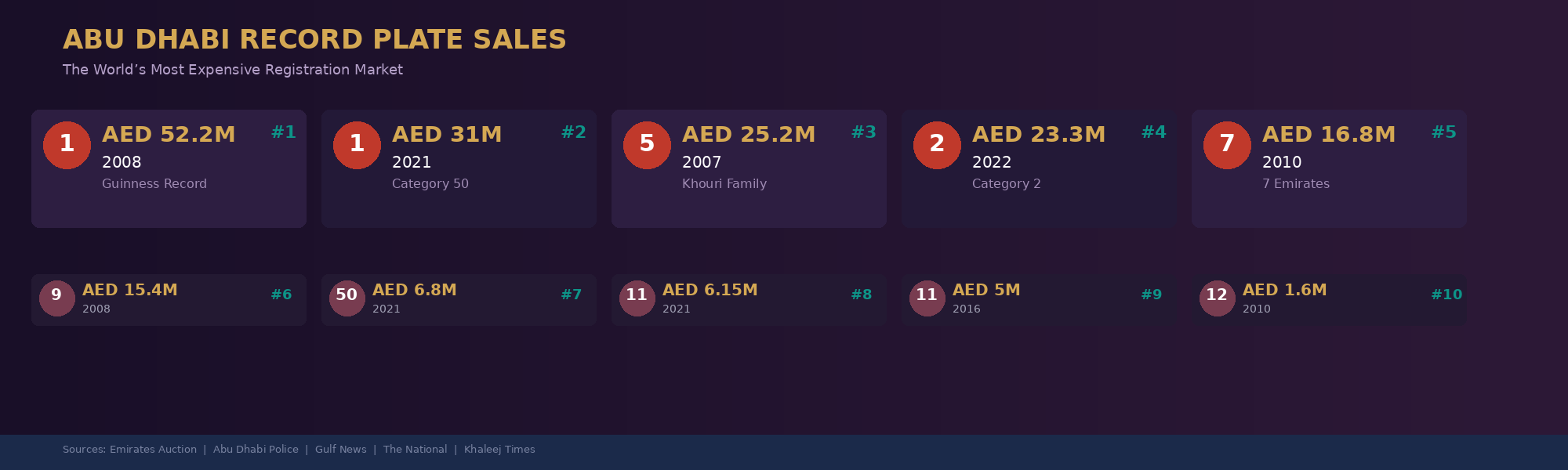
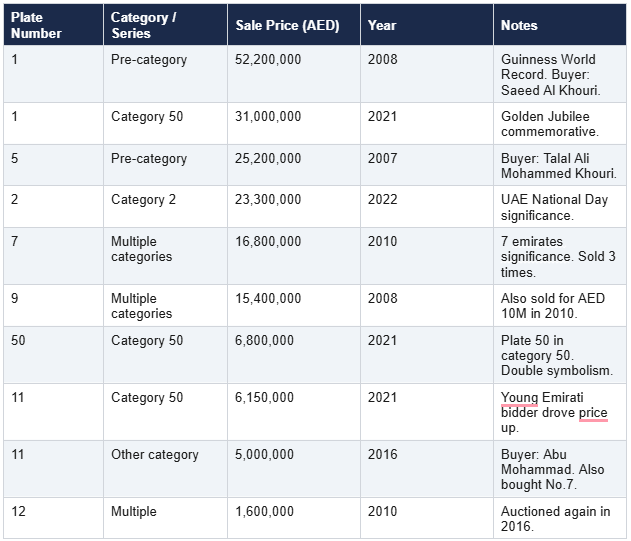
Sources: Emirates Auction, Abu Dhabi Police, Khaleej Times, Gulf News, The National. Note that the same plate number can appear in multiple categories, which is why numbers like 7, 9, and 11 have sold at auction more than once. For a deeper dive into the most expensive plates ever sold across all emirates, see our complete history of record UAE plate sales.
Abu Dhabi Categories vs Dubai Letter Codes: Key Differences
Buyers who are familiar with Dubai’s A to Z code system often find Abu Dhabi’s numbered categories confusing at first. The conceptual framework is actually similar, but the execution differs in several important ways.
Dubai uses single letters (A, B, C through Z) and double letters (AA, BB, CC, DD) as plate codes. Each letter carries different prestige based on its issuance history and association. Code A is the original and most prestigious; codes like V, X, and Z are newer and more affordable. Abu Dhabi’s system mirrors this logic using numbers instead of letters. Category 1 is the equivalent of Dubai’s code A. Categories 17 through 22 are the equivalent of Dubai’s V, X, and Z. For context on how Dubai’s letter codes were valued at recent auctions, including the AED 38 million AA 9 sale, see our dedicated articles on the Dubai system.
The key structural difference is that Abu Dhabi plates are purely numeric. A Dubai plate reads “A 1234” (letter plus number). An Abu Dhabi plate reads “2 – 789” (category number plus plate number). This means Abu Dhabi plates can look cleaner on the road, especially for low-digit registrations where the entire plate might display only two or three digits in total. A category 1 plate with registration number 7 shows just “1 – 7” on the plate, which is visually minimal and striking. For a visual comparison, try our plate generator. Collectors who appreciate heritage aesthetics may also want to explore Dubai Classic plates, which carry their own distinct visual identity.
Another difference is the auction infrastructure. Dubai’s RTA manages its own auctions directly. Abu Dhabi’s auctions are run through a partnership between the Integrated Transport Centre and Emirates Auction, the region’s largest auction house. The result is a slightly different bidding culture, with Abu Dhabi’s prestige auctions often held at landmark venues like Emirates Palace, attracting a distinct collector audience. Buyers interested in plates outside both Dubai and Abu Dhabi can also explore Sharjah, Ras Al Khaimah, and Fujairah markets, each with their own pricing dynamics.
Frequently Asked Questions
What does the number on the red band of an Abu Dhabi plate mean?
The number on the red band is the plate’s category code. It identifies which series the plate belongs to. Abu Dhabi uses numbered categories (1, 2, 4 through 22, and 50) instead of letter codes like Dubai. Lower category numbers generally indicate older, more prestigious series. See the full category map table above or browse all categories directly on LicensePlate.ae.
Is category 1 the most expensive Abu Dhabi plate category?
Category 1 carries the deepest heritage and is the original numbered series, which gives it the highest baseline prestige. However, category 50 plates have also commanded extraordinary prices due to their limited commemorative issuance. Single-digit plates in category 2 have also broken records (plate number 2 sold for AED 23.3 million in category 2). The most expensive Abu Dhabi plate overall is plate number 1, sold for AED 52.2 million in 2008 before the full category system was standardised.
Can expats buy Abu Dhabi number plates?
Yes. The September 2025 DMT administrative decision explicitly enables both citizens and residents to obtain distinctive plate numbers. UAE residents with a valid Emirates ID and traffic file can purchase plates at Emirates Auction, through TAMM, or on the secondary market. The new ownership rules apply equally to Emirati nationals and foreign residents.
What is the cheapest Abu Dhabi plate I can buy?
Five-digit plates in higher categories (15, 16, 17, 18 and above) are the most affordable, starting from approximately AED 3,000 to AED 8,000. These plates are available on marketplace platforms like LicensePlate.ae and can be filtered by digit count and price. Standard plates issued during new vehicle registration through TAMM have even lower base costs.
How do I transfer an Abu Dhabi plate to a new owner?
Transfer is processed through the TAMM platform or at Abu Dhabi Traffic Department centres. Both buyer and seller need Emirates ID, a vehicle registration card (Mulkiya), and any outstanding fines must be cleared. After the September 2025 rules, distinguished plates also require a formal ownership certificate before transfer can proceed. The transfer fee varies by vehicle type and plate classification. For a step-by-step breakdown of the process, see our complete plate transfer guide.
Why did Abu Dhabi skip category 3?
Category 3 does not appear in standard civilian plate listings. It is believed to be reserved for non-civilian or administrative use, similar to how certain letter codes in Dubai (like Dubai Police plates) are not part of the public registration system. Abu Dhabi Police has not published an official explanation for the gap.
What is a category 50 plate and is it worth buying?
Category 50 is a limited-edition plate series launched in November 2021 to celebrate the UAE’s Golden Jubilee. Only 222 distinguished plates were auctioned through Emirates Auction, with plate number 1 selling for AED 31 million. Because the issuance window was a one-time event, the supply is permanently fixed. This makes category 50 plates attractive to collectors and investors seeking assets with a built-in scarcity narrative. Check category 50 listings on LicensePlate.ae for current availability and asking prices.
How do Abu Dhabi plates compare to other emirates for investment?
Abu Dhabi produces the highest-value single plates in the world (AED 52.2 million record). For investors with smaller budgets, northern emirates offer interesting alternatives. Our RAK number plate investment guide covers the Ras Al Khaimah market in detail. You can also compare pricing across Sharjah, Ajman, Fujairah, and Umm Al Quwain to find opportunities across the full UAE market. For a comparison of buying channels across all emirates, see our auction vs private sale vs marketplace guide.
Delete Comment?
Are you sure you want to delete this comment? This action cannot be undone.
Delete Article?
Are you sure you want to delete this article? This will also delete all comments. This action cannot be undone.