

Cross-Emirate Plate Transfer: How to Move Your Number Plate Between Dubai, Abu Dhabi, and Every Other Emirate
26 March 2026
Abu Dhabi
LicensePlate.ae Team
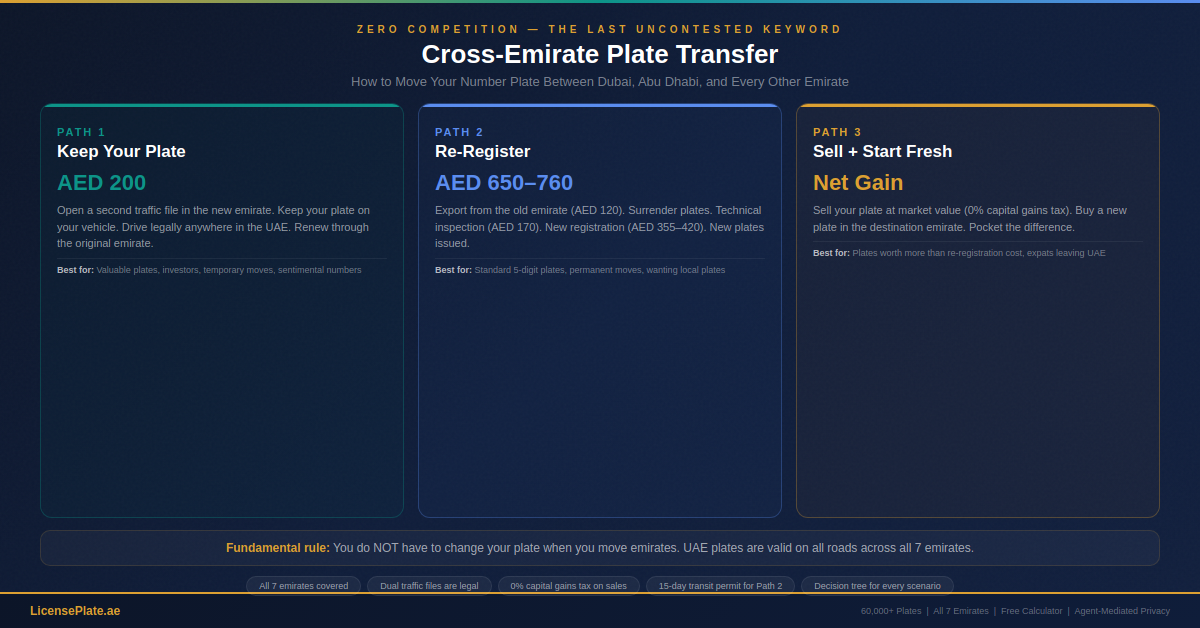
This is the most asked and least answered question in the UAE plate market. A Quora thread asking this exact question has over 25,000 views and no clear answer. The responses range from "you don’t need to change anything" to "you must re-register within 30 days" to "just open a new traffic file." Some of that is correct. Most of it is incomplete. None of it covers every scenario.
This guide does. It maps the three available paths, costs each one down to the dirham, explains which path is right for which scenario, and covers all seven emirates. If you own a standard five-digit plate worth AED 3,000, the answer is different from if you own a two-digit plate worth AED 500,000. The decision tree depends on what your plate is worth, how long you plan to stay in the new emirate, and whether you want to keep the plate or cash it out.
"A vehicle can be registered in the traffic authority in each emirate of the UAE. Registration services are provided through service centres, websites or applications of the traffic departments of the emirates and Ministry of Interior."
— UAE Government Official Portal (u.ae, Registering Vehicles)
1. The Fundamental Rule: You Do NOT Have to Change Your Plate
This is the most important thing most people get wrong. UAE federal traffic law does not require you to change your plate when you move emirates. A Dubai plate is valid on the roads of Abu Dhabi, Sharjah, Ajman, Fujairah, RAK, and UAQ. A Sharjah plate is valid on the roads of Dubai. You can live in Abu Dhabi and drive a Fujairah-registered car every day without breaking any law.
Your vehicle registration (Mulkiya) is tied to the emirate where the plate is issued, not to where you live or work. Your Emirates ID may say Abu Dhabi. Your car registration may say Dubai. That is completely legal. There is no 30-day registration deadline triggered by a residential address change. The 30-day window that some sources reference applies to vehicle ownership transfers (buying or selling a car), not to personal relocation.
What you MUST do: Keep your vehicle registration (Mulkiya) current, your insurance active, and your fines paid. These are requirements regardless of which emirate you live in. If your registration expires, renew it through the issuing emirate’s system (RTA for Dubai, TAMM for Abu Dhabi, Shamil for northern emirates).
What you MAY want to do: Change your plate to match your new emirate. This is a choice, not a requirement. There are practical reasons to change (parking permits, toll registration, local services) and financial reasons to keep (your plate may be worth more than a new plate in the other emirate).
2. The Three Paths (The Decision Tree)
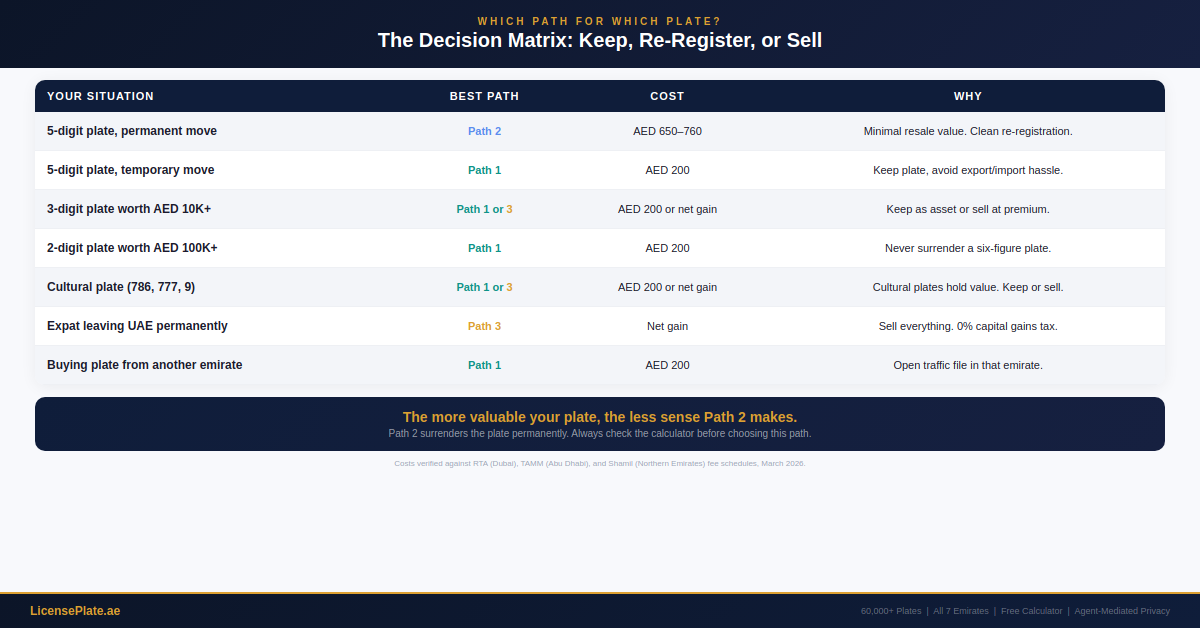
Every cross-emirate plate situation resolves into one of three paths. The right choice depends on the value of your current plate, your timeline, and your long-term plans.
Path 1: Keep Your Plate + Open a Second Traffic File
Best for: Owners of valuable or sentimental plates. Investors holding plates as assets. Anyone who may move back.
You keep your current plate on your current vehicle. You open a new traffic file in the new emirate (AED 200). You now have traffic files in two (or more) emirates simultaneously. This is completely legal. You continue to renew your vehicle registration through the original emirate’s authority. You drive in your new emirate with your original plate.
Cost: AED 200 (new traffic file). That is it. Your existing plate, registration, and insurance remain unchanged.
Key fact: You can hold traffic files in multiple emirates at the same time. Your existing Dubai transfer guide confirms this: "One person can hold traffic files in multiple emirates." The traffic file in the new emirate enables you to register additional vehicles there, pay local fines, and access emirate-specific services.
Path 2: Deregister + Re-Register in the New Emirate
Best for: Owners of standard 5-digit plates with no significant resale value. Anyone making a permanent move who wants local plates and local services.
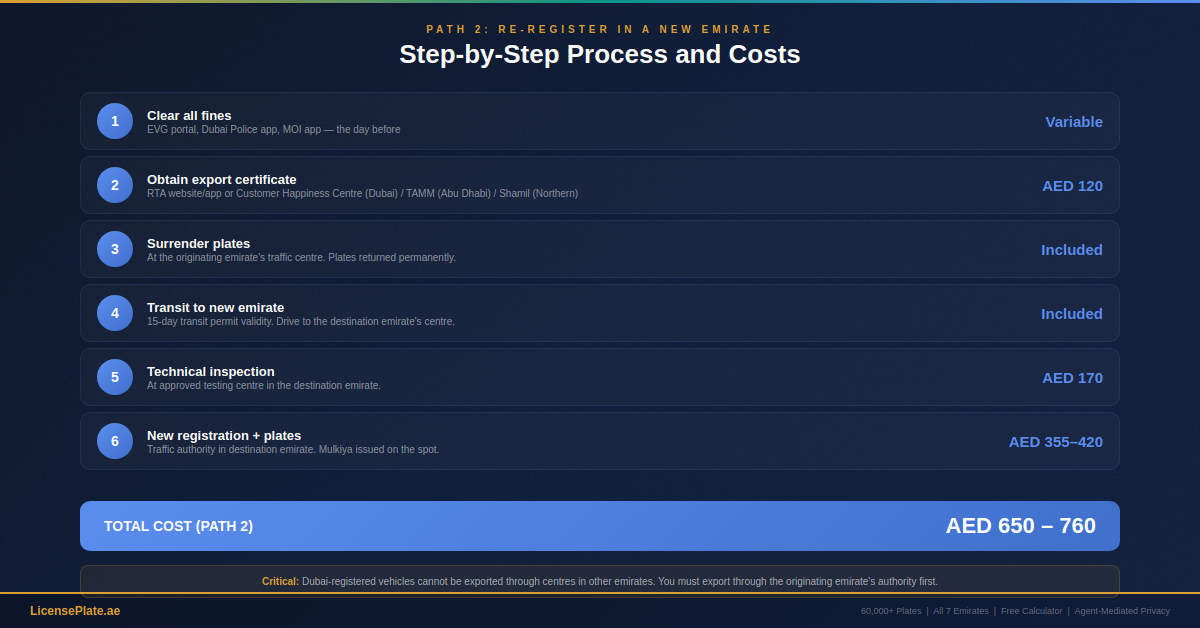
You export your vehicle from the current emirate (deregister and surrender the plates), then import and re-register it in the new emirate (inspection, new plates, new Mulkiya). The RTA’s system literally calls this service "Exporting or transferring a vehicle to another emirate" under Vehicle Licensing.
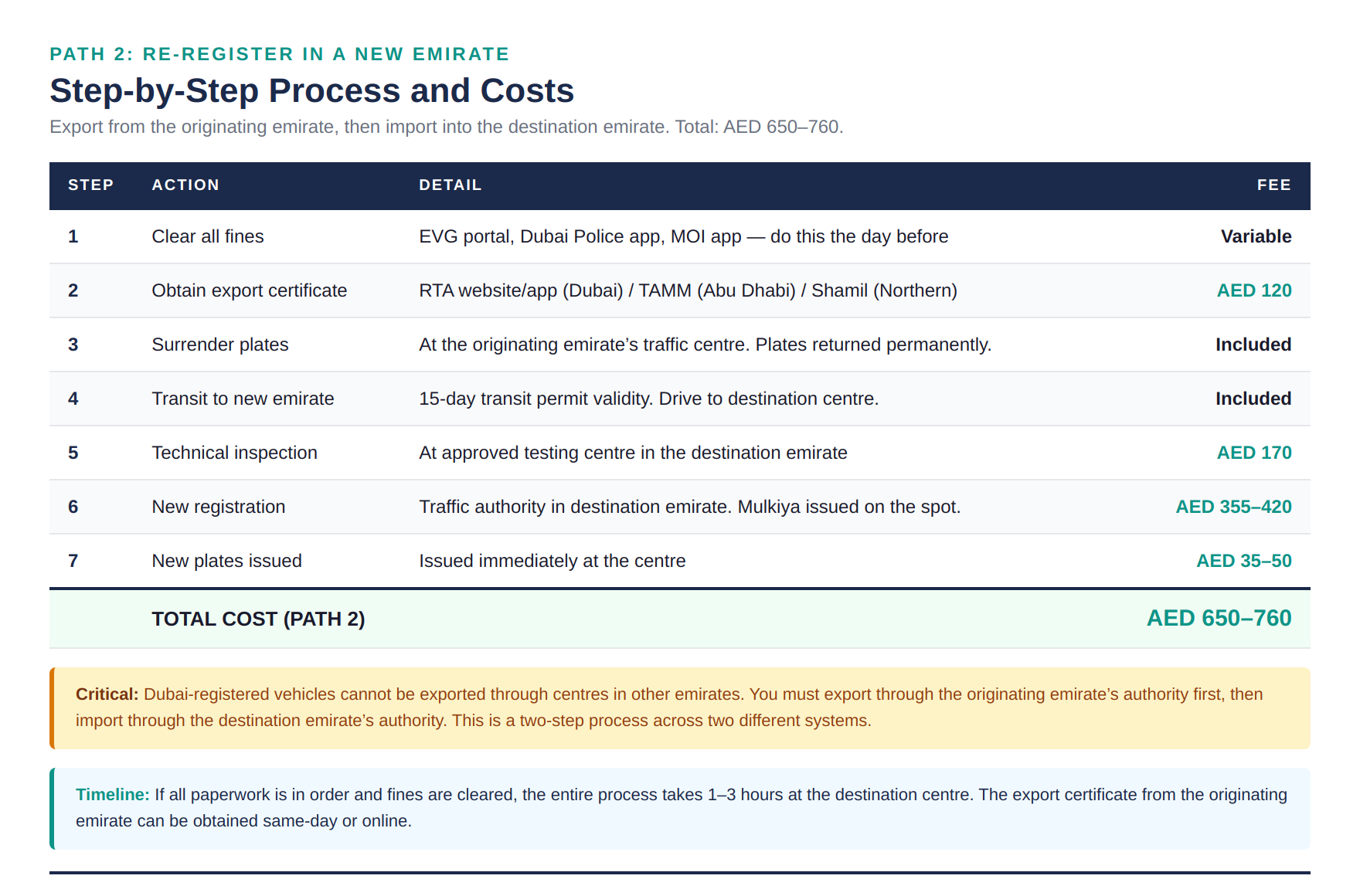
Critical: RTA confirmed that federal centres in other emirates do NOT offer the service of transferring Dubai-registered vehicles. You must export through the originating emirate’s authority first, then import through the destination emirate’s authority. This is a two-step process across two different systems.
Path 3: Sell the Plate + Start Fresh
Best for: Owners of plates with significant resale value who want to monetise the asset. Anyone whose plate is worth more than the cost of a new plate in the destination emirate.
Sell your current plate on the secondary market through LicensePlate.ae (free, agent-mediated) or another platform. Use the plate calculator to check the plate value first. Pocket the proceeds. Then buy a new plate in the destination emirate, either through the marketplace or by registering a new vehicle and accepting the assigned plate. The Seller’s Guide covers the three-step pricing method and timing strategy. 0% capital gains tax on the sale.
When this path makes financial sense: Your current plate’s market value exceeds the total cost of Path 2 (AED 650 to 760) plus the cost of a new plate in the destination emirate. Example: you own an Ajman D 453 worth AED 8,000. You’re moving to Dubai. A 5-digit Dubai plate costs AED 3,000 to 5,000. Selling the Ajman plate (AED 8,000) minus buying a Dubai plate (AED 5,000) minus Path 2 costs (AED 700) leaves you AED 2,300 ahead. The Value Check Framework helps you run this calculation for your specific plate.
3. Which Path for Which Plate?
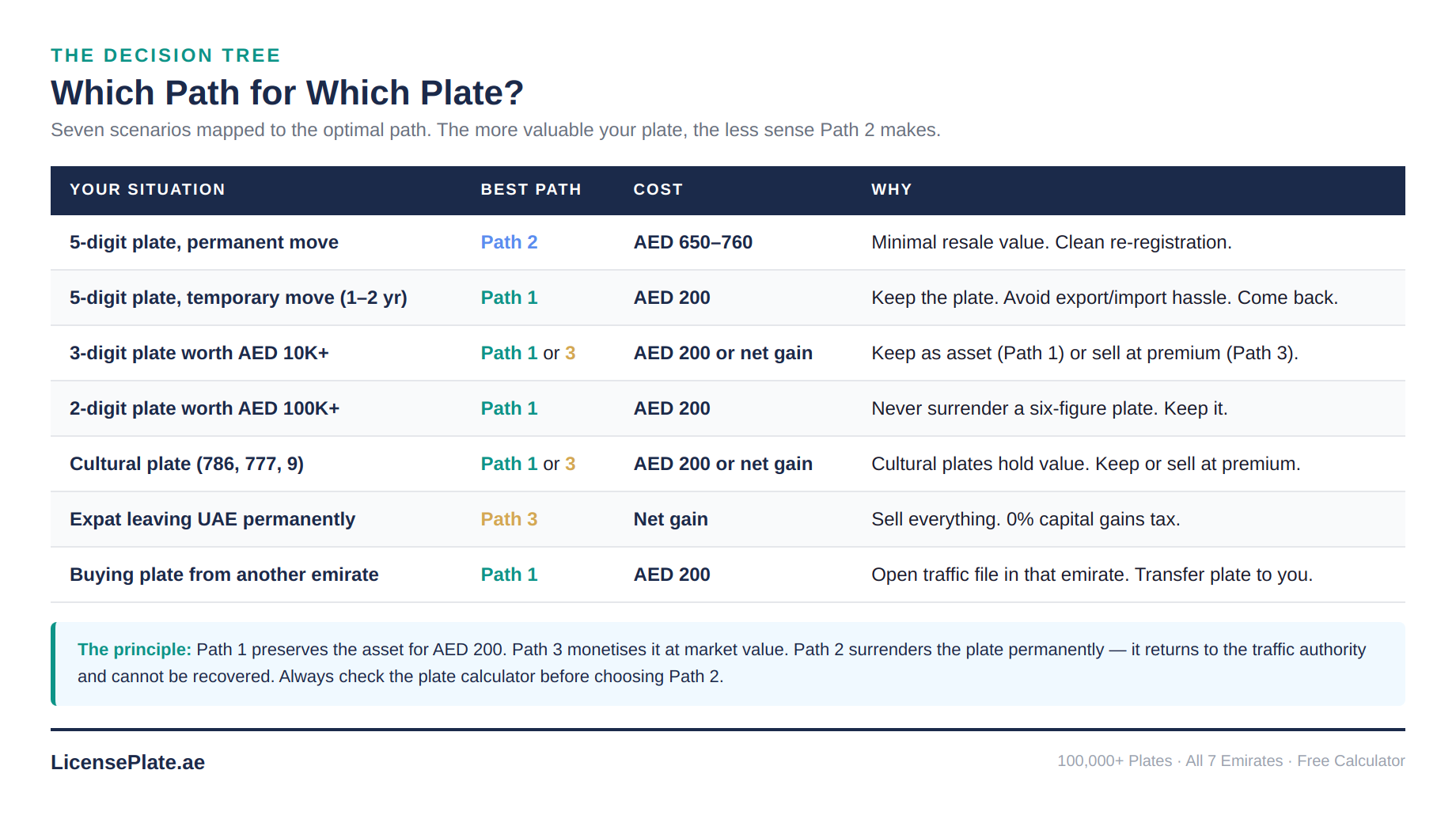
The principle is simple: the more valuable your plate, the less sense it makes to surrender it through Path 2. Path 1 preserves the asset for AED 200. Path 3 monetises it at market value. Path 2 destroys it forever, since the plate is returned to the traffic authority and cannot be recovered.
4. Emirate-by-Emirate: Where to Go and What to Expect
Exporting FROM Dubai
Online via the RTA website or Dubai Drive app: Vehicle Licensing Services → "Exporting or transferring a vehicle to another emirate." Or in-person at any Customer Happiness Centre (Umm Ramool, Deira, Al Barsha, Jebel Ali). Export certificate: AED 120. Surrender plates at the centre. Digital certificate issued same day. The Dubai transfer guide covers the full RTA process.
Exporting FROM Abu Dhabi
Via TAMM platform or at Abu Dhabi Traffic Department centres. Export certificate issued after clearing all fines and submitting the Mulkiya. The Abu Dhabi TAMM guide covers the full process. Fee: AED 100 to 150.
Exporting FROM Northern Emirates (Sharjah, Ajman, RAK, Fujairah, UAQ)
At the Shamil centre in the respective emirate. Both the export certificate and plate surrender happen at the same centre. Fees: AED 100 to 150. Each emirate guide covers the specific Shamil locations and hours: Sharjah, Ajman, RAK, Fujairah, UAQ.
Importing INTO Any Emirate
The process is the same regardless of destination: arrive at the traffic authority or approved testing centre in the new emirate with your export certificate, Emirates ID, insurance in your name, and the vehicle. Pass the technical inspection (AED 170). Pay the registration fee (AED 355 to 420). Receive your new plates and Mulkiya on the spot. Total time: 1 to 3 hours if all paperwork is in order.
5. What Happens to Your Existing Plate
If you choose Path 1 (keep): Nothing happens. Your plate stays registered to you. You renew it through the original emirate. You drive it anywhere in the UAE.
If you choose Path 2 (re-register): Your plate is surrendered to the traffic authority in the original emirate. It re-enters the system and may be re-issued or auctioned. You cannot get it back. If your plate has any sentimental or financial value, do not choose this path without checking its market value on the calculator first.
If you choose Path 3 (sell): You transfer the plate to a buyer before or during your move. The buyer gets the plate. You get the money. The transfer follows the standard process described in the Seller’s Guide. 0% capital gains tax. List for free on LicensePlate.ae.
6. Five Mistakes People Make When Moving Emirates
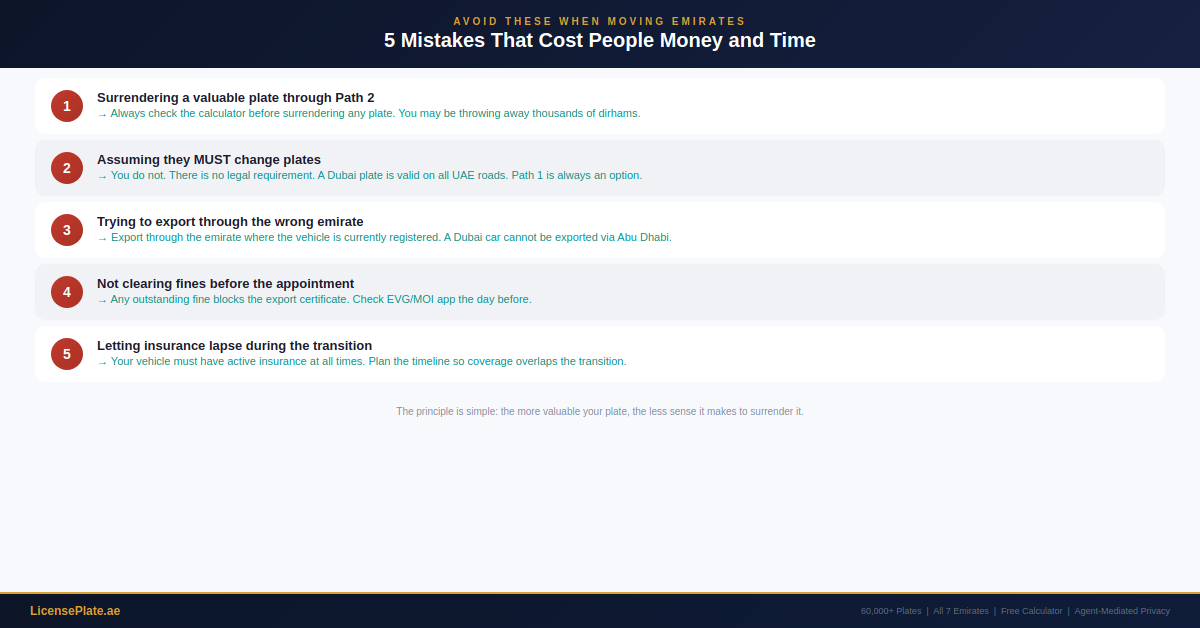
1. Surrendering a valuable plate through Path 2. Check the calculator before surrendering any plate. You may be throwing away thousands of dirhams. A three-digit Ajman plate worth AED 15,000 does not need to be surrendered. It can be kept (Path 1 for AED 200) or sold (Path 3 for AED 15,000).
2. Assuming they MUST change plates. You do not. There is no legal requirement to re-register when you move emirates. Path 1 is always an option.
3. Trying to export through the wrong emirate. You must export through the emirate where the vehicle is currently registered. A Dubai-registered car cannot be exported through an Abu Dhabi centre. The originating emirate’s authority must process the export.
4. Not clearing fines before the export appointment. Any outstanding fine on your traffic file blocks the export certificate. Check via EVG portal, MOI app, or the emirate’s police app the day before.
5. Letting insurance lapse during the transition. Your vehicle must have active insurance at all times. If your old insurance expires before you complete re-registration in the new emirate, you are driving uninsured. Plan the timeline so insurance overlaps the transition.
7. Special Scenarios
Buying a plate from another emirate: You want to buy a plate listed on LicensePlate.ae that is registered in Fujairah, but you live in Dubai. You can do this. Open a traffic file in Fujairah (AED 200) if you do not have one. The seller transfers the plate to you at the Shamil Fujairah centre. You now own a Fujairah plate and can drive it in Dubai legally. Or, if you want a Dubai plate instead, the seller exports from Fujairah and you import into Dubai through Path 2.
Keeping plates in multiple emirates: You can own plates registered in multiple emirates simultaneously. An investor might hold a Dubai AA plate, an Ajman three-digit plate, and a RAK plate, each registered in its respective emirate under the same Emirates ID. Each requires a traffic file in that emirate (AED 200 each). The Investment Guide covers plate portfolio strategy.
Expats leaving the UAE: If you are leaving permanently, sell all plates through Path 3. 0% capital gains tax. The Expat Guide covers full eligibility. Do not let valuable plates expire on your traffic file. They will be reclaimed by the authority.
Frequently Asked Questions
Q: Do I have to change my number plate if I move to another emirate?
No. There is no legal requirement to change your plate when you relocate between emirates. A Dubai plate is valid on all UAE roads. You can live in Abu Dhabi and drive a Dubai-registered car indefinitely.
Q: How much does it cost to transfer a plate between emirates?
Path 1 (keep plate, new traffic file): AED 200. Path 2 (export + re-register): AED 650–760 total. Path 3 (sell + buy new): variable, often results in a net gain if the plate has value.
Q: Can I hold traffic files in multiple emirates?
Yes. You can hold traffic files in Dubai, Abu Dhabi, Sharjah, and any other emirate simultaneously. Each costs AED 200 to open. This is completely legal and common among people who live in one emirate and work in another.
Q: What is an export certificate?
A document issued by the traffic authority in the emirate where your car is currently registered. It officially deregisters the vehicle from that emirate’s system. In Dubai, it costs AED 120 and can be obtained online through the RTA website or app.
Q: Can I export a Dubai car through an Abu Dhabi centre?
No. RTA confirmed that federal centres in other emirates do not offer transfer services for Dubai-registered vehicles. You must export through the emirate where the vehicle is registered.
Q: What happens to my plate if I surrender it?
It is returned to the traffic authority and re-enters the system. It may be re-issued or auctioned. You cannot recover it. Always check the plate’s value before surrendering.
Q: How long does cross-emirate re-registration take?
If all paperwork is in order and fines are cleared: 1 to 3 hours at the destination emirate’s centre. The export certificate from the originating emirate can be done same-day or online.
Q: Is there a time limit to re-register after exporting?
The transit permit is valid for 15 days. Complete the re-registration in the new emirate within this window.
Delete Comment?
Are you sure you want to delete this comment? This action cannot be undone.
Delete Article?
Are you sure you want to delete this article? This will also delete all comments. This action cannot be undone.