

How UAE Number Plates Compare to the World’s Most Expensive Plate Markets: Dubai vs London vs Hong Kong
25 March 2026
Dubai
LicensePlate.ae Team
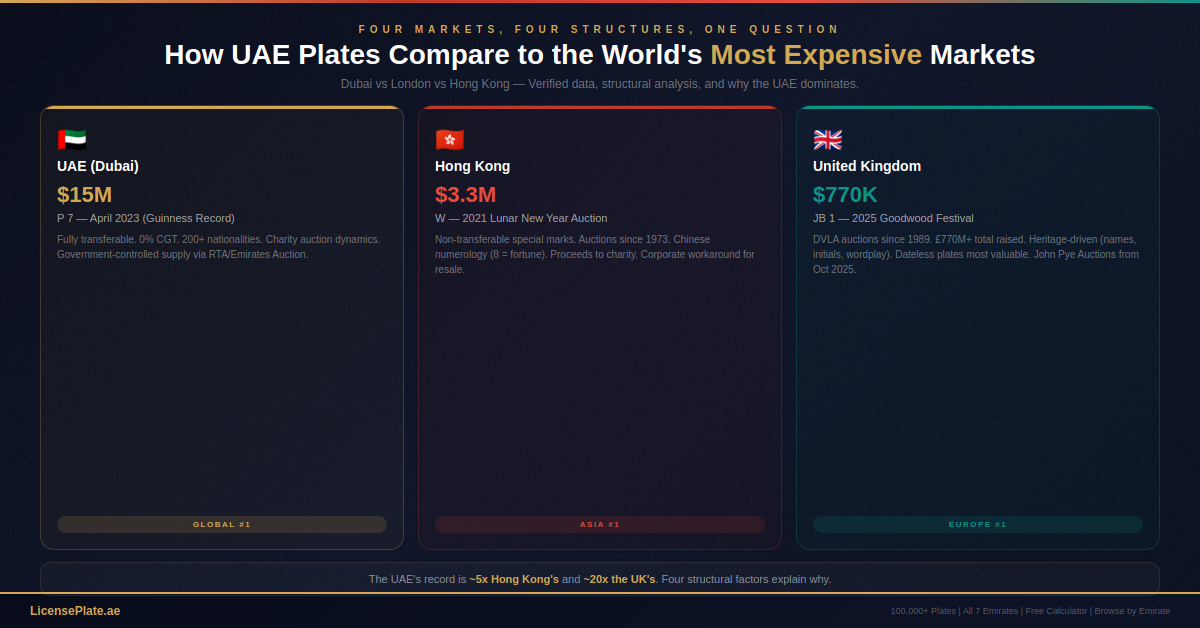
That headline travelled around the world. CNN, CBS News, Bloomberg, The National, and Gulf News all covered it. For most readers outside the UAE, the reaction was the same: why would anyone pay $15 million for a number plate?
The answer is not as simple as "people in Dubai have money." The UAE plate market is structurally different from every other plate market on earth. The combination of government-controlled scarcity, 0% capital gains tax, 200+ nationalities bringing their own number cultures into a single market, and a charity auction system that turns plate purchases into public acts of generosity creates pricing dynamics that do not exist in London, Hong Kong, or anywhere else.
This article compares the UAE to the three other major global plate markets: the United Kingdom, Hong Kong, and an emerging landscape across the rest of the Gulf. It is not a listicle of record prices. It is a structural comparison that explains why the UAE produces the highest plate prices in history and what that means for anyone buying, selling, or investing in plates here.
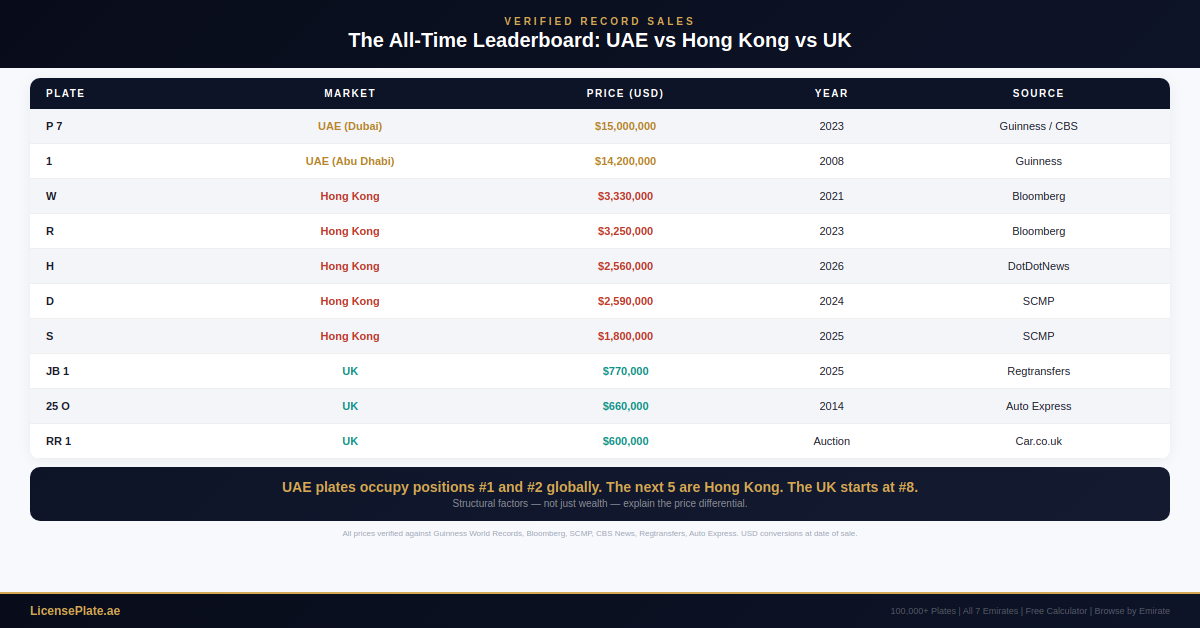
1. The UAE: Where Plates Are National Assets
The UAE’s plate system is governed by each emirate’s transport authority independently. Dubai uses the RTA. Abu Dhabi uses TAMM. Northern emirates use the Shamil system. Each issues plates under its own code structure. Dubai uses single or double letters (A through Z, plus AA, BB, CC, DD). Abu Dhabi uses numbered categories (1 through 50). The full breakdown is in the Codes A to Z Guide and the Abu Dhabi Categories Guide.
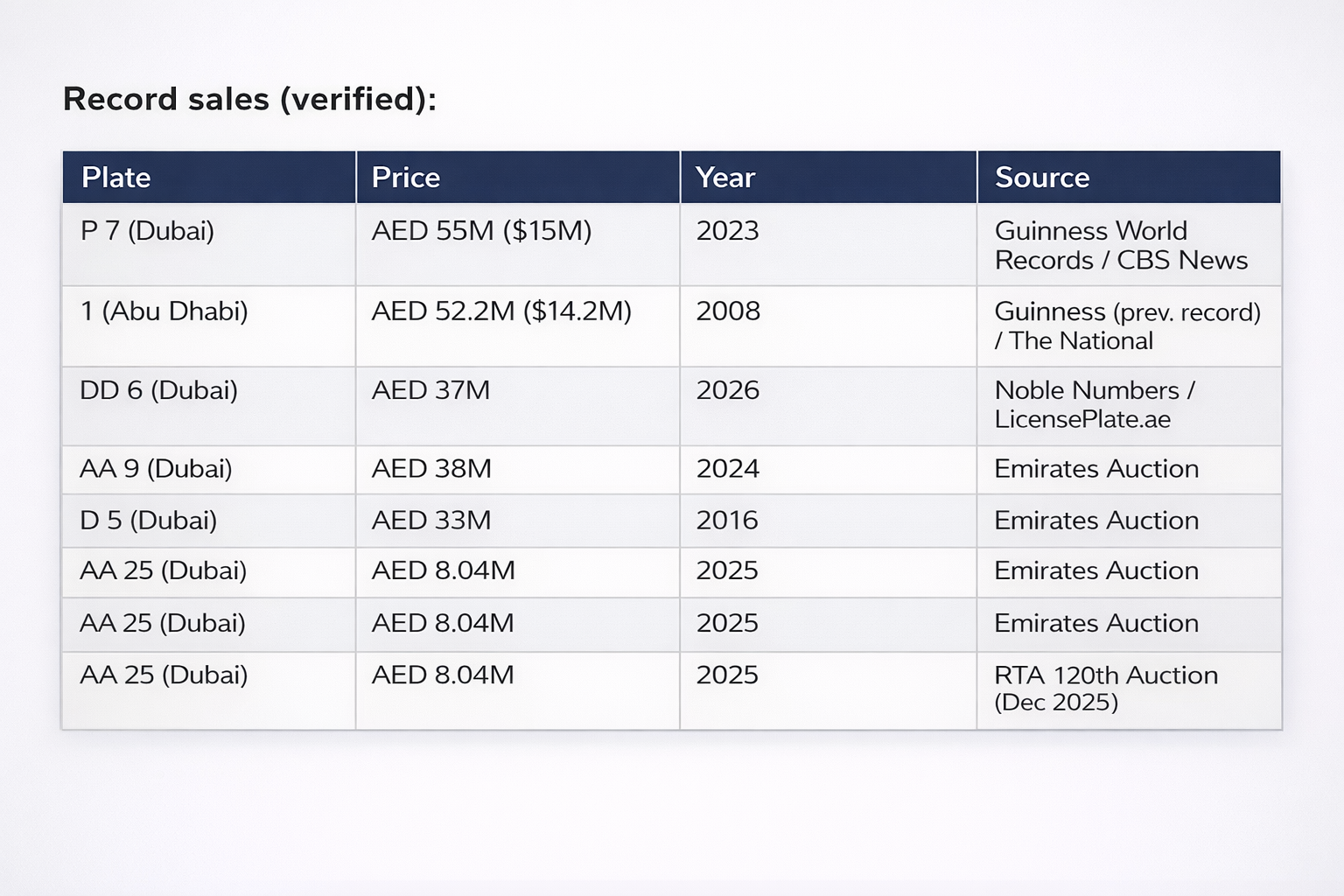
Record sales (verified):
What makes the UAE structurally unique:
Government-controlled supply. New plate numbers enter the market only through official RTA auctions or fixed-price releases. The supply is finite and politically controlled. When the RTA 120th auction in December 2025 raised AED 109 million in a single evening, it demonstrated that the authority can calibrate supply to maximise both revenue and market excitement. The Auction Calendar tracks every upcoming event.
0% capital gains tax. A plate bought for AED 100,000 in 2020 and sold for AED 300,000 in 2026 generates AED 200,000 in tax-free profit. No jurisdiction-level income tax. No federal capital gains tax. This makes UAE plates one of the most tax-efficient alternative assets anywhere in the world. The Investment Guide covers the full returns analysis.
200+ nationalities. The UAE hosts over 200 nationalities. Each brings its own number culture. Arabic speakers revere 7 (seven heavens) and 9 (longevity). South Asian Muslims hold 786 (Bismillah) sacred. Chinese residents prize 8 (prosperity) and 88 (double fortune). Indian communities value 1 (supremacy) and 11 (new beginnings). This cultural density creates demand from multiple buyer pools simultaneously, each driven by different motivations. The Numerology Guide maps every significant number.
Charity auction dynamics. The most expensive UAE plates are sold at charity auctions, where the buyer’s name is announced publicly and the proceeds go to humanitarian causes. The social return of paying AED 37 million for DD 6 during Ramadan while being broadcast on national television is not captured in the plate’s resale value. It is a public act of generosity that carries reputational value far beyond the asset itself.
2. Hong Kong: The Non-Transferable Market
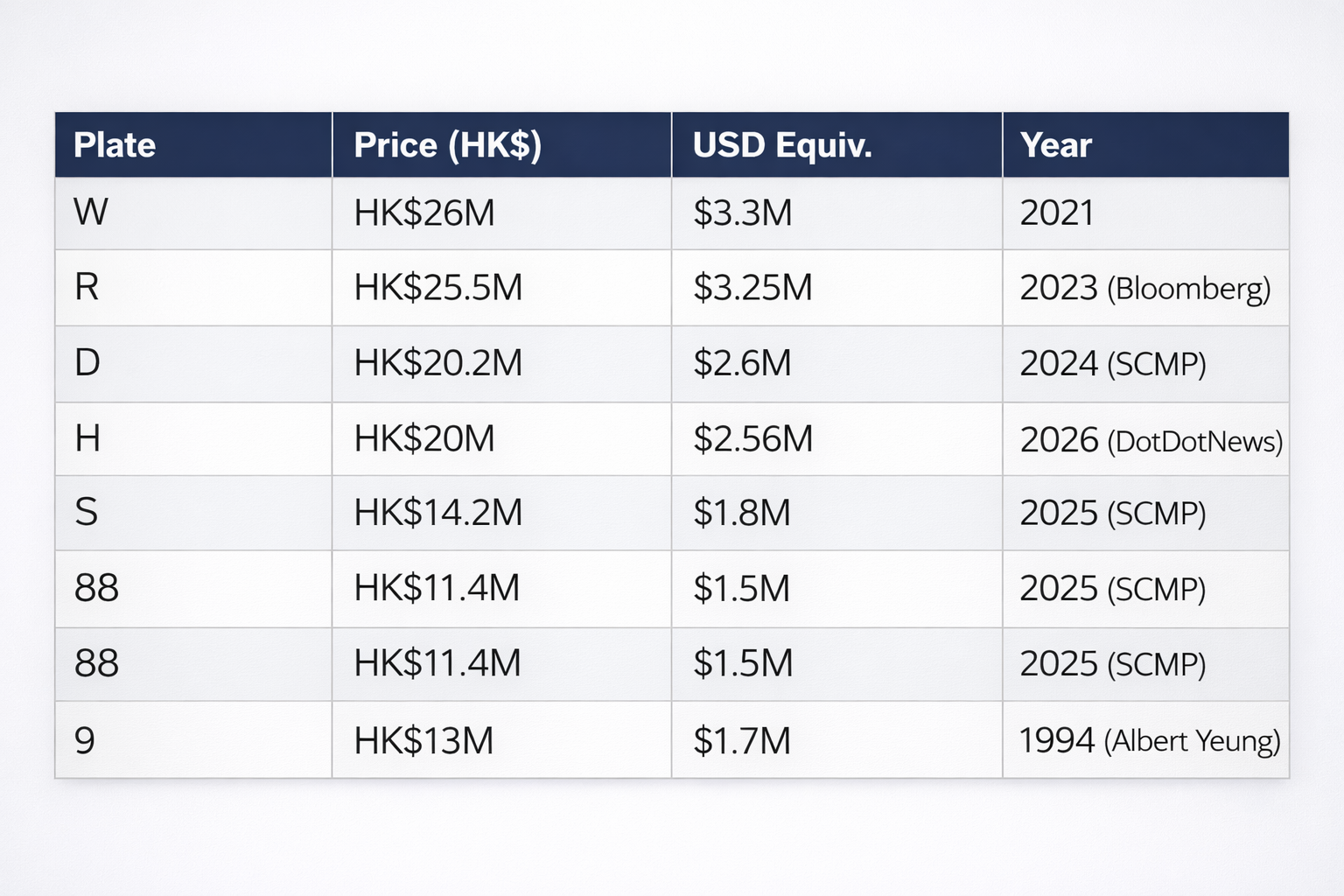
Hong Kong’s Transport Department has conducted plate auctions since 1973, making it one of the oldest formalised plate markets in the world. The proceeds go to the Government Lotteries Fund for charitable purposes. The annual Lunar New Year auction is the marquee event, where single-letter plates and culturally significant numbers attract the fiercest bidding.
The critical structural difference: non-transferability. In Hong Kong, a special registration mark obtained at auction is NOT transferable. The plate can only be used on vehicles registered under the buyer’s name. If the buyer sells the vehicle, the special mark is lost. If the buyer dies, the plate cannot be inherited with the vehicle. This fundamentally limits the plate’s value as an asset, because it cannot be resold on a secondary market. Sophisticated buyers work around this by purchasing through a limited company (which has perpetual succession), but this adds legal complexity and cost.
Compare this to the UAE, where a plate can be freely transferred between individuals for AED 120 via the Dubai Drive app in 15 minutes. UAE plates are fully liquid assets. Hong Kong plates are locked to the buyer unless they use a corporate structure. This single structural difference explains why Hong Kong’s highest plate price (HK$26M / $3.3M for "W") is less than one quarter of the UAE’s record (AED 55M / $15M for P 7).
Cultural overlap, different ceiling. Hong Kong and the UAE share a reverence for the number 8 (prosperity in Cantonese, where it sounds like "fortune"). The "88" plate sold for HK$11.4M in February 2025. In the UAE, plates containing 8 and 88 also carry premiums, but the premium ceiling is higher because UAE plates can be traded, held as standalone assets, and passed between owners without restriction.
3. The United Kingdom: Where Heritage Commands the Premium
The UK’s Driver and Vehicle Licensing Agency (DVLA) has been running plate auctions since 1989 and has raised over £770 million in total. The current auction operator is John Pye Auctions, which took over from BCA in October 2025. Auctions are now entirely online.
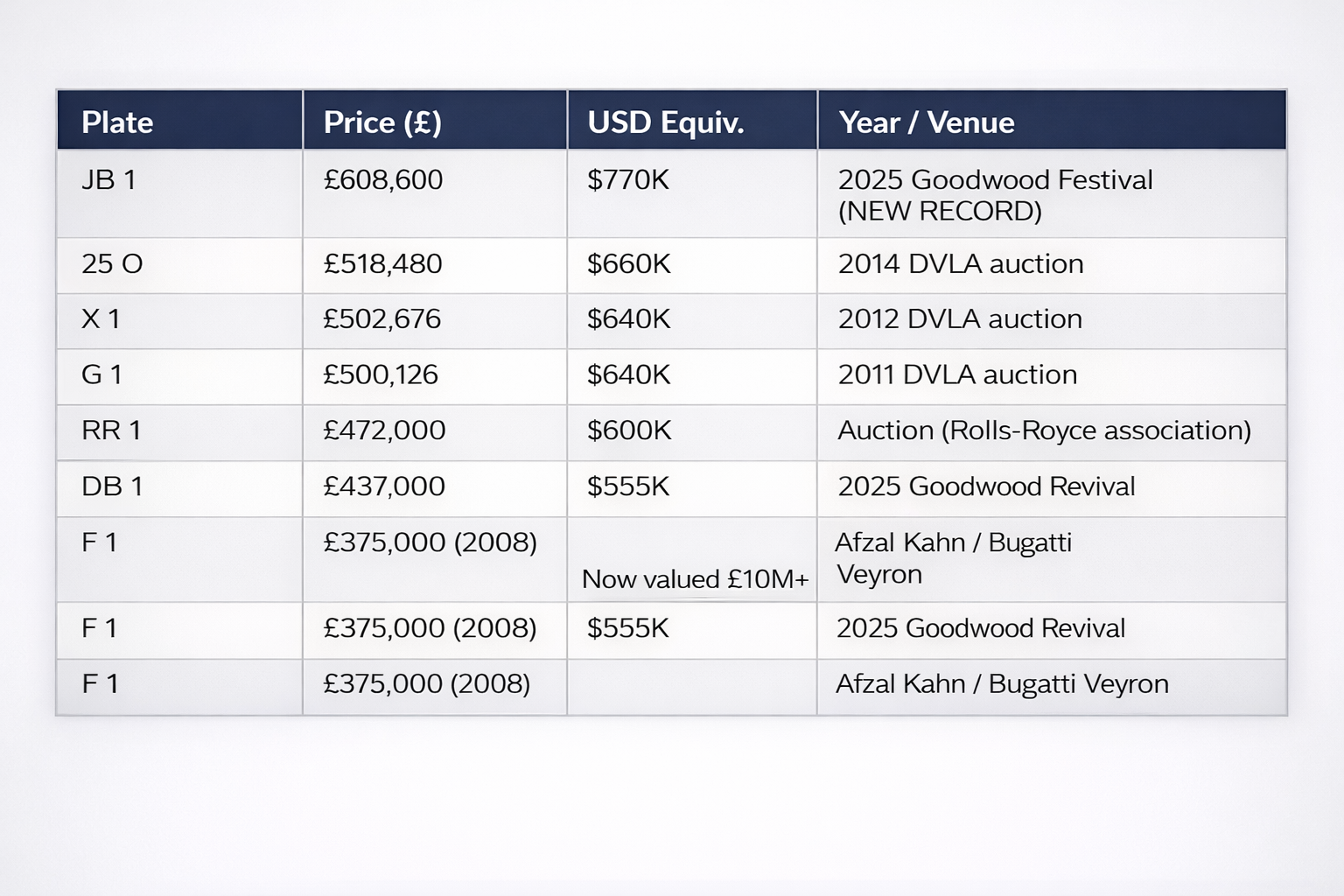
The UK market is fundamentally different in structure. British plates carry an age identifier. The format tells you when the plate was first issued. "Dateless" plates (those with no age identifier, issued before 1963) are the most valuable because they can be legally assigned to any vehicle regardless of age. This means a dateless plate like "1 A" (bought for £160,000 at the very first DVLA auction in 1989) can go on a brand-new 2026 Bentley without violating regulations. Plates with age identifiers can only go on vehicles of the same age or newer.
The name game. UK plates derive much of their value from spelling names or words. "25 O" is coveted because it suggests "250" (as in Ferrari 250 GTO). "JB 1" evokes James Bond. "F 1" is Formula 1. "DB 1" references Aston Martin DB models. This linguistic dimension does not exist in the UAE, where plates are purely numeric with a letter code prefix. UAE value is driven by digit count and cultural numerology. UK value is driven by what the letters and numbers spell.
The price ceiling comparison. The UK’s all-time record is £608,600 for JB 1, set at Goodwood in 2025. That is approximately AED 2.8 million. In the UAE, AED 2.8 million buys a mid-tier three-digit plate on a late code. The UAE’s record (AED 55 million for P 7) is roughly 20 times higher than the UK’s record. The UK market is mature, well-established, and liquid, but it operates at a structurally lower price ceiling than the UAE.
4. Why the UAE Produces the Highest Plate Prices on Earth
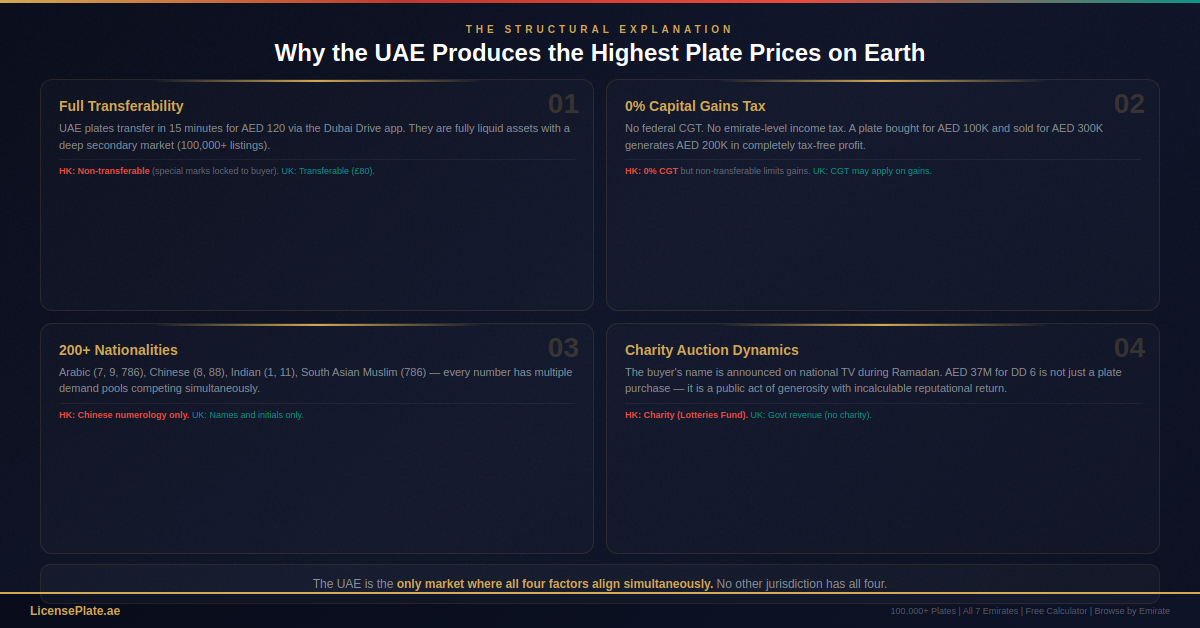 When you compare the four structural factors side by side, the answer is clear:
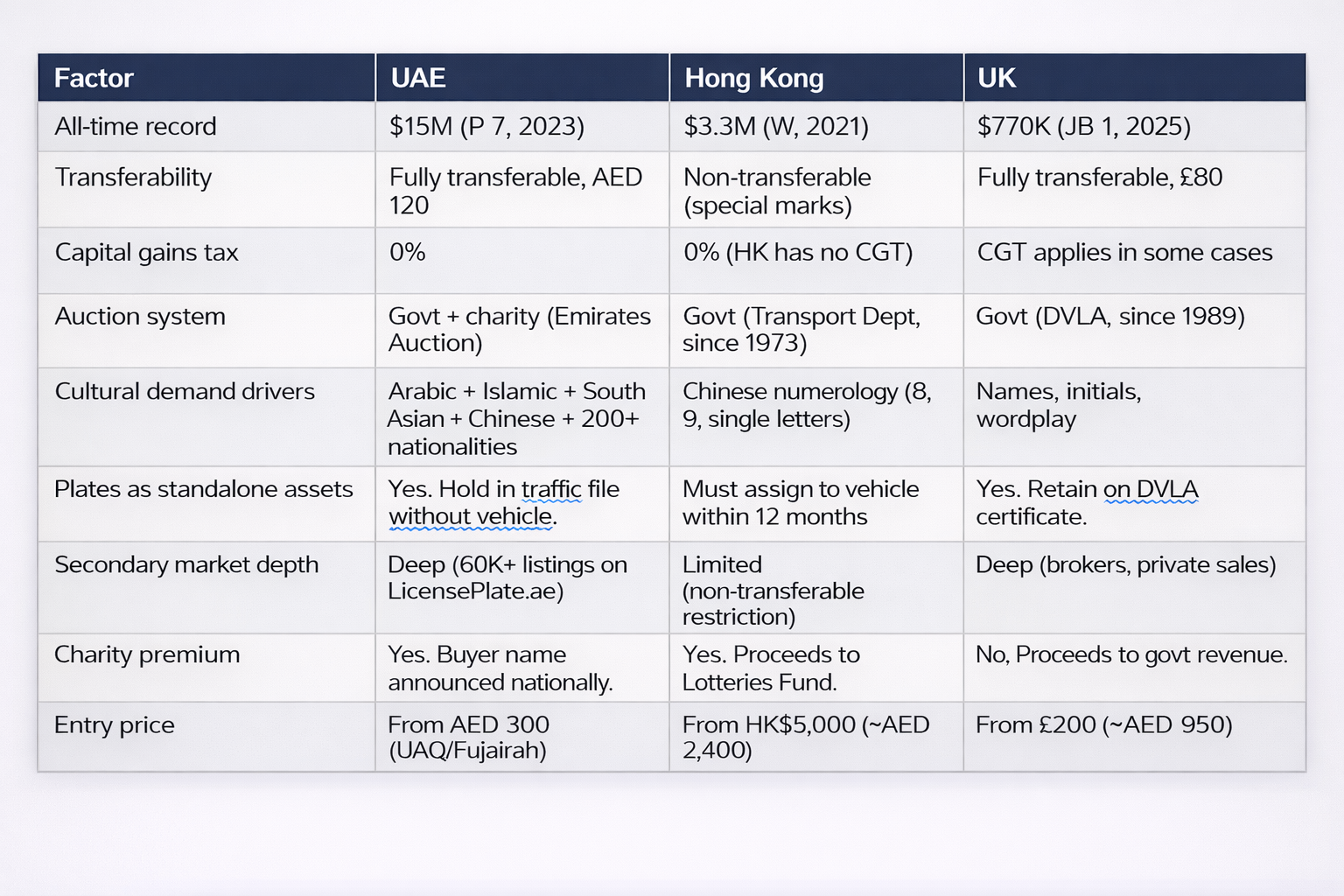
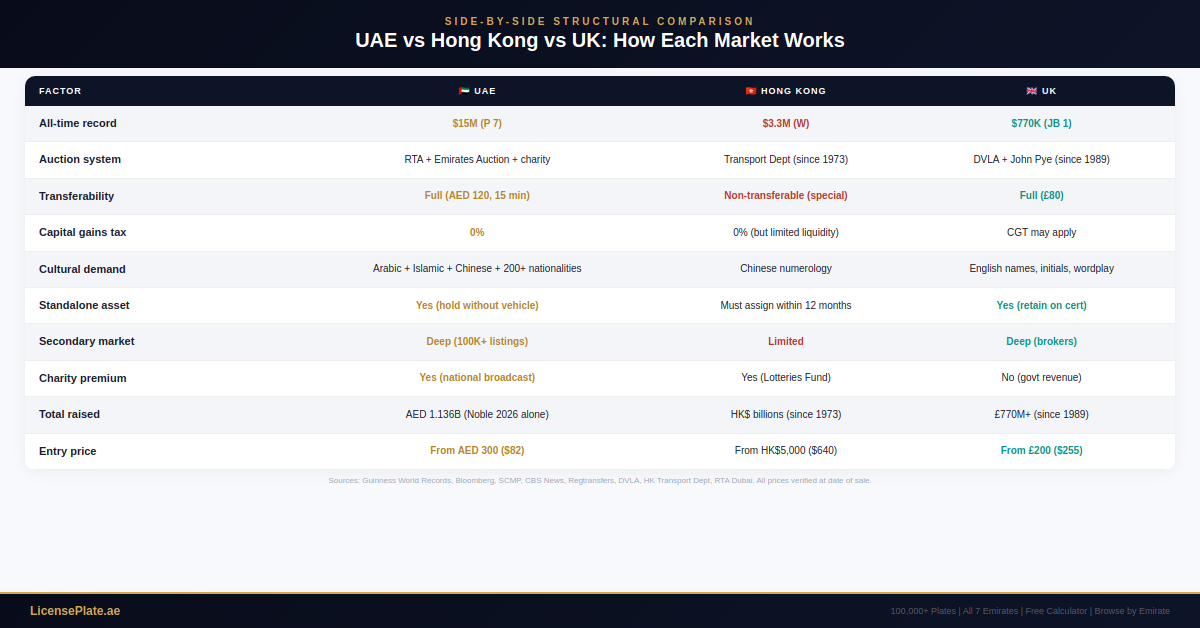
The UAE dominates because it is the only market where all four conditions align simultaneously: full transferability (liquid secondary market), 0% CGT (tax-free gains), multicultural demand (200+ nationalities, each with their own number culture), and a charity auction system that adds reputational value to the purchase price. No other market in the world has all four.
5. What This Means for Buyers and Investors in the UAE
If you are buying or investing in the UAE plate market, the global comparison provides three insights:
1. The UAE’s structural advantages are durable. 0% CGT is a federal policy. Full transferability is built into the RTA system. Multicultural demand grows with population. These are not temporary conditions. They are structural features of the UAE economy that are unlikely to change. The Investment Guide covers the full thesis.
2. Entry prices are lower than you think. The headlines feature AED 55 million sales, but the market starts at AED 300 for a five-digit plate in Fujairah or UAQ. That is cheaper than the minimum bid at a Hong Kong auction (HK$5,000 / AED 2,400). The Price Guide maps what every code and digit count actually costs.
3. The UAE is the only market where you can build a portfolio. You can hold plates in multiple emirates under a single Emirates ID, with no vehicle attachment required. An investor can hold a Dubai AA plate, an Ajman three-digit, and a RAK plate simultaneously, each appreciating on different timelines. Hong Kong’s non-transferability makes portfolio building impractical. The UK allows it but with higher tax friction. The UAE is the cleanest jurisdiction for plate investment globally.
Check any plate’s value on the calculator. Browse listings across all seven emirates on LicensePlate.ae.
Frequently Asked Questions
Q: What is the most expensive number plate ever sold?
P 7 sold for AED 55 million ($15 million) at a charity auction in Dubai on April 8, 2023. It is certified by Guinness World Records as the most expensive vehicle registration ever sold.
Q: How does the UAE plate market compare to the UK?
The UAE’s record (AED 55M / $15M) is approximately 20 times higher than the UK’s record (£608,600 / $770K for JB 1 at Goodwood in 2025). Both markets allow free plate transfers, but the UAE has 0% capital gains tax while the UK may levy CGT on gains.
Q: Can Hong Kong plates be resold like UAE plates?
No. Special registration marks in Hong Kong are non-transferable. They can only be used on vehicles registered under the buyer’s name. This limits their secondary market value compared to UAE plates, which can be transferred for AED 120 in 15 minutes.
Q: Why are UAE plates more expensive than UK and Hong Kong plates?
Four structural factors: full transferability (liquid asset), 0% capital gains tax, 200+ nationalities creating diverse cultural demand, and charity auction dynamics that add reputational value. No other market has all four simultaneously.
Q: What is the cheapest entry point to the UAE plate market?
Five-digit plates in Fujairah and Umm Al Quwain start from AED 300. This is cheaper than the minimum HK$5,000 reserve at a Hong Kong auction. Use the plate calculator for exact pricing on any combination.
Q: Are number plates a global investment trend?
Yes. The UK’s DVLA has raised over £770 million from plate auctions since 1989. Hong Kong’s Transport Department has auctioned plates since 1973. The UAE’s market has grown 480% in organic traffic over five months. Plates are a recognised alternative asset class across multiple jurisdictions.
Q: How does Saudi Arabia’s plate market compare?
Saudi Arabia’s plate market is emerging, with growing auction infrastructure and cultural parallels to the UAE (Arabic numerology, Islamic significance of 7 and 786). It does not yet match the UAE’s market depth or record prices.
Q: Can foreigners invest in UAE plates?
Yes. Any UAE resident with a valid Emirates ID and traffic file can buy, hold, and sell plates. Nationality does not matter. The Expat Guide covers full eligibility across all seven emirates.
Delete Comment?
Are you sure you want to delete this comment? This action cannot be undone.
Delete Article?
Are you sure you want to delete this article? This will also delete all comments. This action cannot be undone.