

The Plate Photography Economy: How UAE Number Plates Shape Instagram, Dealer Marketing, and Resale Value
4 May 2026
Dubai
LicensePlate.ae Team
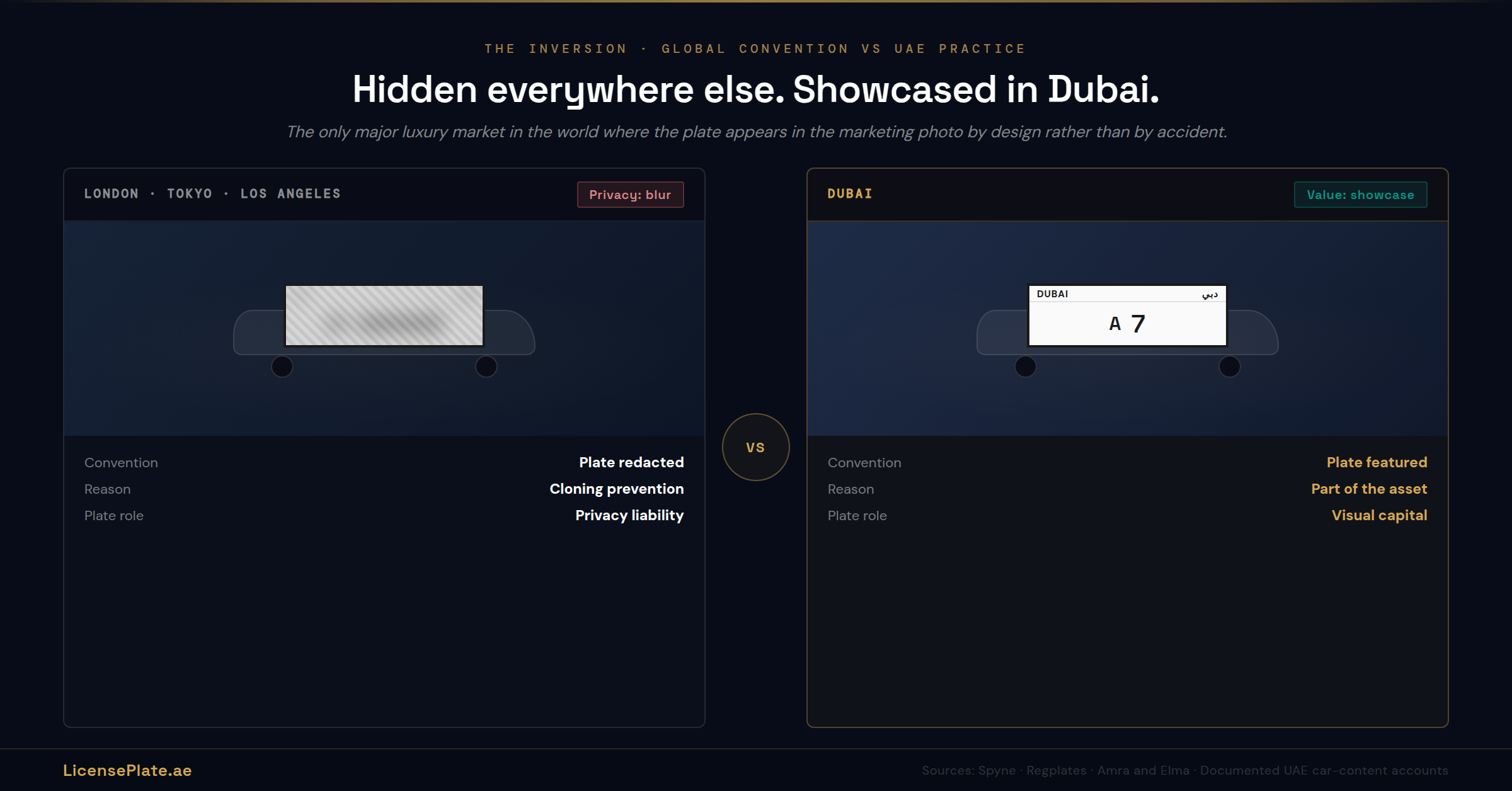 In London, when a dealer photographs a Bentley for a listing, they blur the plate. In Los Angeles, when a Ferrari is sold on Bring a Trailer, the plate is digitally redacted. In Tokyo, dealer photography conventions hide the registration entirely. The reasoning everywhere outside the UAE is identical: privacy protection, cloning prevention, professional polish.
In Dubai, the convention reverses. A Lamborghini photographed by F1rst Motors for an Instagram post almost always shows the plate clearly. The Bugatti at the front of the VIP Motors showroom in Al Quoz is photographed plate-first. The Rolls-Royce featured by a UAE car influencer with two million followers does not have its plate blurred. A specific class of plate (single-digit, double-digit, repeated patterns) is shown in tight focus because the plate is part of what the audience came to see.
This is the most underappreciated structural fact about the UAE plate market. Globally, plates are a privacy liability that car photography conventions have spent two decades learning to hide. In the UAE, premium plates are a visual asset that car photography conventions have spent two decades learning to feature. The inversion is not aesthetic. It is commercial. And it shapes how plates are bought, sold, and valued in ways most plate buyers never think about.
This piece exists to explain that economy. Not as speculation about how big it is in dirhams (the data does not exist publicly), but as a documented account of how Dubai's car culture, social media platforms, and luxury dealers have built an entire visual industry where the number plate functions as part of the marketing surface rather than a thing to be removed from it. The implications are real for buyers, for sellers, and for anyone who wonders why a plate matters even when the car it is on never gets photographed for resale.
The Global Default: Why Every Other Major Market Hides the Plate
To understand what makes Dubai different, start with what every other market does. Per the Spyne automotive photography guidance used by dealerships across North America, Europe, and East Asia, plate blurring serves four documented purposes:
Privacy protection. A visible plate can be tied back to the previous owner via various lookup tools and databases. Dealers blur plates to avoid accidentally publishing personally identifiable information about a customer who consigned the vehicle.
Cloning prevention. Per established privacy guidance for plate sellers, criminals search car listings for specific make-model-colour combinations, photograph the plate, and produce a counterfeit plate to fit on a stolen vehicle of the same description. The cloned car then accrues fines, parking violations, and toll charges that the original registered owner is liable for.
Listing platform compliance. Many international platforms now require or strongly recommend plate redaction as part of their privacy policies. AI-powered batch tools blur plates automatically across hundreds of listings.
Aesthetic professionalism. A clean, plate-free image looks more polished. The plate itself is a distraction from the car, the wheels, the bodywork, the interior shots that the buyer is actually evaluating.
All four reasons are real. They explain why a 2026 Cars.com listing in California, an Auto Trader listing in the UK, and a Goo-net listing in Japan all share the same convention. Plate blurring is the global standard for car photography hygiene.
The Dubai Inversion: Why Premium Plates Are Showcased, Not Hidden
Walk into any major Dubai supercar dealer's Instagram feed and the pattern is unmistakable. Plates are present, sharp, and often centred. F1rst Motors, recognised as one of the world's leading luxury car showrooms, regularly features vehicles with their plates clearly visible.
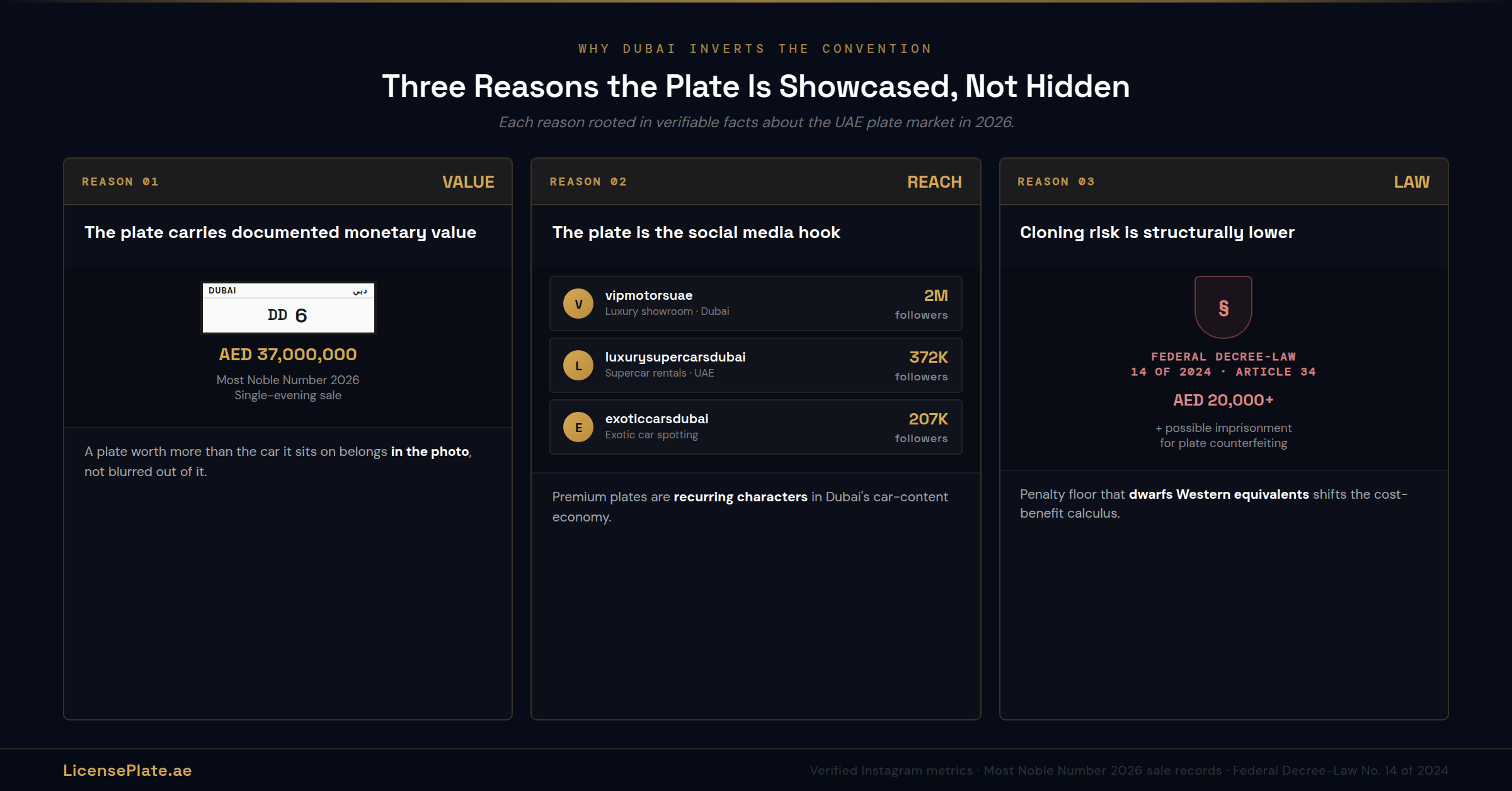
Three reasons explain the inversion, and they all stem from the same underlying fact: in the UAE, a premium plate is part of the asset, not separate from it.
Reason 1: The plate carries documented monetary value
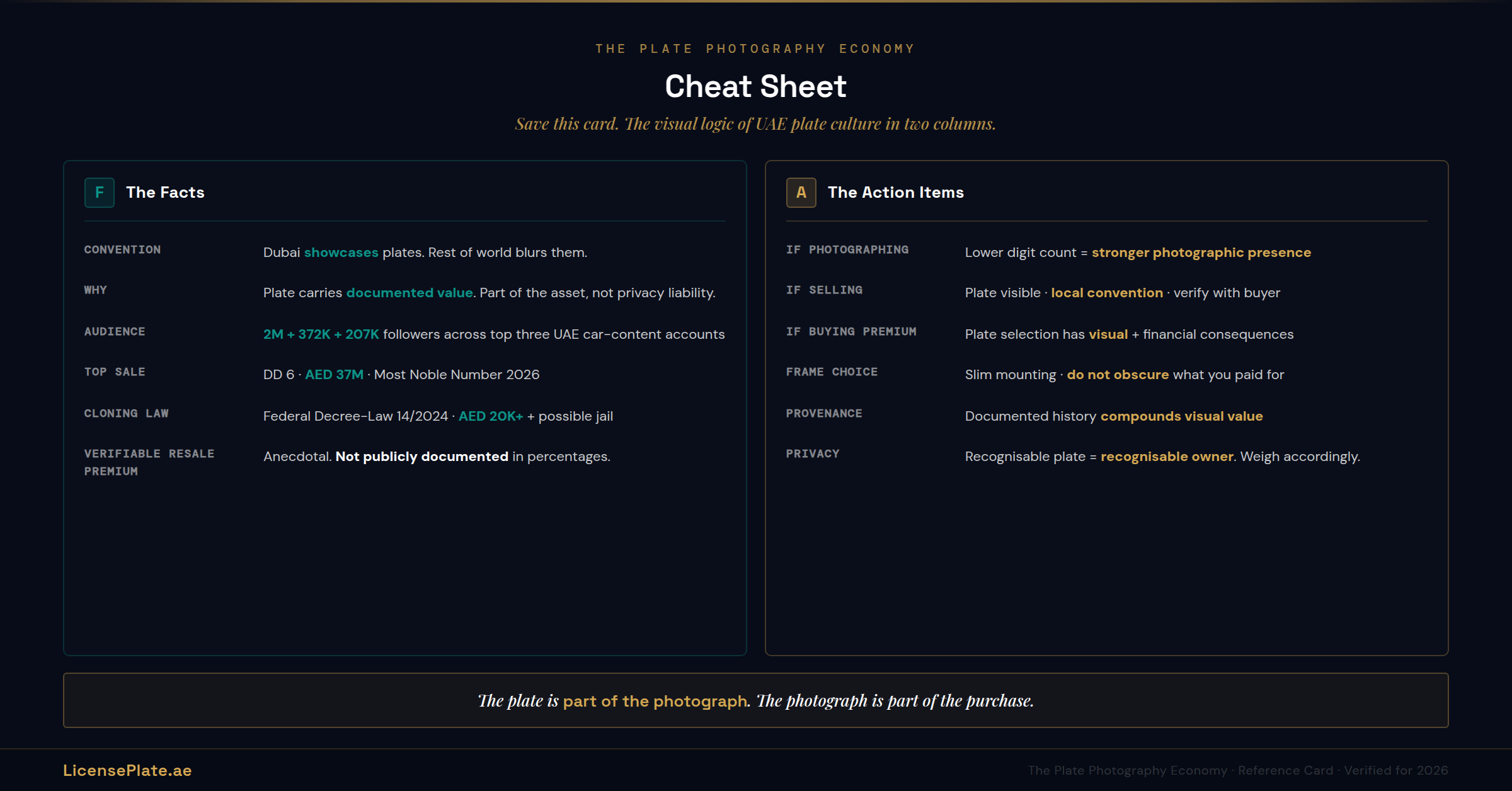
Per Shory's analysis of Dubai's three-digit plate market, premium 3-digit Dubai plates traded between AED 3 million and AED 6 million across 2025 auctions. BB 777 cleared at AED 6 million in September. AA 707 and AA 222 cleared at AED 3.31 million and AED 3.3 million respectively in April. Higher up the pyramid, the most expensive Dubai plate ever sold (P7) reached AED 55 million in 2023. Higher still, the Most Noble Number 2026 charity event saw DD 6 sell for AED 37 million alongside AED 1.1 billion in total pledges in a single evening.
A plate that costs more than the car it sits on is part of the asset being marketed. Hiding it from the photo would be like blurring out the carbon-fibre wing on a Pagani Huayra. The plate is the wing.
Reason 2: The plate is the social media hook
Dubai car culture lives on Instagram, TikTok, and YouTube in a way no other city's car culture does. Per the Amra and Elma analysis of Dubai car influencers, Dubai functions as 'the holy grail of car photography' with global influencer traffic specifically because the city's daily luxury-vehicle density is unparalleled. Documented audience metrics for major UAE car-content accounts illustrate the scale:
VIP Motors (vipmotorsuae): approximately 2 million Instagram followers as of early 2026, marketed as 'The Biggest Luxury Car Showroom in the World.'
Luxury Supercar Rentals Dubai (luxurysupercarsdubai): approximately 372,000 followers, the UAE's largest documented luxury rental fleet account.
Exotic Cars Dubai (exoticcarsdubai): approximately 207,000 followers documenting the city's exotic car spotting culture.
These accounts' content depends on premium-vehicle visual identity. Premium plates participate in that identity. A Bugatti Chiron with a five-digit standard plate reads as a rental or a show car. The same Bugatti with a single-digit private plate reads as belonging to someone you should know about. The plate is a signal, and signals carry engagement.
Reason 3: The cloning risk is structurally lower
UAE plate cloning is harder than its Western equivalent for three structural reasons. First, plates are issued by emirate-specific RTA equivalents with embossed metal seals and security features documented in the visual decoder, making counterfeit production technically demanding. Second, Federal Decree-Law No. 14 of 2024 Article 34 imposes a minimum AED 20,000 fine plus potential imprisonment for plate counterfeiting, a deterrent floor that dwarfs equivalent Western penalties. Third, premium plates are matched to specific high-end vehicles in such tight numbers that a cloned plate would be conspicuous against the documented vehicle it claims to identify.
This does not mean cloning never happens (the plate fraud playbook documents the categories that do exist), but the cost-benefit calculus that makes a London dealer hide a Bentley plate does not translate cleanly to a Dubai dealer photographing a Bugatti. The marketing benefit of showing the plate exceeds the marginal fraud risk.
The Instagram Effect: How Premium Plates Earn Engagement
Specific Instagram engagement data on UAE plates is not published. No platform releases per-post analytics that isolate the plate as a variable. What is observable is the consistent pattern across the largest UAE car-content accounts: posts featuring vehicles with premium plates appear more frequently in 'top posts' carousels and saved-post compilations than posts featuring vehicles with standard plates of equivalent make and model.
Three observed dynamics drive this pattern.
Dynamic 1: The plate is a recognisable identifier. UAE car culture has a documented community of 'plate spotters' (the dedicated Instagram account 'Cars of Dubai' has built an audience around fan-submitted spotting content). When a follower recognises a specific premium plate from a previous post, the recognition itself drives engagement. The plate becomes a recurring character.
Dynamic 2: The plate signals exclusivity. A 1-, 2-, or 3-digit plate communicates that the owner has either purchased from RTA's most exclusive auctions or acquired from a high-end secondary market. The two-plate decision article covers the cultural logic of plate-vehicle pairing in Dubai car culture. For followers, recognising the exclusivity signal is part of the engagement reward.
Dynamic 3: The plate creates content reusability. Influencers and dealers can reference 'the AA 22 Rolls' or 'the D 7 Bugatti' across multiple posts without re-explaining what makes the vehicle distinctive. The plate becomes a content shorthand that compounds across the account's archive.
None of this means a premium plate adds X percent to a post's reach. The honest answer is that the data does not exist in any verifiable form. What is observable is that Dubai's largest car-content accounts behave as if showing the plate is part of the value of the post, and they do so consistently across two million-plus follower counts spanning multiple operators.
Dealer Marketing: How the Plate Becomes Part of the Listing
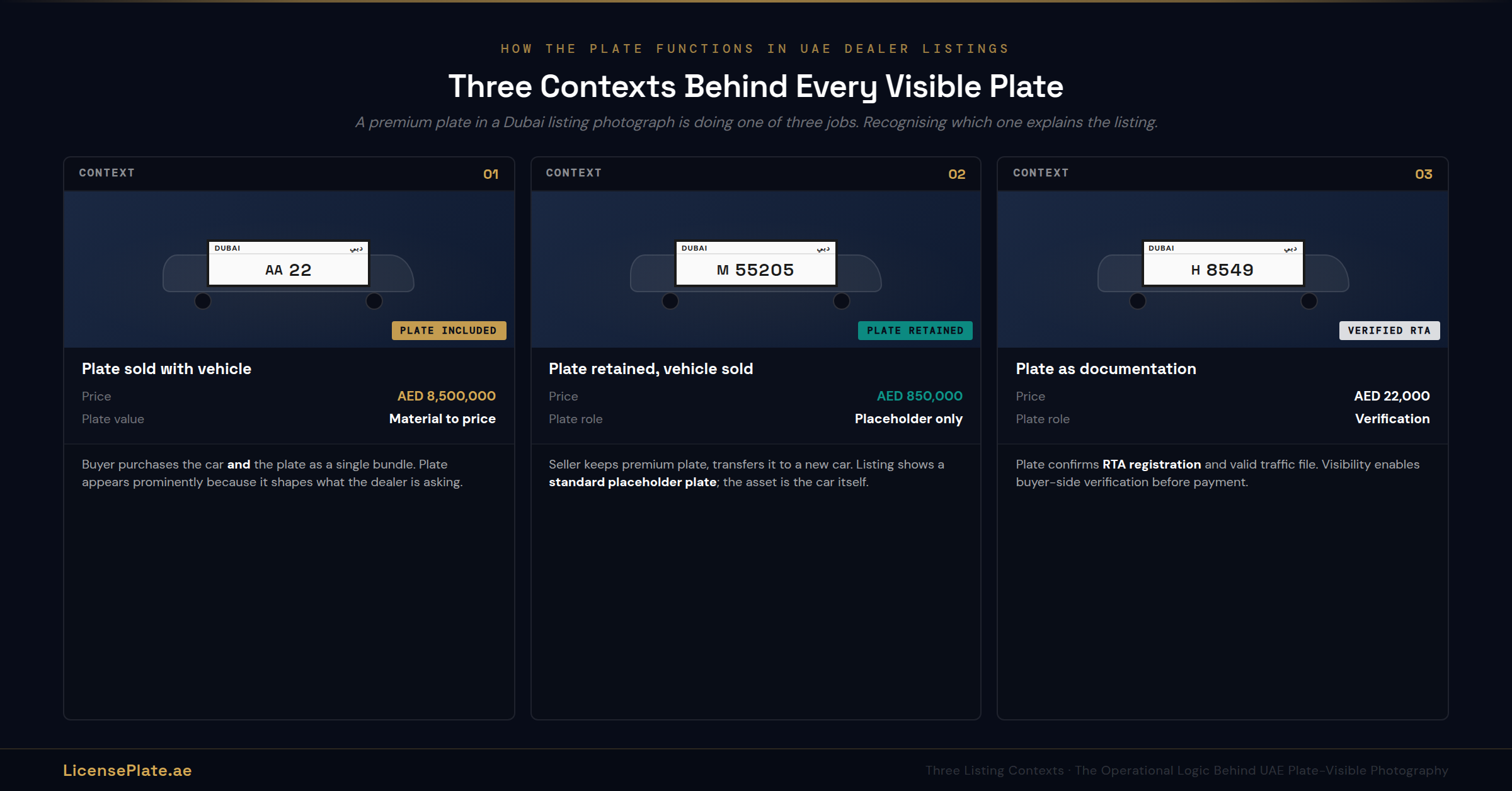
On a typical UAE supercar listing, the plate appears in three contexts.
Context 1: Plate sold with the vehicle
Some listings explicitly include the plate as part of the asset being sold. The buyer purchases the car and the plate together as a single bundle. The plate inheritance and ownership ecosystem supports this transaction structure: the plate is its own legal asset with its own ownership certificate, transferable independently or bundled with the vehicle. When a dealer markets a Rolls-Royce with a premium plate included, the photographs feature the plate prominently because it materially affects the price the dealer is asking.
Context 2: Plate retained, vehicle sold separately
More common at the upper tier: the seller retains the premium plate and transfers it to a new vehicle, then sells the original car with a different (often standard) plate. This is the workflow described in the plate ownership preservation guide. In these listings, the photographed plate is a placeholder, not the asset. Dealer convention varies: some show the placeholder plate (because Dubai's general convention is to show plates regardless), some swap to a temporary 'export' plate for marketing photos, some blur as a neutral choice.
Context 3: Plate as documentation
Some listings show the plate primarily as a verification signal. The plate confirms the vehicle is RTA-registered, has a valid traffic file, and has provenance the buyer can verify before paying. Per the plate verification due diligence checklist, verifying the plate-to-vehicle linkage before a purchase is one of the documented protections against fraud. Dealer photography that shows the plate clearly enables that verification at the listing stage.
The result is that across thousands of UAE supercar listings on the major UAE car marketplaces, plate visibility is the norm, not the exception. The opposite of every other major market.
The Resale Effect: Does a Premium Plate Boost the Price of the Car?
This is the question with the most speculation and the least public data. Anecdotal claims from UAE car dealers suggest that a high-value vehicle bundled with a premium plate sells faster and at a higher net than the same vehicle with a standard plate. The logic is straightforward: a buyer in the supercar tier values the plate as part of the purchase, and the dealer captures some of that value as a price premium.
What can be verified is the inverse: the plate retention behaviour of UAE owners. Per the two-plate decision article, high-net-worth UAE owners frequently retain their premium plates across multiple vehicle changes. A Rolls-Royce owner trades in for a Bentley, but the plate stays. The plate becomes the constant; the cars rotate around it. This pattern strongly implies the plate is treated as the more durable asset, which is consistent with the appreciation data published in how UAE plates actually appreciate.
What cannot be verified publicly is a specific plate-attached resale premium percentage. Some sources cite figures in the 5-15% range for high-end vehicles bundled with premium plates, but these figures are dealer-quoted rather than market-validated. A genuinely rigorous answer would require listing-level data with controlled comparisons, which none of the major car marketplaces has published. This piece will not invent a number.
What it will say is the structural truth that does survive scrutiny: in the UAE, the plate participates in the resale story in a way it does not anywhere else. Even if the dollar premium is unverifiable, the cultural premium is observable. A buyer evaluating a supercar listing in Dubai considers the plate as part of the package. A buyer evaluating the same listing in London or Los Angeles sees a blurred rectangle.
Why This Matters Even If You Will Never Flip Your Plate
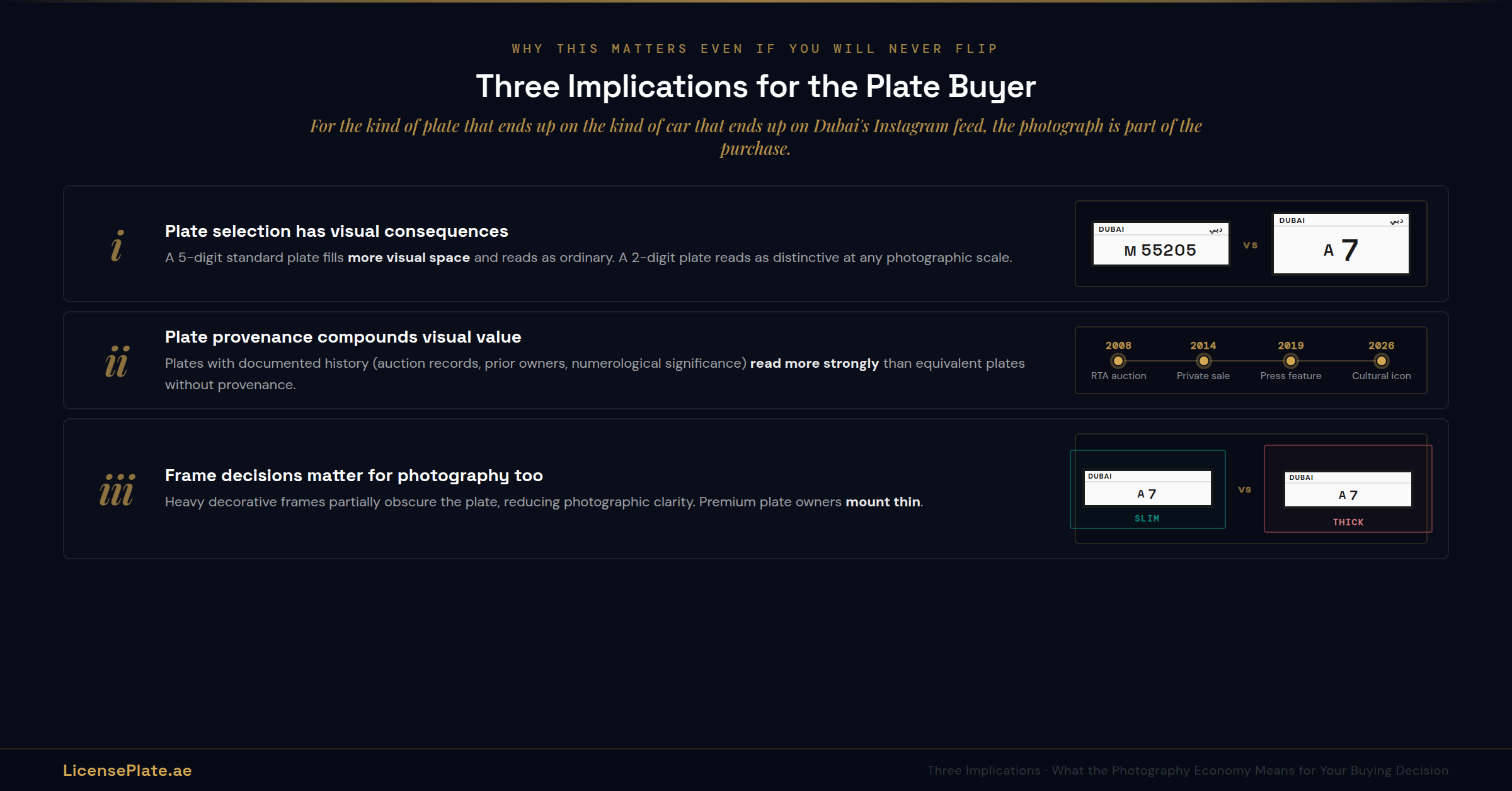
The plate-photography economy has implications for plate buyers who never plan to participate in it directly. Three matter most.
Implication 1: Plate selection has visual consequences. If the vehicle the plate sits on is going to be photographed (whether for personal social media, family photos, dealer marketing, or eventual resale), the plate appears in that photograph. A 5-digit standard plate fills more visual space and reads as ordinary. A 2-digit plate reads as distinctive at any photographic scale. The plate price check covers what each digit count and pattern actually costs; the visual consequence is one of the inputs that justifies the cost differential at the high end.
Implication 2: Plate provenance affects how the plate photographs. Plates with documented history (auction records, prior high-profile owners, distinctive numerological significance per the cultural numerology guide) read more strongly in photography than equivalent plates without such provenance. This is because UAE car culture is sophisticated about plate history; followers and buyers recognise specific plates and their stories. Provenance compounds visual value.
Implication 3: Plate framing decisions matter for photography too. The plate frames and mounting rules article covers the regulatory side of frame choices. The visual side: some dealer frames partially obscure the plate, which (legality aside) affects how the plate reads in tight shots. Owners of premium plates tend to mount them without thick decorative frames specifically because the plate itself is what they want photographed.
How Dubai Compares to London and Hong Kong
The global comparison piece covers the three most expensive plate markets in the world. Photography conventions diverge sharply across them.
London: Premium personalised plates exist (the most expensive UK plate, '25 O,' sold for GBP 518,000 in 2014) but the photography convention is to blur or remove plates from listing imagery. UK car culture treats plate visibility as a privacy issue first and a value asset second.
Hong Kong: Single-letter and short-digit plates carry significant value (HK$25 million for the plate '1' set the regional record). However, Hong Kong's dense urban environment and stricter privacy norms mean dealer photography typically obscures plates. Hong Kong car content on social media is also far smaller in scale than Dubai's.
Dubai: Premium plates are showcased. Dealer photography includes them. Influencer content features them. Auction marketing centres on them. The visual economy is structurally part of the plate market in a way it is not in either of the other two largest plate markets globally.
This makes Dubai unique among major plate markets, not just larger. The cultural conditions that make plate-as-photograph work (high-density luxury vehicle population, established car-content social media ecosystem, regulatory framework that protects plate identity, cultural acceptance of conspicuous wealth display) compound into a structural difference that London and Hong Kong have not replicated even with high plate values.
Where the Photography Economy Has Its Critics
Honesty requires acknowledging that not everyone in the UAE plate ecosystem celebrates the visibility convention. Three legitimate criticisms exist.
Criticism 1: It elevates display over function. Some long-time plate collectors view the social media economy as having shifted plate culture toward conspicuous display and away from the quieter prestige tradition where ownership of a low-digit plate was an understated identity marker rather than an Instagram backdrop. The editorial on what visitors notice engages with this tension directly.
Criticism 2: It can attract security risk. Even with structurally lower cloning incidence than other markets, individual high-net-worth owners who become recognisable through repeated plate appearances on social media accept some elevated risk profile. The owner of a recognisable single-digit plate is, by definition, identifiable in any city he or she drives through.
Criticism 3: It commodifies cultural significance. Plates with deep numerological or religious meaning (covered in the cultural numerology guide) trade increasingly as visual luxury markers rather than cultural artefacts. Some commentators worry that the social media economy is hollowing out the meaning that made the plates valuable in the first place.
These criticisms do not invalidate the economy; they sit alongside it. The UAE plate market in 2026 is large enough to accommodate both the photographed Bugatti at VIP Motors and the quietly-held single-digit plate that has never appeared on Instagram. Both modes of ownership coexist. The photography economy is the more visible mode, but visibility is not the same as totality.
Frequently Asked Questions
Q: Why do Dubai dealers show plates in photos when dealers everywhere else blur them?
Because in the UAE, premium plates carry significant monetary value (AED 3-50 million range for top-tier plates) and cultural value (recognisable identity markers in a sophisticated car culture). The plate is part of the asset being marketed rather than a privacy liability. This inversion is unique among major luxury car markets globally.
Q: Does a premium plate make a car worth more on resale?
Anecdotally yes, structurally probably yes, but verifiable percentage premiums are not publicly documented. What is observable is that high-net-worth UAE owners retain their premium plates across multiple vehicle changes, treating the plate as the more durable asset. This implies the market values plates as separable from the cars they sit on.
Q: Which UAE Instagram accounts focus on supercar and plate content?
The largest documented accounts include VIP Motors (vipmotorsuae, approximately 2 million followers), Luxury Supercar Rentals Dubai (luxurysupercarsdubai, approximately 372,000 followers), and Exotic Cars Dubai (exoticcarsdubai, approximately 207,000 followers). Cars of Dubai is a documented community spotting account. Many smaller accounts and individual influencers also operate in this space.
Q: Should I blur my plate when selling my car privately on a classifieds site?
Most UAE private sellers do not blur plates because the local convention does not require it. However, if you are concerned about privacy, blurring the plate is your choice and does not harm the listing. If your plate has documented value (premium digits or pattern), showing it likely helps the listing rather than hurting it.
Q: Do influencers pay car owners to feature their plates?
No publicly documented compensation framework exists. Influencer-owner relationships in the UAE supercar scene tend to be informal, with owners welcoming exposure and influencers welcoming distinctive content. Some commercial dealer arrangements exist for product placement but these involve the vehicle, not specifically the plate.
Q: Is showing my plate on social media a security risk?
Some elevated risk profile exists for highly recognisable plates, but UAE structural conditions (issuance security, Federal Decree-Law No. 14 of 2024 penalties, vehicle-plate matching) make cloning materially harder than in other jurisdictions. Most owners weigh the prestige and engagement benefits against the marginal risk and choose visibility. Very high-net-worth owners sometimes maintain a more private profile.
Q: What plates photograph best?
Photographic strength tracks pricing strength. Single-digit plates and 2-digit plates read most powerfully because they fill the plate's visual space with maximum impact. Repeating-digit patterns (777, 999, 1111) photograph well because the pattern is visually obvious. 5-digit standard plates carry the least photographic value because they read as ordinary.
Q: How does this affect my plate buying decision?
If photographic appearance matters to you (whether for personal use, social media, or future resale), prioritise lower digit counts and recognisable patterns. If photographic appearance is irrelevant to you, the visual economy is not a primary consideration. The plate calculator helps quantify the cost differential between digit counts so you can decide whether the visual premium justifies the price premium.
The Dubai plate-photography economy is one of those things that is impossible to see from outside the city and impossible to miss from inside it. Walk through Dubai Marina on a Saturday evening and the plate-first photography aesthetic is everywhere. The Bugatti at the valet stand is photographed plate-first. The Rolls-Royce parked at Dubai Mall is photographed plate-first. The Lamborghini Aventador on the influencer's feed is photographed plate-first. None of this is accidental.
It is a structural feature of a market where the plate carries documented monetary value, where the cultural recognition of premium plates is sophisticated and widely held, where the legal infrastructure protects plate identity strongly enough to lower cloning risk, and where the social media platforms that built modern car culture were built into Dubai's economy from inception. London and Hong Kong have premium plates. They do not have this.
For most plate buyers, the photography economy is not the reason they buy. They buy for personal preference, cultural significance, or investment intent (covered in the investment guide). But for buyers near the top of the pyramid, the photography economy is part of the implicit value calculation. A premium plate that will appear on a vehicle that will be photographed (by the owner, by friends, by dealers, by influencers, by future buyers) carries visual capital that adds to the financial capital. Both forms of capital compound over the holding period.
If you are evaluating a plate purchase and have not considered the visual question, this piece is the prompt to consider it. Use the plate calculator for the financial side. Use the how UAE plates appreciate guide for the return profile. And keep in mind that for the kind of plate that ends up on the kind of car that ends up on Dubai's Instagram feed, the photograph is part of the purchase.
Delete Comment?
Are you sure you want to delete this comment? This action cannot be undone.
Delete Article?
Are you sure you want to delete this article? This will also delete all comments. This action cannot be undone.